Placemat - Evaluation of the Other Community Infrastructure and Activities Program
Evaluation of the Other Community Infrastructure and Activities Program
Evaluation Scope
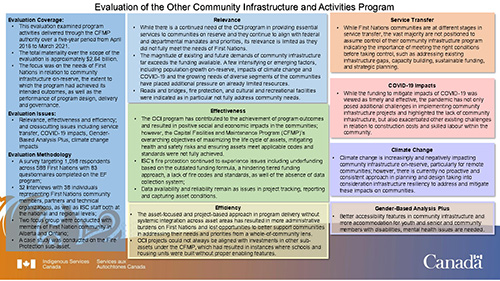
- This evaluation examined program activities delivered through the CFMP authority over a five-year period from April 2016 to March 2021.
- The total materiality over the scope of the evaluation is approximately $2.64 billion.
- The focus was on the needs of First Nations in relation to community infrastructure on-reserve, the extent to which the program had achieved its intended outcomes, as well as the performance of program design, delivery and governance.
Evaluation Assessed the Following Domains
- Relevance
- Effectiveness
- Efficiency
- Service Transfer
- COVID-19 Impacts
- Climate Change Impacts
- Gender-Based Analysis Plus
Evaluation Methodology
- A survey targeting 1,098 respondents across 588 First Nations with 83 questionnaires completed on the EF program;
- 32 Interviews with 38 individuals representing First Nations community members, partners and technical organizations, as well as ISC staff both at the national and regional levels;
- Two focus group were conducted with members of First Nation community in Alberta and Ontario;
- A case study was conducted on the Fire Protection sub-asset.
Presentation of Findings
Relevance
- While there is a continued need of the OCI program in providing essential services to communities on reserve and they continue to align with federal and departmental mandates and priorities, its relevance is limited as they did not fully meet the needs of First Nations.
- The magnitude of existing and future demands of community infrastructure far exceeds the funding available. A few intensifying or emerging factors, including population growth on-reserve, impacts of climate change and COVID-19 and the growing needs of diverse segments of the communities have placed additional pressure on already limited resources.
- Roads and bridges, fire protection, and cultural and recreational facilities were indicated as in particular not fully address community needs.
Effectiveness
- The OCI program has contributed to the achievement of program outcomes and resulted in positive social and economic impacts in the communities; however, the Capital Facilities and Maintenance Program (CFMP)'s overarching objectives of maximizing the life cycle of assets, mitigating health and safety risks and ensuring assets meet applicable codes and standards were not fully achieved.
- ISC's fire protection continued to experience issues including underfunding based on the outdated funding formula, a hindering tiered funding approach, a lack of fire codes and standards, as well of the absence of data collection system;
- Data availability and reliability remain as issues in project tracking, reporting and capturing asset conditions.
Efficiency
- The asset-focused and project-based approach in program delivery without systemic integration across asset areas has resulted in more administrative burdens on First Nations and lost opportunities to better support communities in addressing their needs and priorities from a whole-of-community lens.
- OCI projects could not always be aligned with investments in other sub-assets under the CFMP, which had resulted in instances where schools and housing units were built without proper enabling features.
Service Transfer
- While First Nations communities are at different stages in service transfer, the vast majority are not positioned to assume control of their community infrastructure program indicating the importance of meeting the right conditions before taking control, such as addressing existing infrastructure gaps, capacity building, sustainable funding, and strategic planning.
COVID-19 Impacts
- While the funding to mitigate impacts of COVID-19 was viewed as timely and effective, the pandemic has not only posed additional challenges in implementing community infrastructure projects and highlighted the lack of community infrastructure, but also exacerbated other existing challenges in relation to construction costs and skilled labour within the community.
Climate Change
- Climate change is increasingly and negatively impacting community infrastructure on-reserve, particularly for remote communities; however, there is currently no proactive and consistent approach in planning and design taking into consideration infrastructure resiliency to address and mitigate these impacts on communities.
Gender-Based Analysis Plus
- Better accessibility features in community infrastructure and more accommodation for youth and senior and community members with disabilities, mental health issues are needed.
Management Response and Action Plan (MRAP)
Recommendation 1
Better support community-led infrastructure planning and prioritization to meet First Nations' needs.
- Action 1.1: Review and adapt community infrastructure planning processes to better support First Nations in having reliable, sustainable, and community-led infrastructure.
- Advance the initiative to review and modernize ISC's infrastructure policy and funding delivery models that support long-term, whole-of community infrastructure planning in collaboration with First Nations partners. (Q3 2023-24)
- Update and modernize Operations and Maintenance (O&M) national funding formulas including annual updates to the cost indices to keep pace with inflation. (Ongoing)
- Action 1.2: Explore opportunities to better align program design and implementation with the evolving priorities identified in this evaluation by First Nations to address the unique needs in their communities, which could include health outcomes, climate change, and accessibility.
- Develop a plan for further collaboration between Regional Operations branches and regions, including First Nations and Inuit Health Branch, to better support health outcomes in First Nation communities. (Q2 2024-25)
- Integrate climate change mitigation and adaptation considerations and resiliency tools, aligned with ISC's Climate Change Strategy, into project selection decisions and implementation. (Q4 2023-25)
- Develop a plan that best supports First Nation identified accessibility needs on reserve (TBD)
Recommendation 2
Prioritize or allocate dedicated funding or efforts to areas identified as top needs or gaps by the communities.
- Action 2.1 Conduct an analysis to identify gaps in addressing First Nations' needs, including communities that are smaller, more remote and with lesser resources.
- Conduct a review and analysis of existing studies and reports that identify gaps in addressing First Nations' needs, including smaller, more remote communities. (Q2 2024-25)
- Action 2.2 Remove barriers in accessing the fire protection capital funding by building in more flexibility in the three-tiered funding approach and examine ways to ensure the O&M funding for fire protection is used for its intended purpose.
- Update the three-tiered funding approach as part of the Fire Protection Level of Service Standard to be more responsive to the needs of First Nations. (Q1 2024-25)
- Action 2.3 Further assist and support communities with their capacity development activities to manage and maintain their community infrastructure and service transfer.
- Advance institution and capacity development in support of service transfer, in partnership with First Nations-led organizations, to advance self-determined service delivery models that will address the needs and priorities identified by member communities. All models are opt-in and First Nations-led. (Q4 2027-28)
Recommendation 3
Improve data quality in departmental systems, including to establish clear definitions of the fields and categories used in the Integrated Capital Management System (ICMS) Project Tracking module to help ensure data entry is consistent to improve data quality.
- Action 1: Extend the ACRS inspection program to provide data that forecasts future capital investment needs for existing infrastructure and ensures a comprehensive inspection of major components of each asset. (Q4 2025-26)
- Action 2: Update ICMS to allow for import and export of the capital investment forecasts from the extended ACRS inspection program and create reports to be generated from ICMS. (Q3 2024-25)
- Action 3: Conduct an analysis of the data collected in ICMS – Project Tracking module to determine its reliability and assess information gaps to implement improvements related to data quality and lead a regional standardization business process exercise (tools and practices) in the ICMS – Project Tracking module to ensure a common understanding and usage of the data to improve reliability and the planification and tracking of infrastructure investments. (Q2 2026-27)
Recommendation 4
Recommendation #4: Implement strategies to mitigate impacts of staff turnover to better support collaboration with First Nations.
- Action 1: Review existing human resources, succession and onboarding plans, processes and guides, and develop strategies to ensure new staff have been sufficiently trained to carry out their duties in working with First Nations. (Q3 2024-25)
- Action 2: Review communities of practice and other knowledge sharing tools/forums to develop a toolkit to improve collaboration, information sharing and knowledge transfer during staff turnover. (Q3 2024-25)