Transition 2025 Minister Gull-Masty Indigenous Services Canada overview - Book 1
Table of contents
Part A
Part B
1. Overview of Indigenous Services Canada
Role of the Minister of Indigenous Services
Department of Indigenous Services Act, s.6 (2)
The Minister is to ensure that: child and family services; education; health; social development; economic development; housing; infrastructure; emergency management; and governance services are provided to eligible Indigenous individuals, communities and governing bodies.
The Minister is to provide Indigenous organizations with an opportunity to collaborate in the development, provision, assessment and improvement of the services and take the appropriate measure to give effect to the gradual transfer to Indigenous organizations of departmental responsibilities. (Department of Indigenous Services Act, s.7(a-b))
Department of Indigenous Services Act, s.15
The Minister must cause to be tabled in each House of Parliament, within three months after the end of the fiscal year (…) a report on:
- the socio-economic gaps between First Nations, Inuit, Métis individuals, and other Canadians and the measures taken by the Department to reduce those gaps; and,
- the progress made towards the transfer of responsibilities.
Legislative Environment
Constitution Act, 1982
- Section 91(24) provides the Government of Canada with jurisdiction over "Indians and lands reserved for Indians".
- Section 35 recognizes and affirms "Aboriginal and treaty rights".
Department of Indigenous Services Act
- Came into force in July 2019.
- Outlines the powers, duties and functions of the Minister of Indigenous Services. It directs the Minister to ensure that programs and services are delivered to eligible Indigenous individuals and emphasizes the objectives of closing socio-economic gaps between Indigenous Peoples and other Canadians, and of building capacity of Indigenous communities to support self-determination.
- The legislation notably includes:
- the different types of services provided to eligible Indigenous individuals (i.e., child and family services; education; health; social development; economic development; housing; infrastructure; emergency management; and governance);
- responsibilities to ensure that Indigenous organizations can collaborate in the development, provision, assessment and improvement of services; and
- a ministerial power to enter into agreements with Indigenous organizations to transfer departmental responsibilities.
Indian Act
- Regulates the relationship between Canada and First Nations in a wide range of areas.
- For the purposes of this Act, the Minister of Indigenous Services is the Superintendent General of Indian affairs.
Legislation for which the Minister of Indigenous Services is responsible:
- An Act respecting First Nations, Inuit and Métis children, youth and families
- Department of Indigenous Services Act
- Indian Act
- Indian Act Amendment and Replacement Act
- First Nations Elections Act
- Indian Oil and Gas Act
- First Nations Oil and Gas and Moneys Management Act
- First Nations Commercial and Industrial Development Act
- First Nations Financial Transparency Act
- Family Homes on Reserves and Matrimonial Interests or Rights Act
- Saskatchewan Treaty Land Entitlement Act
- Kanesatake Interim Land Base Governance Act
Influencing legislation:
- United Nations Declaration on the Rights of Indigenous Peoples Act (referenced in the Department of Indigenous Services Act, and includes a number of obligations for all departments, to be advanced in consultation and cooperation with Indigenous Peoples) (Minister of Justice)
- Indigenous Languages Act (Department of Canadian Heritage)
- Interpretation Act (recently amended to add non-derogation clause in section 8.3) (Minister of Justice)
- Addition of Lands to Reserves and Reserve Creation Act (Minister of Crown-Indigenous Relations and Northern Affairs)
- First Nations Fiscal Management Act (Minister of Crown-Indigenous Relations and Northern Affairs)
- Framework Agreement on First Nation Land Management Act (Minister of Crown-Indigenous Relations and Northern Affairs)
- Dominion Water Power Act (Names the responsible minister as the Minister of Indigenous Services but the Minister of Crown-Indigenous Relations and Northern Affairs performs the functions and duties)
- National Housing Strategy Act (Minister of Housing, Infrastructure and Communities)
- Emergency Management Act (Minister of Public Safety and Emergency Preparedness)
Overview of Services
Indigenous Services Canada provides programs and services to First Nations, Inuit and Métis peoples, which focus on:
- keeping children and families together;
- supporting quality education;
- improving health outcomes;
- building reliable infrastructure; and
- enabling economic prosperity and effective governance.
Eligibility for the programs and services of Indigenous Services Canada varies based on multiple factors including legislative basis, location (i.e., off reserves vs. on reserves), the existing role of provinces and territories, and policy decisions of successive governments.
First Nations, Inuit and Métis people who have completed self-government agreements receive most services directly from their Indigenous government. These relationships fall mainly under the mandate of Crown-Indigenous Relations and Northern Affairs Canada.
First Nations, Inuit and Métis
- Indigenous Services Canada also supports a wide range of Indigenous governments and institutions who serve and represent First Nations, Inuit and Métis.
- As such, First Nations, Inuit and Métis Nation partners have access to a range of services that supplement those provided by the provinces and territories (including support for increased access to post-secondary education).
- Urban Programming for Indigenous Peoples is delivered through not-for-profit urban Indigenous service delivery organizations (i.e., Friendship Centres, Inuit and Métis organizations) and non-Indigenous organizations, including municipal governments, health and education authorities and institutions that have demonstrated support from Indigenous organizations or Indigenous community groups.
- Indigenous Services Canada also supports the implementation of the 5% target for federal procurement with Indigenous businesses.
Common to First Nations and Inuit
- First Nations and Inuit communities have access to a range of services that are supplementary and complimentary to those provided by the provinces and territories, including mental health and substance use services, public health services, home, community, and palliative care.
- Some services are available to First Nation individuals and Inuit regardless of place of residency (e.g., non-insured health benefits, access to health, social, and educational services for children through Jordan's Principle and the Inuit Child First Initiative, the First Nations and Inuit Youth Employment Strategy, and post-secondary education funding).
- Some Inuit communities have self-government agreements and governance structures that allow for greater community control.
- Indigenous Services Canada funds communities, service delivery organizations and, in some instances and communities, delivers services directly (e.g., nursing).
First Nation Individuals on Reserves
- Indigenous Services Canada supports a wide range of services for First Nation individuals on reserves, similar to a province/territory or municipalities. This includes health, social, education, economic development, governance, and infrastructure services.
- The main services supported by the Department include status registration, estates, supports for effective land and environmental governance capacity, assessment and remediation of contaminated sites, supports for Indigenous entrepreneurs in accessing capital, planning and economic development services and capacity building supports, primary care nursing, public health nurses and environmental public health, elementary and secondary education, post-secondary education, income assistance, assisted living, infrastructure such as housing, water and waste water, and education, and health facilities, among others.
- In the provision of these services, the Department's main role is one of funder, via contribution agreements, to First Nation governments and organizations who manage service delivery.
- The New Fiscal Relationship provides stabilized long-term funding to over 160 First Nations through the ten year grant funding mechanism. This initiative aims to provide eligible First Nations, who choose to join the grant, with program supports to build capacity, do effective planning, and account for inflation and population increases on reserves.
A National Footprint
National Capital Region
- The National Capital Region office of Indigenous Services Canada plays an important collaborative role with partners and stakeholders in defining the general policy direction of the Department.
- It also maintains relationships with Indigenous organizations located in the National Capital Region.
Regional Offices
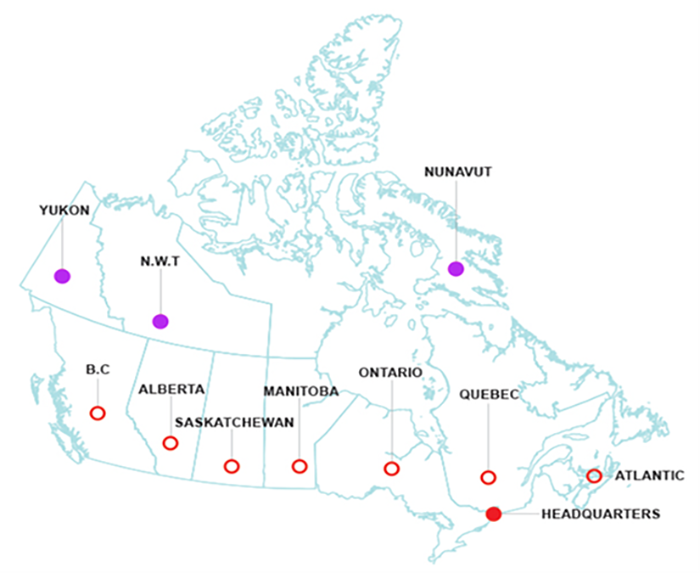
Text alternative for Regional Offices map
This is a map indicating which regions across Canada have a regional office.
Northern Regional Offices for Nunavut, the Northwest Territories, and the Yukon report through Crown-Indigenous Relations and Northern Affairs Canada (purple dot).
Yukon
Northwest Territories
Nunavut
Indigenous Services Canada regional offices are indicated with an empty red circle.
British Columbia
Alberta
Saskatchewan
Manitoba
Ontario
Quebec
Atlantic
Headquarters office
This office is located in Ottawa (National Capital Region) and is indicated with a full red circle.
- The regional offices of Indigenous Services Canada are the face of the Department in direct work with Indigenous communities and as regional partners in building and maintaining relationships.
- Located in all provinces and the Atlantic region, they maintain day-to-day relationships with a wide web of Indigenous organizations and governments at the local and regional levels, including collaborating with provincial and territorial governments in the delivery of services that do not fall under the Minister's authority.
- While Northern Regional Offices for Nunavut, the Northwest Territories, and the Yukon report through Crown-Indigenous Relations and Northern Affairs Canada, Indigenous Services Canada maintains and fosters strong working relationships with these partners primarily through First Nation and Inuit Health Branch's Northern Region.
- Indigenous Services Canada regional offices are also responsible to ensure that programs are appropriately implemented.
Indigenous Services Canada Portfolio Organizations
Indian Oil and Gas Canada
- Indian Oil and Gas Canada is an organization committed to managing and regulating oil and gas resources on First Nation reserve lands. It is a special operating agency under Indigenous Services Canada.
- Indian Oil and Gas Canada's mandate is to fulfil the Crown's fiduciary and statutory obligations related to the management of oil and gas resources on First Nations land and to further First Nations initiatives to manage and control their oil and gas resources such as governance.
- The organization's general responsibilities are to:
- identify and evaluate oil and gas resource potential on Indian reserve lands;
- encourage companies to explore for, drill and produce these resources through leasing activity;
- ensure equitable production, fair prices and proper collection of royalties on behalf of First Nations; and,
- secure compliance with and administer the regulatory framework in a fair manner.
Indigenous Services Canada Ministerial Advisory Board
National Indigenous Economic Development Board
- The National Indigenous Economic Development Board's mandate is to provide strategic policy advice to the federal government on Indigenous economic development in Canada.
- The National Indigenous Economic Development Board mission is to support Indigenous economic inclusion and opportunity and to empower Indigenous Peoples to have a voice in government policy.
- The Board is comprised of First Nations, Inuit, and Métis business and community leaders from across Canada. It helps governments respond to the unique needs and circumstances of Indigenous Peoples in Canada.
Annex A: Inventory of ISC's Programs and Services
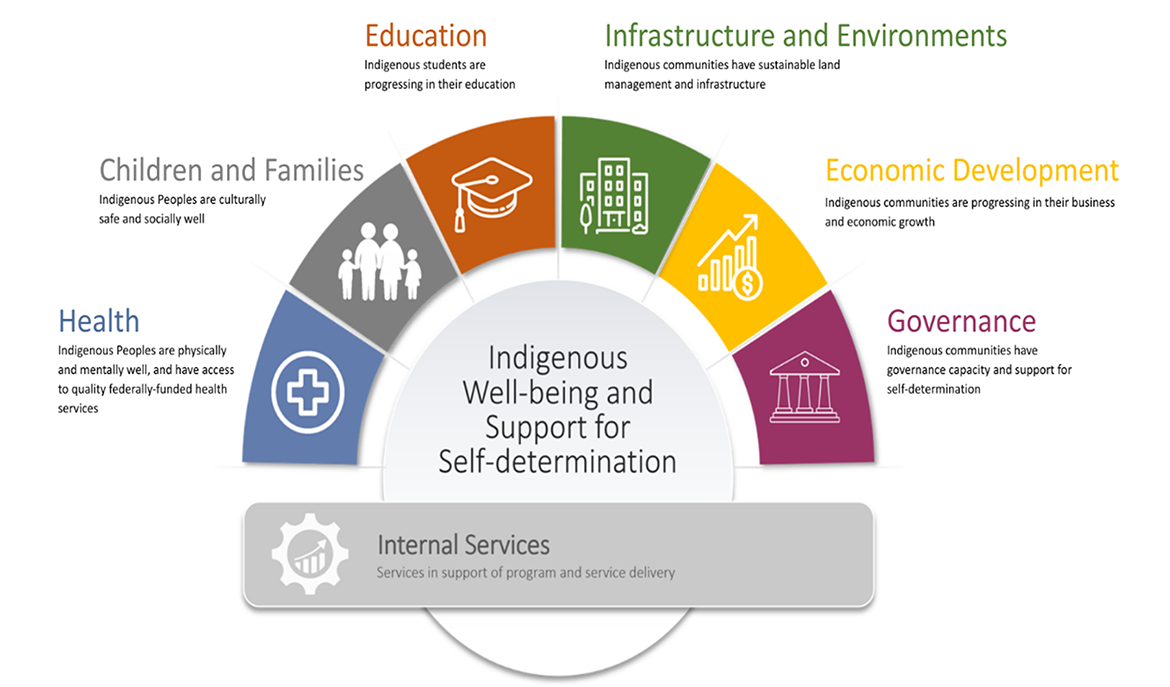
Text alternative for Annex A: Inventory of ISC's Programs and Services
A circular infographic titled "Inventory of ISC's Programs and Services", representing the department's seven color-coded service areas arranged around a central core. The middle of the diagram is the core responsibility and reads: "Indigenous Well-being and Support for Self-Determination" – signaling the overarching purpose of ISC's programs.
Surrounding this core are the following color-coded service areas, arranged in a half circle:
- Health – Indigenous Peoples are physically and mentally well, and have access to quality federally-funded health services.
- Children and Families – Indigenous Peoples are culturally safe and socially well.
- Education – Indigenous students are progressing in their education.
- Infrastructure and Environments – Indigenous communities have sustainable land management and infrastructure.
- Economic Development – Indigenous communities are progressing in their business and economic growth.
- Governance – Indigenous communities have governance capacity and support for self-determination.
Along the bottom half of the circle, forming the foundation of the diagram, is the Internal Services segment in grey – Services in support of program and service delivery.
The layout emphasizes the interconnectedness of the programs and the foundational role of internal services in enabling program delivery.
2024-25 DRF: Departmental Results & Program Inventory by Service Area
Health Service Area
DR1: Indigenous Peoples are physical well
DR2: Indigenous Peoples are mentally well
DR3: Indigenous Peoples have access to quality federally-funded health services
1. Public Health Promotion and Disease Prevention
- Mental Wellness
- Healthy Living
- Healthy Child Development
- Communicable Disease Control and Management
- Environmental Public Health
2. Home and Long-Term Care
- Assisted Living
- Home and Community Care
3. Primary Health Care
- Clinical and Client Care
- E-Health Infostructure
- Community Oral Health Services
4. Health Systems Support
- Health Planning, Qualify Management and Systems Integration
- Health Human Resources
- British Columbia Tripartite Health Governance
5. Supplementary Health Benefits
6. Jordan's Principle and the Inuit Child First Initiative
Children and Families Service Area
DR4: Indigenous Peoples are culturally safe and socially well
7. Safety and Prevention Services
- Family Violence Prevention Program
8. Child and Family Services
- First Nations Child and Family Services
- An Act respecting First Nations, Inuit and Métis children, youth and families
9. Income Assistance
10. Urban Programming for Indigenous Peoples
Education Service Area
DR5: Indigenous students are progressing in their education
11. Elementary and Secondary Education
12. Post-Secondary Education
Infrastructure and Environments
DR6: Indigenous communities have sustainable land management and infrastructure
13. Community Infrastructure
- Housing
- Education Facilities
- Health Facilities
- Other Community Infrastructure and Activities
- Water and Wastewater
14. Communities and The Environment
- Lands, Natural Resources and Environmental Management
15. Emergency Management Assistance
Economic Development Service Area
DR7: Indigenous communities are progressing in their business and economic growth
16. Community Economic Development
- Economic Development Capacity and Readiness
- Indian Oil and Gas
17. Indigenous Entrepreneurship and Business Development
Governance Service Area
DR8: Indigenous communities have governance capacity and support for self-determination
18. Indigenous Governance and Capacity Supports
- Indigenous Governance and Capacity
- Individual Affairs
- New Fiscal Relationship: Capacity Building and Engagement
- Statutory, Legislative and Policy Support to First Nations Governance
- Transformational Approach to Indigenous Data
2. ISC and CIRNAC: Division of Responsibilities
Indigenous Services Canada and Crown-Indigenous Relations and Northern Affairs Canada: Division of Responsibilities
Indigenous Services Canada's (ISC) primary responsibilities are the delivery of services and programs to Section 91(24) Indigenous communities, with a particular emphasis on closing the socio-economic gap between Indigenous Peoples and non-Indigenous Peoples and building up the capacity of Indigenous communities so that they have the means and ability to move forward on the path to self-determination.
Crown-Indigenous Relations and Northern Affairs Canada's (CIRNAC) primary responsibilities are to guide and coordinate the whole-of-government relationship with Section 35 rights holders and Indigenous nations; to reach and implement agreements to accelerate self determination (through self-government and land claim agreements, including reconstituting nations); and to manage northern programing and Arctic Policy.
| ISC Responsibilities (lead sector) | CIRNAC Responsibilities (lead sector) |
|---|---|
|
Crown-Indigenous Relations
Northern Affairs (Northern Affairs Organization)
|
|
Shared Internal Service housed in ISC
|
Shared Internal Service housed in CIRNAC
|
|
|
3. Indigenous Services Canada Financial Overview
2025-2026 Financial & Full-Time Equivalent Overview
Financial Overview

Note:
- Figures may not add due to rounding.
- 2022-2023 to 2023-2024 Actual Expenditures as per ISC Departmental Results Reports.
- Graph above excludes $2.3 billion expected to be received in year 2025-2026 from Treasury Board submissions approved in March 2025.
Text alternative for Financial Overview
- Actual expenditures for fiscal year 2022-2023 were 22,566.4 million. This amount includes 17,672.6 million in Vote 10, 132 million in Statutory Vote, and 4,748.3 million in Vote 1.
- Actual expenditures for fiscal year 2023-2024 were 46,477.2 million. This amount includes 19,619.2 million in Vote 10, 156.2 million in Statutory Vote, and 26,693.6 million in Vote 1.
- Forecasted spending for fiscal year 2024-2025 is 27,829.9 million. This amount includes 23,795.2 million in Vote 10, 160.2 million in Statutory Vote, and 3,865 million in Vote 1.
- Main Estimates for fiscal year 2025-2026 is 22,962.1 million. This amount includes 19,653.1 million in Vote 10, 159.4 million in Statutory Vote, and 3,143.0 million in Vote 1.
- Departmental Plan spending for fiscal year 2026-2027 is 21,178.1 million. This amount includes 18,004.9 million in Vote 10, 116.2 million in Statutory Vote, and 3,050.3 million in Vote 1.
- Departmental Plan spending for fiscal year 2027-2028 is 20,040.8 million. This amount includes 17,018.2 in Vote 10, 110.1 million in Statutory Vote, and 2,905.9 million in Vote 1.
For the Period from 2022-2023 to 2024-2025
Spending is expected to increase by $5,273.5 million between 2022-2023 actual spending and 2024-2025 forecast spending. This is primarily due to:
- a net increase in funding for child and family services, which is primarily due to an additional funding for reforms to the First Nations Child and Family Services program;
- a net increase in funding for Jordan's Principle and the Inuit Child First Initiative, which is primarily due to an additional funding for Jordan's Principle;
- a net increase for supplementary health benefits;
- a net increase in funding for elementary and secondary education, as well as post-secondary education, which is primarily due to investments in First Nations education provided by Budget 2024; and
- a net increase in funding for public health promotion and disease prevention which is primarily due to funding for mental wellness and substance use treatment services (Budget 2024).
For the Period from 2025-2026 to 2027-2028
Spending is expected to decrease by $2,921.2 million between 2025-2026 and 2027-2028 planned spending. This is primarily due to:
- a net decrease in funding for infrastructure projects in Indigenous communities;
- sunset (at the end of 2025-2026) of funding for the First Nations Water and Wastewater Enhanced Program;
- a net decrease in funding for elementary and secondary education, as well as post-secondary education, which is primarily due to sunset (at the end of 2025-2026) of funding for the First Nations Elementary and Secondary Education Program (Budget 2024); and
- a net decrease in funding for public health promotion and disease prevention, which is primarily due to sunset (at the end of 2025-2026) of funding for mental wellness and substance use treatment services (Budget 2024).
Decisions on the renewal of the sunset initiatives will be taken in future budgets and reflected in future Estimates.
Full-Time Equivalents Overview
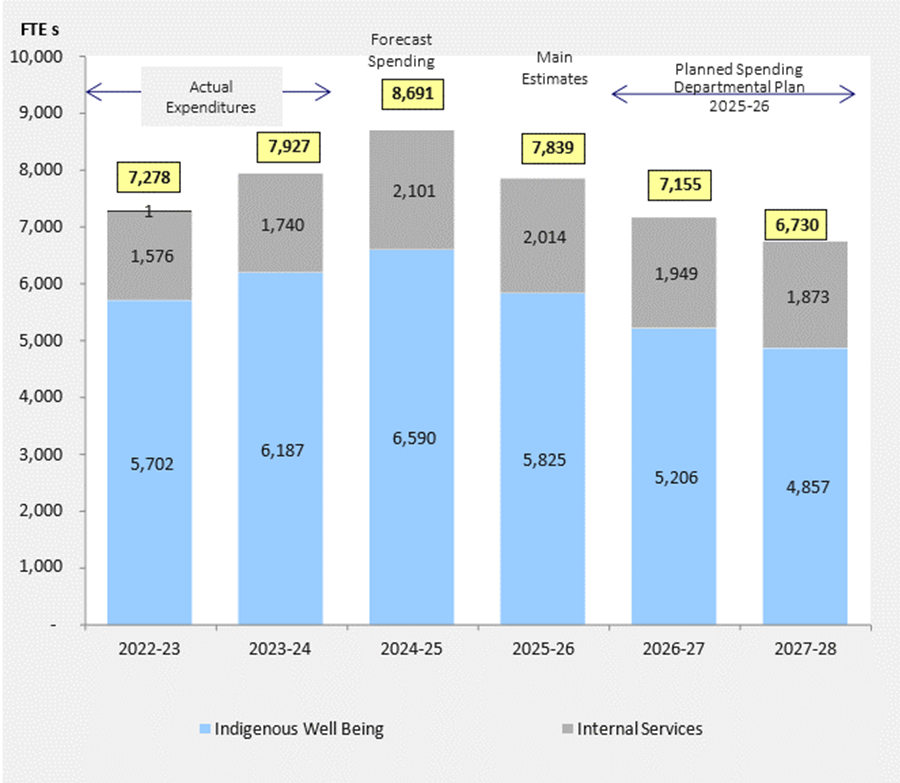
Note:
- Figures may not add due to rounding.
- Graph above excludes 246 Full-Time Equivalents expected from Treasury Board submissions approved in March 2025 for sunsetting programs renewal.
Text alternative for Full-Time Equivalents Overview
- Actual expenditures for fiscal year 2022-2023 included 7,278 full time equivalents. This amount includes 1,576 full time equivalents for Internal Services and 5,702 for Indigenous Well Being.
- Actual expenditures for fiscal year 2023-2024 included 7,927 full time equivalents. This amount includes 1,740 full time equivalents for Internal Services and 6,187 for Indigenous Well Being.
- Forecasted spending for fiscal year 2024-2025 includes 8,691 full time equivalents. This amount includes, 2,101 full time equivalents for Internal Services and 6,590 for Indigenous Well Being.
- Main Estimates for fiscal year 2025-2026 includes 7,839 full time equivalents. This amount includes, 2,014 full time equivalents for Internal Services and 5,825 for Indigenous Well Being.
- Departmental Plan spending for fiscal year 2026-2027 includes 7,155 full time equivalents. This amount includes 1,949 full time equivalent for Internal Services and 5,206 for Indigenous Well Being.
- Departmental Plan spending for fiscal year 2027-2028 includes 6,730 full time equivalent. This amount includes 1,873 full time equivalent for Internal Services and 4,857 for Indigenous Well Being.
For the Period from 2022-2023 to 2024-2025
The variance in FTE utilization is mainly due to:
- Allocation of additional resources throughout the year to meet program needs and priorities, to sustain the program's growing operations, and creation of a new human resources branch at ISC.
- Incremental funding provided through Supplementary Estimates mainly for the continued implementation of Jordan's Principle, funding to Reform the First Nations Child and Family Services Program, funding for safe drinking water access in First Nation communities and implementing the First Nations Clean Water Act and other funding (Act respecting First Nations, Inuit and Métis children, youth and families, advance First Nation self-determination and economic reconciliation in First Nations land management).
- The increase is also offset by the variance in Full-Time Equivalent utilization due to factors related to turnover in the programs.
For the Period from 2025-2026 to 2027-2028
The variance in Full-Time Equivalents is mainly due to decrease in funding and sunsetting items:
- operational efficiencies in delivery of First Nations Child and Family Services Program related to first Refocusing Government Spending, and;
- sunset of funding to sustain support for Mental Wellness and Substance Use Treatment Services, for Health Human Resources, to support Indigenous policing and community safety, for First Nations Elementary and Secondary Education Program Integrity and other sunsetting funds.
Decisions on renewal of sunset initiatives will be taken in future budgets and reflected in future Estimates.
4. Profiles of Indigenous Services Canada Senior Executives
- Deputy Minister
- Associate Deputy Minister
- Regional Operations
- Regional Offices
- Chief Finances, Results and Delivery Officer
- First Nations and Inuit Health Branch
- First Nations and Inuit Health Branch Regional Executives
- Child and Family Services Reform
- Education and Social Development Programs and Partnerships
- Strategic Policy and Partnership
- Lands and Economic Development
- Indian Oil and Gas Canada
- Corporate Secretariat
- Ombuds
- Human Resources
Deputy Minister

Deputy Minister, Indigenous Services, Government of Canada
Name: Gina Wilson
Title: Deputy Minister
Gina Wilson is a grandmother, a proud Algonquin and the Deputy Minister of Indigenous Services, as well as the Champion for Indigenous public servants. Gina began her career in her First Nation community of Kitigan-Zibi as Director of Health and Social Services. She was also Child Welfare Advisor, Director of Health and Social Services, and Chief Executive Officer when she was with the Assembly of First Nations.
She joined the federal government in 1996 and has held several senior executive positions at various departments, including the Privy Council Office, Aboriginal Affairs and Northern Development Canada, Employment and Social Development Canada, and the Correctional Service of Canada.
One of her career highlights was as the Assistant Deputy Minister of Indian Residential Schools Resolution Canada, where she oversaw the implementation of the Indian Residential Schools Settlement Agreement and the Prime Minister's apology to Survivors of residential schools in 2010. She then became Senior Assistant Deputy Minister of Regional Operations at Indian and Northern Affairs Canada until moving to Public Safety Canada as the Assistant Deputy Minister of Emergency Management.
Gina was the Assistant Deputy Minister of Treaties and Aboriginal Government at Indian and Northern Affairs Canada before joining the deputy ranks in 2014 as the Associate Deputy Minister at Employment and Social Development Canada, Associate Deputy Minister at Public Safety, and Deputy Minister of Women and Gender Equality in 2017. She was appointed Deputy Minister of Public Safety Canada in 2019.
Gina held the role of Deputy Minister of Diversity and Inclusion and Youth at Canadian Heritage, then rejoined Women and Gender Equality Canada as Deputy Minister on September 1, 2021. She previously served at Women and Gender Equality Canada from 2017 to 2019, where she led the establishment of the new department.
Gina is the recipient of the 2020 Indspire Award for her leadership and lifelong work on Indigenous issues and support for Indigenous employees. She holds a Bachelor of Social Sciences from the University of Ottawa.
Associate Deputy Minister

Associate Deputy Minister, Indigenous Services, Government of Canada
Name: Michelle Kovacevic
Title: Associate Deputy Minister
Since joining the public service, Michelle Kovacevic climbed the ranks with sheer dedication and diligent work. Michelle was recently appointed Associate Deputy Minister of Indigenous Services on January 22, 2024, after serving as the Senior Assistant Deputy Minister for the Federal-Provincial Relations and Social Policy Branch at the Department of Finance Canada for nearly seven years.
In addition to her professional accomplishments, Michelle has a solid academic background as well, holding an undergraduate degree from Carleton University and a Master of Social Work in clinical social work from Wilfrid Laurier University. The areas of her study and expertise included psychology and clinical social work.
Her academic background led Michelle to hold several senior executive positions related to health and social policy within the Government of Canada. Michelle began her career in the Ontario public service in the Ministries of Health and Social Services. Her past roles include serving as the Assistant Deputy Minister of Public Affairs and Communications for the Public Health Agency of Canada and Health Canada. Michelle has also held senior executive positions with the Social Policy Branch of Health Canada, at the First Nations and Inuit Health Branch of Health Canada, and Correctional Services Canada.
Regional Operations

Title: Senior Assistant Deputy Minister

Title: Associate Assistant Deputy Minister
Overview
Regional Operations Sector is the direct service delivery arm for all program and policy areas of ISC, with the exception of health. National programs and services are delivered through seven south of 60° regional offices, and in one north of 60° regional office, Yukon.
Regional offices deliver programs and services including those related to governance, emergency management, infrastructure, education, social, child and family, lands and environment, and economic development. Frontline services include services to individuals, such as registration under the Indian Act and applications for Secure Certificate of Indian Status.
Regional offices maintain strong relationships with First Nations partners, enabling ISC to work collaboratively with First Nations partners to improve access to high quality services, and to enable and support First Nations communities to assume control and delivery of services.
As a key example of collaboration with First Nations partners to advance service transfer, the Atlantic First Nations Water Authority (AFNWA) and the Minister of Indigenous Services signed a historic transfer agreement on November 7, 2022. This began the transfer of responsibility for the operation, maintenance, and capital upgrades of all water and wastewater assets in participating First Nations in Atlantic Canada.
Regional Operations Sector is also responsible for developing, managing and delivering on Governance Capacity and Community Development, Community Infrastructure, Emergency Management, and Individual Affairs programs.
Governance Capacity and Community Development
The Governance Capacity and Community Development program area supports Indigenous communities and institutions in the implementation of strong and sustainable governments. In 2023-24, total funding provided included:
- $280M in core funding to 576 First Nations governments for their governance and administrative functions;
- $81M to support employer contributions to pension and benefit plans for 562 First Nations governments;
- $34M in core operational funding for 79 tribal councils;
- $52M to support governance capacity projects across 377 First Nations and Inuit communities; and
- $30M in Community Development initiatives for 22 First Nations, which has also leveraged an additional $143.5M in partner investments since 2022-23.
Community Infrastructure
The government of Canada has committed to closing the infrastructure gap by 2030.
Regional Operations officials work with First Nations to support their efforts to have reliable and sustainable infrastructure. The program provides funding to plan, design, construct, acquire, operate and maintain infrastructure assets and facilities, as well as to coordinate training and undertake capacity-building activities. Infrastructure assets supported include: safe and adequate housing; the provision of clean, safe and reliable drinking water and the effective treatment of wastewater on First Nation lands; the provision of safe education infrastructure; and other community infrastructure essential to healthy, safe, and prosperous communities, such as roads and bridges, energy, fire protection and structural mitigation in the face of climate change.
Community Infrastructure also includes modernization of infrastructure policies, including the advancement of service delivery transfer to First Nation organizations, and development of legislation, as well as resolution support for infrastructure-related litigation actions.
Since 2016 and as of December 31, 2024, ISC has committed more than $17 billion in targeted funding and invested more than $12 billion to support critical infrastructure including water, housing, education infrastructure, and other community infrastructure like roads and bridges.
Emergency Management
The Emergency Management Assistance Program supports the health and safety of on-reserve First Nations residents as well as their lands and critical infrastructure. This program promotes a four pillar approach to emergency management: mitigation; preparedness; response; and recovery. ISC promotes efficiency by accessing existing resources and services of provinces and territories and emergency management partners to address on-reserve emergencies and reimburses these partners for eligible expenses.
To enhance First Nation partner emergency management capacity, the Emergency Management Assistance Program provides funding to support over 260 Emergency Management Coordinator positions in First Nations communities and organizations. Emergency Management Coordinators support their communities in carrying out emergency management planning and pursuing projects to enhance resiliency to emergency events.
In addition, as part of the transfer of responsibility, ISC has been working with First Nations partners and provincial/territorial governments to develop a new approach to emergency management agreements that support First Nations-led emergency management, and provide culturally appropriate and comparable EM services. These new multilateral emergency management service agreements will include First Nations as full and equal partners in their development and implementation and are a mechanism to support First Nations-led emergency management. However, what service transfer ultimately looks like must be determined by First Nation partners and may require multi-phased approaches.
Individual Affairs
The Individual Affairs Branch delivers services that are legislative and/or treaty obligations of Canada. It administers national programs that apply to First Nations persons individually and at the band level. These programs include: trust moneys, treaty annuity payments, estates services for First Nations, registration and status card services.
Canada collects and disburses trust moneys (capital and revenue) on behalf of First Nations pursuant to the Indian Act. Summaries of the moneys held in trust by Canada for First Nation bands and individuals are reported in ISC's financial statements and the Public Accounts of Canada. Treaty annuity payments are paid annually on a national basis to registered individuals who are entitled to treaty annuities through registration to bands that have signed historic treaties with the Crown (Robinson Treaties (1850) and the eleven Numbered Treaties (1871–1921)).
Pursuant to the Indian Act, the Minister of Indigenous Services has exclusive jurisdiction and authority over estates of deceased people who were, or could have been, registered under the Indian Act and ordinarily resided on a reserve. The Minister is also required to manage the estates of people who currently cannot manage their financial or legal affairs and ordinarily reside on a reserve, and may help manage the estates of minors registered under the Indian Act who ordinarily reside on a reserve.
Services provided by the Estates Program include approving wills, appointing executors, acting as administrators of last resort, administering assets of minors and dependent adults, and offering capacity building initiatives to First Nations.
Indian Registration underpins billions of dollars in programming and services that are integral to other parts of ISC, other government departments, and other institutions that depend on registration to identify individuals eligible to receive their programs, services and benefits. The Indian Registrar renders statutory decisions on entitlement to registration based on the provisions of the Indian Act, and maintains an accurate Indian Register. Registration under the Indian Act allows individuals to access rights and benefits not available to non-registered persons, Métis, Inuit, or other Canadians, including non-insured health benefits, post-secondary education and exemptions from federal, provincial and territorial taxes in specific situations.
The program also issues the Secure Certificate of Indian Status ('secure status card') to registered individuals, which as a federal identity document facilitates access to benefits and services. The Indian Registrar and the processing of entitlement decisions is based solely on the provisions of the Indian Act and is independent from Ministerial direction or interference. Processing time for a complete application for registration under the Indian Act can take from 6 months to 2 years, depending on the complexity of the file. Once registered, it usually takes from 8 to 12 weeks to process a complete application for a secure status card.
Regional Offices
Atlantic Region

Title: Regional Director General
Alberta Region

Title: Regional Director General
British Columbia Region

Title: Regional Director General
Saskatchewan Region

Title: Regional Director General
Manitoba Region

Title: Regional Director General
Ontario Region

Title: Regional Director General
Quebec Region

Title: Regional Director General
Yukon Region

Title: Regional Director General
Chief Finances, Results and Delivery Officer

Name: Philippe Thompson
Title: Chief Finances, Results and Delivery Officer
Overview
The Chief Finances, Results and Delivery Officer (CFRDO) Sector is responsible for providing leadership and ensuring effective management of departmental resources within the legislative mandate. The Sector also provides strategic advice, oversight, and support to the Deputy Minister and the senior executive team to ensure integrity and sound financial controls and management in the planning and operations of Indigenous Services Canada.
The Sector is responsible for establishing the planning framework for ISC that aligns the mandated outcomes and departmental strategic priorities with resource management via the Departmental Results Framework. The CFRDO leads the reporting to Cabinet and Parliament on outcomes through the Departmental Plan and Departmental Report and the implementation of the Minister's mandate letter commitments.
The CFRDO Sector supports delivery of services through policies, directives, and other activities in the areas of financial planning and analysis, accounting and reporting, contracting and procurement, assets and materiel and information management.
The CFRDO is responsible for ISC's Chief Information Officer functions that include information management and technology services, investments structures and controls within ISC, to leverage Information Management and Information Technology reliably, securely, and cost effectively to support effective and efficient business process design and execution.
The Sector is accountable for providing grants and contributions advisory and support services through policies, directives and other activities, including the development of national funding agreements models and guidelines; the establishment of funding agreement service standards; the management of the Grants and Contributions Information Management System; and the national monitoring, compliance and reporting.
In the context of transformation of the Indigenous policy and service space, the CFRDO plays a key role in elaborating and monitoring arrangements, including service level agreements for shared internal services while participating as a service lead in the finance and corporate management space and as a client for those services provided by its sister-department, Crown Indigenous-Relations and Northern Affairs Canada.
First Nations and Inuit Health Branch

Title: Senior Assistant Deputy Minister

Title: Assistant Deputy Minister

Title: Interim Assistant Deputy Minister, Jordan's Principle and Inuit Child First Initiative
Overview
The First Nations and Inuit Health Branch works with First Nations, Inuit, other federal departments and provincial and territorial partners to support healthy First Nation and Inuit individuals, families, and communities. While First Nations and Inuit health has improved in recent years, gaps remain between the overall health status of Indigenous and non-Indigenous Peoples.
On a shared path to improved health, ISC health services include:
Public Health: Communicable Disease Control and Management Program; Environmental Public Health Program; and Health Emergency Management Program.
Mental Health and Health Promotion: Mental Wellness Program; Healthy Children, Youth and Families; and Healthy Living.
Primary Care: Clinical and Client Care Program; Community Oral Health Services; and First Nations and Inuit Home, Community Care and Long-Term Care Program.
Health Systems: Health Transformation; Anti-Indigenous Racism in Canada's Health Systems; and the Indigenous Health Equity Fund.
Health Infrastructure: Health Facilities Program; Capital Projects Risk Management; Regional Navigation Team; eHealth Infostructure Program, Community Health Initiatives and Program Support; and Canadian Human Rights Tribunal 41 – Jordan's Principle Major Capital Coordination Unit.
Non-Insured Health Benefits: The Non-Insured Health Benefits Program provides eligible First Nation and Inuit clients with coverage for a range of health benefits that are not covered through other social programs, private insurance plans, provincial or territorial health insurance.
Jordan's Principle: Named in memory of Jordan River Anderson, Jordan's Principle is a human rights principle established by the Canadian Human Rights Tribunal, which requires the Government of Canada to ensure that First Nation children do not face gaps, delays, or denials in accessing government services because of their identity as First Nation children. Jordan's Principle is administered through a request-driven, federally-adjudicated delivery model. Requests for health, social and education products, services and supports are submitted on behalf of individual children or on behalf of a group when needs would be more effectively represented in the contexts of a collective request. These requests can be either submitted through First Nation service coordination organizations or directly to the Department through regional offices or the Jordan's Principle National Call Centre. Funding to reimburse requestors flows through contribution agreements for group requests or through direct payments to individuals.
Inuit Child First Initiative: Operationally mirrors Jordan's Principle and ensures Inuit children have equal access to essential government funded health, social and educational products, services and supports. The Inuit Child First Initiative largely operates under similar parameters as Jordan's Principle, as it is implemented on a request basis; approves requests related to health, social and education products, services and supports and receives individual and group requests. The Inuit Child First Initiative has different eligibility requirements than Jordan's Principle; it is limited to requests for Inuit children under the age of majority who are recognized as being Inuk by an Inuit Treaty Organization. ISC and Inuit partners are co developing an Inuit specific approach that will form the basis of operations for the long term.
With partners, the Branch strives to improve health outcomes, provide access to quality health services, and support greater control of health systems by First Nations and Inuit.
First Nations and Inuit Health Branch Regional Executives
Atlantic Region

Title: Acting Regional Executive
Québec Region

Title: Acting Regional Executive
Ontario Region

Title: Regional Executive
Manitoba Region

Title: Acting Regional Executive
Saskatchewan Region

Title: Acting Regional Executive
Alberta Region

Title: Regional Executive
Northern Region

Title: Regional Executive
Child and Family Services Reform

Name: Catherine Lappe
Title: Assistant Deputy Minister
Overview
In March 2018, ISC created the Child and Family Services Reform Sector in order to address the need for long term reform of child and family services on reserve and to co-develop and then implement the Act respecting First Nations, Inuit and Métis children, youth and families, with the goal of reducing the over-representation of Indigenous children and youth in care in Canada.
The Child and Family Services Reform Sector's responsibilities include:
- Overseeing the delivery of the First Nations Child and Family Services Program on reserve and in the Yukon in accordance with the national principles and minimum standards set out in the Act respecting First Nations, Inuit and Métis children, youth and families.
- Continuing to work with partners to implement the Canadian Human Rights Tribunal orders to address the Tribunal's 2016 Decision, that determined the First Nations Child and Family Services Program was discriminatory in its funding and created various adverse impacts for many First Nations children, youth, and families
- Continuing to improve aspects of the program and support the broader reform of the program to address discrimination identified by the Tribunal, which focused on addressing the real needs of First Nations children, youth and families living on reserve or in the Yukon and preventing the perpetuation of historical disadvantage.
- Supporting, through a distinctions-based approach, the ongoing implementation of An Act respecting First Nations, Inuit and Métis children, youth and families.
- Co-developing a data and reporting strategy with Indigenous groups, rights holders and stakeholders that will help provide a more complete picture of the outcomes of children in care to inform future service delivery improvements.
An Act respecting First Nations, Inuit and Métis children, youth and families (the Act): The Act was co-developed with Indigenous Peoples and came into force on January 1, 2020. The Act represents a historic and transformational shift in the area of Indigenous child and family services. Specifically, the Act:
- Affirms the rights and jurisdiction of Indigenous Peoples in relation to child and family services and supports communities in pursuing self-determination and in exercising jurisdiction over child and family services.
- Establishes national principles, such as the best interests of the child, cultural continuity, and substantive equality.
- Provides an opportunity for Indigenous Peoples to choose their own solutions for their children and families.
Long-Term Reform of the First Nations Child and Family Services Program: ISC has been working to establish a path forward to address the national long-term reform of the First Nations Child and Family Services Program. In February 2025, an agreement has been signed with two of the four parties to the Canadian Human Rights Tribunal complaint (the Chiefs of Ontario and the Nishnawbe Aski Nation) for a reformed and redesigned First Nations Child and Family Services Program in Ontario. This agreement builds on progressive and incremental reforms to the program, such as a shift from a protection-focused model to one that focuses on prevention, the need for culturally adapted approaches and supporting youth aging out of care until the age of 26. Since 2016, Canada has worked with the parties to develop and implement many new funding approaches in support of First Nations Child and Family Services Program reform to ensure that First Nations and First Nations Child and Family Services service providers have rapid and streamlined access to unprecedented levels of funding, which have increased the Program's overall budget fivefold.
Key Partners: The Sector works in close collaboration with rights holders, regional and national Indigenous organizations, delegated child and family services agencies, provinces and territories, and the parties to the Canadian Human Rights Tribunal complaint.
Education and Social Development Programs and Partnerships
Name: Marc Sanderson
Title: Assistant Deputy Minister
Overview
The Education and Social Development Programs and Partnerships Sector works with Indigenous partners, provinces and territories, other federal government departments and regional offices, to support self-determination and control over education and social services for Indigenous individuals, families, and communities.
The Sector is comprised of two branches: Education Branch, and the Social Policy and Programs Branch.
Education Branch works to advance Indigenous control of Indigenous education. To this end, the Branch is working to:
- Support elementary and secondary education for eligible First Nations students ordinarily resident on reserve, including national enhancements that provide funding for full-day kindergarten for children aged four and five, language and culture programming and support for before- and after-school programming.
- Support distinctions-based post-secondary education strategies to increase access to and enable success in post-secondary education for First Nations, Inuit, and Métis Nation students.
- Provide First Nations and Inuit youth with work experience, information about career options and opportunities to develop skills to help gain employment and develop careers.
Social Policy and Programs Branch is committed to ensuring that Indigenous Peoples have access to social services appropriate to their needs. To this end, the Branch provides:
- Funding through the Income Assistance Program to cover essential needs (e.g., food, clothing), special needs (e.g., doctor-recommended diets), and case management and pre-employment supports.
- Funding through the Family Violence Prevention Program to support a network of emergency shelters and transitional housing across Canada, as well as violence prevention projects.
- Funding through Assisted Living Program for non-medical social supports through in home care, adult foster care or group homes, and long-term care facilities; including Long-Term Continuum of Care supports.
- Funding through Urban Programming for Indigenous Peoples for Indigenous organizations to address critical needs faced by Indigenous Peoples in urban centres.
- Funding for infrastructure investments through the urban component of the Indigenous Community Infrastructure Fund.
- Funding for Urban, Rural and Northern Housing for First Nations south of 60.
The Sector is closely linked with eight regional offices (seven South of 60° and one in the Yukon) and the Regional Operations Sector.
Education related programs and services are delivered in collaboration with partners including First Nations regional education organizations, National Indigenous Organizations, and provinces. Other federal departments, particularly Employment and Social Development Canada, are also partners in funding and delivering education-related programs and services.
Social programs and services are delivered in collaboration with Indigenous governments, organizations and communities, provinces, territories and other federal departments. These partners includes: Health Canada, Employment and Social Development Canada, the Canada Mortgage and Housing Corporation, Housing, Infrastructure, and Communities Canada, the Public Health Agency of Canada, provincial and territorial governments, National Indigenous Organizations, and others.
Strategic Policy and Partnership

Name: Lisa Smylie
Title: Assistant Deputy Minister
Overview
The Strategic Policy and Partnerships Sector of ISC was established to support ISC sectors in the improvement and transfer of Indigenous services to Indigenous Peoples, for Indigenous Peoples, by Indigenous Peoples. The Strategic Policy and Partnerships Sector serves as an internal driver of change by supporting ISC sectors in improving services and enabling Indigenous control.
The Sector includes the following branches:
Strategic Policy
- The Strategic Policy Branch leads departmental forward thinking via budget, medium-term planning, transition processes and supporting departmental governance structures to fulfill the department's overall mandate and advance key departmental and federal priorities. This ensures evidence-based decision-making and policy development that reflects Indigenous ways of knowing and doing, is informed by Gender Based Analysis Plus and International Relations considerations, as well as the implementation of the United Nations Declaration on the Rights of Indigenous Peoples Act. The Branch also supports the Deputy Minister's participation in various interdepartmental committees and forums. Working across ISC sectors and regions, the Branch coordinates a whole-of-government response to the legacy of residential schools and in advancing reconciliation. As a shared service to both ISC and CIRNAC, the Branch provides expertise to advance the Cabinet agenda and legislative priorities while supporting the departments' participation at Cabinet and Parliamentary committees.
- The Branch also enhances the Department's presence and impact on the international stage through participation in United Nation bodies and other multilateral fora; strengthened bilateral relationships (e.g., New Zealand, Australia, United States), and supporting international engagements led by Global Affairs Canada and/or CIRNAC as required.
Evaluation
The role of ISC Evaluation is to offer robust, timely and meaningful evidence to help shape and support the re-design of the Department's policies and programs, and to inform and influence improved service delivery and the transfer of services to Indigenous partners and contributes to the broader the Government of Canada's commitments to advance reconciliation with Indigenous Peoples.
ISC Evaluation is transforming its practice to deliver on the following three primary objectives:
- Ensure that evaluations are grounded in an understanding of the colonial history of the Department and co-develop, adapt, and implement evaluation methods and approaches with Indigenous Peoples and partners that are more centered on Indigenous worldviews and knowledge systems.
- Explore and implement ways to support Indigenous evaluation capacity and advance Indigenous-led evaluation functions in the context of gradual transfer of services to Indigenous Peoples and partners.
- Deliver and manage core work on program evaluations and activities further to the Treasury Board of Canada Secretariat Policy on Results (2016) and the Financial Administration Act (FAA).
Policy Re-Design
- Leads the re-design of approaches and tools to support service transfer, coordinates the departmental relationship with National Indigenous Organizations through the permanent bilateral mechanisms, and supports community safety and wellbeing.
- Identifies innovative policy interventions and partnerships to improve and transfer services, and serves the Department's formal evaluation function in accordance with the Treasury Board Policy on Results and the Financial Administration Act, while increasingly emphasizing models of co-development and co-creation with Indigenous partners in all evaluation projects.
- Evaluate the success of transferred services through an Indigenous lens.
Strategic Research and Data Innovation
- The mandate of the Strategic Research and Data Innovation Branch is to provide high quality information regarding the demographic and socio-economic conditions of Indigenous Peoples in Canada in order to support ISC's mandate and priorities. This includes closing the socio-economic and health gaps between Indigenous and non-Indigenous Peoples in Canada, supporting and empowering Indigenous Peoples to independently deliver services in their communities, and supporting the self-determination of First Nations, Inuit and Métis Peoples, including data sovereignty.
- The Strategic Research and Data Innovation Branch houses the office of the Chief Data Officer (CDO) for ISC, who is the departmental focal point in three key data domains:
- Coordination, developing in collaboration with sectors a strategic vision with respect to the departmental data needs for programs, policy, and service delivery purposes, as well as working with federal partners to advance a whole-of-government approach to Indigenous data, including Indigenous data sovereignty.
- Innovation, exploring new sources of data that are faster, cheaper, and less burdensome on respondents than traditional methods; and new analytics approaches to provide fresh insights.
- Transition, leading engagement with First Nations, Inuit, and Métis to facilitate their meaningful involvement in federal data-related activities, and to develop the data governance and management capacity they will need as they increasingly take on service delivery.
Fiscal Arrangements
- Provides leadership and strategic advice on approaches and opportunities to guide the evolution of new fiscal relationships as means of advancing the Department's transformation agenda on service transfer and self-determination.
- Leads the New Fiscal Relationship (ten year) Grant national coordination and enhancement co-development with key partners. The Grant provides improved predictability, flexibility and escalation to 160 First Nations and counting.
- The Branch also provides strategic advice on intergovernmental aspects of the reconciliation agenda and supports the Deputy Minister and Minister's participation in Indigenous-Federal-Provincial-Territorial related fora.
Lands and Economic Development

Name: Keith Conn
Title: Assistant Deputy Minister
Overview
The Lands and Economic Development Sector manages a suite of programs, legislation and relationships with Indigenous organizations that, together, promote entrepreneurship, build economic development capacity and foster the creation of wealth. Lands and Economic Development also leads the administration of reserve land and supports environmental protection on reserve, both critical elements related to stimulating economic development. Lands and Economic Development consists of three branches:
1. The Economic Policy Development Branch provides policy options/direction and intra/inter departmental policy coordination for the sector, manages electoral governance and legislative initiatives, and leads co-development with Indigenous partners to identify and pursue economic priorities.
2. The Economic Business Opportunities Branch administers proposal-driven programs for economic development projects. business and capacity building initiatives, including managing and transforming federal procurement strategies for Indigenous businesses and a business navigator service, and leads strategic, whole-of-government economic development Initiatives.
3. The Lands and Environmental Management Branch works with First Nations and First Nation organizations on the administration of lands, the expansion of reserve lands through additions to reserve, the development of departmental climate change policies, environmental impact assessment services, and the remediation of contaminated sites and the management of waste sites on-reserve.
Lands and Economic Development also oversees a special operating agency (Indian Oil and Gas Canada), which is responsible for the management and regulation of oil and gas development of reserve lands.
The Sector works with institutions, such as the Lands Advisory Board, the National Aboriginal Lands Managers Association, and the First Nations Land Management Resource Centre to improve First Nations lands and environmental governance, and leads lands modernization initiatives to improve existing legislation and regulations. The Sector also leads on the implementation of the ISC Working Strategy on Climate Change.
Additionally, the Sector undertakes research and analysis to support policy development, fosters partnerships with stakeholders and coordinates a whole-of-government approach on Indigenous economic development. The Sector houses the Indigenous Business Navigator service, which connects Indigenous businesses, organizations and communities to Government of Canada economic development and business oriented programs and services. All Sector efforts contribute to the ultimate goal of increasing the participation of Indigenous Peoples in the economy.
Regional offices across Canada implement Lands and Economic Development's programming and services and carry out the administration of the Crown's statutory and fiduciary obligations under the Indian Act. While the regions get their direction from Lands and Economic Development in terms of the activities that they perform to promote lands and economic development, they formally report to the Regional Operations Sector.
Indian Oil and Gas Canada

Name: Wallace Fox
Title: Executive Director and Chief Executive Officer
Overview
Indian Oil and Gas Canada (IOGC) manages and regulates oil and gas resources on designated First Nation lands across Canada. They are a Special Operating Agency within Indigenous Services Canada. The dual mandate is to fulfill the Crown's fiduciary and statutory obligations related to the management of oil and gas resources on First Nation lands, and to further First Nation initiatives to manage and control their oil and gas resources such as governance.
IOGC is currently managed through an IOGC Co-Management Board. The IOGC Co-Management Board includes First Nation, industry, and Crown representatives. The Board provides guidance on our strategic direction and operations. The Board was established in 1996 through a Memorandum of Understanding (MOU) between the Minister of Indigenous Services Canada (formerly Aboriginal Affairs and Northern Development) and the Indian Resource Council (IRC).
Indian Oil and Gas Canada is responsible for:
Assisting First Nations with designated reserve lands in the oil and gas process through the following activities:
- identification and evaluation of oil and gas resource potentials on designated First Nation lands (reserves);
- engagement with First Nations and industry to explore and develop First Nation oil and gas resources;
- negotiation, review, issuance, and administration of contracts between First Nations, industry, and IOGC;
- ensuring environmental stewardship and optimization of benefits throughout the entire oil and gas life cycle;
- monitoring and verification of oil and gas production and sales prices;
- verification, assessment, and collection of moneys such as bonuses, royalties and rents;
- ensuring that all legislative and contractual requirements are met; and
- working with First Nations to further initiatives for their further control of the oil and gas on their lands.
IOGC works closely with Chiefs and Councils. Band Council approval is required for all deals.
IOGC operates pursuant to the Indian Oil and Gas Act and Indian Oil and Gas Regulations. We also operate under federal legislation such as the Indian Act, the Impact Assessment Act, the Financial Administration Act, and other relevant federal and provincial legislation. We provide these services at no cost to First Nations.
For further details, such as information on IOGC business units and recent news, see the IOGC Internet page.
Corporate Secretariat

Name: Kyle J. McKenzie
Title: Corporate Secretary
Overview
The Corporate Secretariat provides executive services to the Minister's Office and the Deputy Ministers' Offices, as well as delivering key corporate functions across ISC. The Secretariat supports ISC in a number of areas:
Executive Services Operations: comprised of three divisions responsible for coordinating and reviewing correspondence and briefing materials for the Deputy Ministers and the Minister:
- Officials Trips Directorate (MinTrips): works with the Minister's Office, sectors, regions and communications to guide horizontal coordination of Ministerial trip planning. The team ensures a strategic, coherent, and consistent approach in the development of material for, and in follow up to trips.
- Ministerial Correspondence Directorate: reviews and provides final quality control for briefing notes and correspondence to the Minister and Deputy Ministers, as well as oversight for departmental processes and practices associated with correspondence; and
- Governance and Planning Coordination: responsible for the coordination of material for ministerial briefings, invitations, transition, and portfolio coordination. The team also provides support to senior governance committees.
Planning and Resource Management Directorate: responsible for providing administrative support services for the Minister's Office, Deputy Ministers' Offices, and the Corporate Secretariat, including business planning, finance, human resources, and contracting services.
Indigenous Employee Secretariat: Supports the work done by Indigenous Advisory Circles and Indigenous employee networks and serves as an information centre through which Indigenous and non Indigenous employees can enquire about various Indigenous related programs, initiatives and events.
Access to Information and Privacy Directorate (shared service with Crown Indigenous Relations and Northern Affairs Canada): receives all access to information and privacy requests and, working with sectors and regions, compiles the appropriate responses in accordance with the requirements of the Access to Information Act and Privacy Act.
Ombuds

Name: Dr. Nadia Ferrara
Title: Ombuds
Overview
In Fall 2022, the Indigenous Services Ombuds Office was established to address key government priorities, including the implementation of recommendations from the former Clerk's Safe Workplaces report aimed at resolving workplace harassment. The office serves as an important resource for employees within Indigenous Services Canada (ISC), ensuring a safe and supportive environment. Dr. Nadia Ferrara was appointed as the Ombuds for both ISC and the Privy Council Office (PCO), playing a central role in facilitating conflict resolution and promoting fairness across both departments.
The ISC Ombuds Team supports individuals to share the challenges they face in the workplace. This is done confidentially and without the fear of reprisal. The team includes the Inclusion, Diversity, Equity and Accessibility (IDEA) Secretariat and the Informal Conflict Management Office (ICMO). While listening closely to clients, the Ombuds Team takes note of any themes or patterns that arise which may point to systemic issues. They provide advice on how best to address these issues.
Grounded in cultural humility and trauma-informed approaches, the Ombuds Team promotes empathy, inclusivity and collaboration to address employee concerns. While it cannot mandate change, the team uses moral suasion, which is the use of verbal persuasion and moral appeals to convince people to change their behavior and influence positive transformation. It advocates for a human-centered workplace that values lived experiences and strives for continued improvement.
Inclusion, Diversity, Equity and Accessibility: The office leads all initiatives to advancing Inclusion, Diversity, Equity and Accessibility (IDEA) at ISC. This includes the leadership council, task force and diversity and inclusion networks. This innovative approach allows the Department to drive meaningful change based on real-time trends and issues identified by ongoing engagement with employees.
Informal conflict management: The Informal conflict management team establishes an approach to managing and resolving conflicts in the workplace quickly and constructively, and it supports a culture of effective conflict management that emphasizes honest discussion and collaborative problem solving.
Human Resources

Name: Robin Buckland
Title: Director General
Overview
The human resources branch works with its partners to ensure that people management supports the achievement of ISC's mandate with regard to First Nations, Inuit and Métis. This means establishing a diverse, inclusive and empowering workplace, in which employees acquire strong cultural competencies and realize their full potential.
The Human Resources Services Branch works to:
- Enable managers to attract, recruit, develop and retain a diverse, inclusive and culturally competent workforce, with a focus on Indigenous employees.
- Advance the corporate mandate by providing strategic client-focused, strategic advice and effective HR services support HR and Pay Stabilization.
- Ensure that the workplace and the behaviors of all employees demonstrate a deep commitment to the public service values.
- Establish the conditions necessary for employee well-being and mental health at work.
- Support a culture of learning, talent and performance management and recognition.
The workforce issues and opportunities at ISC are distinctively unique and aligned with its mandate mainly focused on improving well-being of Indigenous communities across Canada.
The presence of a highly diversified workforce in positions of influence, particularly members of the First Nations, Inuit and Métis, superior people management skills and the constant search for efficiency in the processes that support its mandate, are the main priorities of the Human Resources Branch.
What is unique to ISC is the need to recruit and retain Indigenous employees and those in the North. Employee engagement is important across all occupations categories, across all regions, and has an effect on achieving departmental objectives. Addressing workplace issues and opportunities will ensure that we have the right working conditions for employees in a high performing organization and generate high employee engagement and productivity.
5. Profiles of Shared Services Senior Executives
Legal Services Unit

Name: Marie Bourry
Title: Senior General Counsel
Overview
The Legal Services Unit provides a complete range of specialized legal advice and support to both Indigenous Services Canada (ISC) and Crown-Indigenous Relations and Northern Affairs Canada (CIRNAC) in relation to all their business lines. This includes legislative initiatives, litigation, policies, and programs. In the Indigenous context, the law is very complex and continues to evolve (including multiple recent cases before the Supreme Court of Canada).
Legal Services supports CIRNA with complex negotiations of treaties, self-government agreements, and of specific claims under the Specific Claims Policy and Process. Legal Services also provides extensive legal support to ISC aimed at mitigating constitutional, human rights and other liability risks in relation to the delivery of essential services to Indigenous Peoples (e.g. education, housing, health, child and family services, drinking water, infrastructure).
The Senior General Counsel, Marie Bourry, is a full member of the ISC's Executive Committee and various management committees and, as such, provides legal advice as well as legal policy and strategic policy advice. As the Head of the Legal Services Unit, the Senior General Counsel brings forward legal concerns and advice around risk management relating to matters within ISC and CIRNAC's purview. The Senior General Counsel is the primary interface between ISC and CIRNAC and the Department of Justice Canada.
The Legal Services Unit is located at Headquarters in the National Capital Region, while its Treaties and Aboriginal Government-Negotiations West Section is located in Vancouver. The Legal Services Unit is part of the Indigenous Rights and Relations Portfolio of the Department of Justice Canada.
Communications and Public Affairs

Name: Charles Slowey
Title: Assistant Deputy Minister
Overview
The Communications and Public Affairs Sector is a shared service supporting Crown-Indigenous Relations and Northern Affairs and Indigenous Services Canada and their Ministers.
The Sector provides a wide range of services and uses a number of communications tools to reach partners, stakeholders, clients, media, and the public. The Sector's staff are located across Canada and apply a regional lens to strategic communications advice and initiatives, as they work to support the government and departmental priorities.
The Sector works in partnership with Indigenous leaders, communities and organizations to communicate about issues impacting Indigenous communities, and about services and outcomes for First Nations, Inuit, Métis, and Modern Treaty Nations. This includes collaboration and co-development with Indigenous partners, other government departments and others to create compelling narratives that promote reconciliation and our key priorities.
The Sector is headed by Charles Slowey, Assistant Deputy Minister, with the support of three Directors General.
Audit

Name: Stephanie Barozzi
Title: Chief Audit and Executive
Overview
Stephanie Barozzi is the Chief Audit Executive (CAE) for ISC and the Chief Audit and Evaluation Executive for CIRNAC. In this role, she has the responsibility for internal audit for both departments, and evaluation for CIRNAC only, while Lisa Smylie, Assistant Deputy Minister, Strategic Policy and Partnerships Sector, has the responsibility for evaluation within ISC.
The Chief Audit Executive for ISC leads the internal audit and the assessment and investigation functions within ISC. The Chief Audit Executive provides the Deputy Minister with independent advice on matters of risk management, control and governance. The Chief Audit Executive consults senior management on the development of ISC's Risk-Based Audit Plan on an annual basis and as required throughout the year. The Plan guides the internal audit work conducted in accordance with Treasury Board policies, resulting in reports that are provided to the Deputy Minister for approval. The Chief Audit Executive also serves as a point of contact for audit work conducted in ISC by external assurance providers, such as the Office of the Auditor General and Treasury Board Secretariat.
The Departmental Audit Committee, chaired by and composed of external members, provides strategic advice to the Deputy Minister. The Committee advises on internal audit reports, follow up for both internal audits and Auditor General chapters, government wide audits and action plans to address audit findings. The Chief Audit Executive works closely with the Departmental Audit Committee throughout the year and also serves as the Secretary to the Departmental Audit Committee.
The Audit and Assurance Services Branch conducts independent internal audits and advisory projects of ISC's programs, services, management practices and controls. A Risk-based Audit Plan is developed annually. The Branch provides ISC with liaison support when external assurance providers audit ISC.
The Assessment and Investigation Services Branch is the designated focal point of complaints and, allegations of misuse of ISC's funding, and conducts forensic audits to determine whether departmental funds were used for their intended purpose.
6. Overview of First Nation, Inuit, and Métis Cultural Protocols
Context
- The Government of Canada has engaged with various Elders and Knowledge Keepers to increase the understanding and acknowledgement of cultural protocols. To ensure respectful engagement, learning and observing the respective protocols advances trust building that is vital to establishing meaningful and lasting relationships with Indigenous Peoples, communities and representative organizations.
- The diversity among First Nations, Métis and Inuit, and their worldviews in Canada is immense and very complex; it is not possible to apply one national protocol given the specificity and context, nor is it possible to apply one protocol to all First Nations given their diverse cultural practices tribe to tribe.
Guiding Principles
- To ensure that government officials work effectively and demonstrate respect, principles for engagement with respect to cultural protocols have been established to promote and sustain positive strong relations with First Nations, Métis and Inuit partners:
- recognition of Indigenous Peoples, diversities and distinctions between cultures is a benefit for all Canadians;
- all relations and engagement with Indigenous Peoples shall be approached with humility and respect;
- First Nation, Métis and Inuit communities' inherent right to determine their Elders, Traditional Knowledge Keepers and other cultural representatives will be respected by departmental officials;
- culturally engaging with Indigenous Peoples is an opportunity to demonstrate cooperation and collaboration; and
- the approach in how officials and public servants engage with and care for community Elders, Knowledge Keepers and/or other cultural representatives is critical.
Considerations
- Government officials who wish to engage First Nation, Métis and Inuit Elders, Knowledge Keepers and other cultural representatives are encouraged to seek advice from relevant local Indigenous partners, on:
- who are the appropriate people to engage,
- how to appropriately and respectively interact with them, and
- key questions on the traditional protocols and customary practices of the Nation(s).
Culture and Traditions
First Nations
- Elders:
- An Elder from the community of the region in which the event is being held should be invited to conduct an opening prayer and possibly to close the event if the Elder deems appropriate.
- Smudging is usually only reserved for very specific events, such as negotiations and unique discussions. However, it will depend on the Elder and the Elder's helper on whether a smudge will be used.
- Ceremonies:
- In ceremonies where First Nations are central participants, it can be expected that representatives will request that sacred objects be included, such as drums, feathers or Eagle Staffs (an Eagle Staff is a unique, sacred symbol that represents traditional Indigenous culture and clans; it is used at ceremonies and celebratory functions, much like a nation's flag would be). Provisions should be made to accommodate these sacred objects as much as possible and displayed in a prominent manner during the ceremony and/or gathering. Note that if Eagle Staffs are to be included, it is advisable to request that the First Nation provide a stand for the staff.
- Feasts:
- Feasts involve sharing of food, natural resources, one's labour, and hospitality.
- At a feast, participants are not supposed to refuse the food; refusal may result in loss of face for one who offers, so if invited to a family's home or to a community feast, politely accepting what is offered is best.
- Gift giving was traditionally a matter of sharing resources, but a thoughtful token of respect is appreciated (value depends on the means of the recipient).
- Smudging:
- A 'smudge' is smoke used for ritual cleansing and/or to accompany prayer – the smoke from the smudge carries the prayers to Creator. Smudging is a ceremony practiced by some First Nation tribes (not all) to carry prayers, purify or cleanse negative energy, feelings or thoughts from a place or a person. Sacred medicines used to smudge include cedar, sage, sweetgrass or tobacco.
- For some Nations that use the abalone shell to burn medicine, the shell represents water, the first of four elements of life; the medicines represent gifts from mother earth and the burning represents fire, the next two elements.
- The person puts their hands in the smoke and carries it to their head (good mind, eyes and ears) and body (cleansing). The smoke represents air, the final element.
Inuit
- Elders:
- Elders play a strong role in the family and the community and are always acknowledged with respect.
- Elders are regarded as culture-bearers and transmitters; key to cultural preservation. Designation of an Elder status is not a measure of chronological age (it is noted that there is difference between a Senior Citizen and an Elder), but as a function of the life experience, knowledge sharing and respect accorded to individuals who exemplify the values and lifestyle of the culture.
- When approaching an Inuit Elder for advice, it is customary to present the Elder with a type of offering such as jam or another small gift of food. In First Nations and Métis communities, tobacco is the appreciated gift. Although tobacco does not play a large role in Inuit culture, it can still be offered as a sign of respect.
- Sharing of Food and Hospitality:
- Refusal to do so may result in loss of face for the one who offers, so if invited to a family's home or to a community feast, politely accepting what is offered is appropriate.
- Gift giving was traditionally a matter of sharing resources, but a thoughtful token of respect is appreciated (value depends on the means of the recipient).
- With modernization, these values are still important, but are less defined.
- Lighting of the Qulliq:
- Cultural protocols are generally included in more ceremonial settings or for broad gatherings. The lighting of the qulliq is often practiced, as is inviting an Elder(s) to provide opening remarks and/or say a prayer.
- A qulliq (kood-lick) is a traditional soapstone oil lamp used by Inuit women for light and warmth. While it has been traditionally used in a home, it is often utilized at events and ceremonies now as a symbolic gesture that provides light and warmth. A designated "keeper of the light" or "qulliq keeper" (often a female Elder) will light the qulliq at the beginning of the ceremony or gathering, while providing commentary on its cultural significance, and tend to it throughout.
Métis
- Customs and Protocols will vary greatly from province to province and from community to community.
- Some Métis customs are similar to First Nation ceremonies.
- All ceremonies are opened and closed with a prayer usually given by an Elder.
- However, certain elements common to First Nations ceremonies, such as smudging or pipe ceremonies, may not be present at Métis ceremonies.
- Common elements present at most Métis ceremonies include fiddle music, the Métis infinity flag, the "sash" and art with visible beadwork which are all rooted in Métis history and represent aspects of the distinct Métis culture.
Engaging with Indigenous Communities
Proper Acknowledgements
- Seek advice from Indigenous partner(s) within the community on how to appropriately acknowledge the territory and people to assure proper sequence and correct pronunciations (request phonetic pronunciations/spelling if necessary): Land then Leadership then Elders then Women and Youth.
Engaging with Elders
- Designate a team member, or a community partner who has already been established, to be the key contact for the Elder(s) both leading up to the event or meeting, as well as on the ground. Many times there will be an assigned Elder helper or person in charge of protocol that can be sought out.
Invitation and Engagement
- First Nation/Métis Elders: If tobacco offerings and gifts are accepted by the Elder(s) and/or cultural representatives, be sure to seek advice from Indigenous partners on their protocol practices and how to do offerings appropriately. Most Elders accept tobacco when you ask them to share their knowledge; however, this is not true for everyone. Elders have diverse teachings, so it is best to ask first. Please also note that it is important to be specific in making your request upon your tobacco offering. If the Elder accepts the tobacco, s/he is accepting the request and will do her/his best to help you. If they cannot do what you are asking, they will respectfully decline the request and not accept the tobacco. Understand that receiving the tobacco is receiving a responsibility, the Elder will then have to take your tobacco and offer it in prayer (by burning it or placing it at a sacred place – ie: in the bush).
- Métis Elders: There are many Métis who accept tobacco as an offering, but as with First Nations peoples, not all Métis follow tobacco teachings. It is best to ask Indigenous partners beforehand and if tobacco is not needed, then ask what would be an appropriate offering, such as some tea, jam, or medicines (sage, sweetgrass, kiniinick, and other regional variants).
- Inuit Elders: Inuit Elders do not expect tobacco offerings, because traditionally it is not part of their customs. A small gift may be offered in the same token as one would make a request to a First Nations or Métis Elder. Place the gift in front of you and state your request; the Elder indicates acceptance of your request by taking the gift in their hands.
- Gifting: Gifts are different from offerings; there is a broader range of options and fewer protocols involved, but awareness of the culture and history of the Indigenous Elder is still important. Inquire with Indigenous partners beforehand and assure this is done in a meaningful and respectful way.
- Follow-up: Once a commitment has been established it would be wise to follow up with a formal invitation by letter or email outlining the event information, location, time and date. However, some Elders may need frequent reminders; it is recommended to follow up as many times as needed.
Respect for Indigenous Peoples and Spaces
Sacred Items
- Avoid touching sacred items and belongings of the Elder(s) and cultural representative(s), these items may include: Eagle Feathers, Eagle Staffs, Pipes, drums, or other sacred ceremonial items.
Traditional Clothing
- There are various types of regalia among Indigenous Peoples, this can include: Elders, men and women, children's pow wow outfits, as well as Elders and Leaders who don vests and headdresses, Métis sashes, Inuit clothing made of hides and skins, and women who wear pieces of beaded artwork. A lot of time and thoughtful prayers go into the preparation and creation of these traditional pieces, as it is widely believed donning these sacred items is a reflection of ones' Spirit; this is a prideful time for Indigenous Peoples, take an interest and ask questions of the origin of the pieces as these items typically offer teachings or tell a story. This is a more appropriate way to acknowledge and appreciate the beautiful pieces of sacred art, but avoid neither touching nor referring to them as "costumes".
Hair
- In most Indigenous communities, hair is considered sacred for various beliefs, it is not appropriate to ask an Indigenous person to touch their hair.
Photography and/or Recording Videos
- There are certain ceremonies, activities, places or items that should not be recorded, be sure to follow through and respect the direction of Elders and Knowledge Keepers on the timing and use of electronic devices.
1. National Indigenous Organizations
Your earliest and most frequent contacts will likely be with the leaders of the three National Indigenous Organizations representing First Nations, Inuit and the Métis people. You may also wish to connect with the three National Indigenous Women's organizations. It is recommended that you reach out to each of them in the coming days to affirm your commitment to building and maintaining collaborative working relationships, and to listen to their unique priorities and concerns as they relate to the Department's work.
Assembly of First Nations
The Assembly of First Nations is a prominent national advocacy organization, representing the interests and rights of First Nation citizens across Canada. Comprising a National Executive that includes eleven regional chiefs along with the chairs of the Elders, Women's, and Youth councils, the Assembly of First Nations plays a crucial role in addressing the diverse needs and challenges faced by First Nations communities. The Assembly convenes regularly to discuss and strategize on key issues, and you may be invited to their next meeting.
National Chief Cindy Woodhouse Nepinak
Cindy Woodhouse Nepinak was elected as the National Chief of the Assembly of First Nations in December 2023. Raised in the Anishinaabe community of Pinaymootang First Nation in Manitoba, she previously held the position of Regional Chief of Manitoba's Assembly of First Nations since July 2021. During her tenure as Regional Chief, Woodhouse was involved in child welfare reform.
Contact Information:
- National Chief Cindy Woodhouse Nepinak (NCEA@afn.ca)
Regional Chiefs
| Title | Incumbent | |
|---|---|---|
| Yukon Regional Chief | Kluane Adamek | [redacted] |
| Northwest Territories Regional Chief | George Mackenzie | [redacted] |
| Alberta Regional Chief | Vacant since 2021 | |
| British Columbia Regional Chief | Terry Teegee | [redacted] |
| Ontario Regional Chief | Abram Benedict | [redacted] |
| Manitoba Regional Chief | Willie Moore | [redacted] |
| Saskatchewan Regional Chief | Bobby Cameron | [redacted] |
| Québec/Labrador Regional Chief | Francis Verreault-Paul | [redacted] |
| New Brunswick Regional Chief | Joanna Bernard | [redacted] |
| Newfoundland Regional Chief | Brendan Mitchell | [redacted] |
| Nova Scotia Regional Chief | Andrea Paul | [redacted] |
| Prince Edward Island Chief | Wendall LaBobe | [redacted] |
Inuit Tapiriit Kanatami
Inuit Tapiriit Kanatami serves as the national voice protecting and advancing the rights and interests of Inuit in Canada. They represent 65,000 Inuit, and are governed by a Board of Directors that includes the leaders of the four Inuit regional land claims organizations that make up "Inuit Nunangat" – the Inuit homeland: Inuvialuit Regional Corporation (Inuvialuit/ Northwest Territories); Makivik Corporation (Nunavik/Northern Quebec); Nunavut Tunngavik Incorporated (Nunavut); and the Nunatsiavut Government (Northern Labrador).
President Natan Obed
President Obed was acclaimed for a third term as President in August 2021, which will last four years due to a recent bylaw change. He has previously served two terms, starting in 2015. President Obed is a beneficiary of the Labrador Inuit Land Claim Agreement and is originally from Nain, Nunatsiavut. Prior to his election as President, he was the Director of Social and Cultural Development for Nunavut Tunngavik Incorporated, the land claims organization representing the rights of Nunavut Inuit. President Obed has worked his entire professional career with Inuit representative organizations. In Nunatsiavut, he has been a longstanding trustee of the Labrador Inuit Capital Strategy Trust, and at the national level, he chaired the National Inuit Committee on Health for six years. President Obed has a B.A. in both English and American Studies from Tufts University.
Contact Information:
- President: Natan Obed (president@itk.ca)
- Executive Assistant: Kathleen Tagoona [redacted]
- Executive Director: Elizabeth Ford [redacted]
Regional Presidents
| Organization | Incumbent | |
|---|---|---|
| Inuit Circumpolar Council (Canada) |
Herbert Nakimayak (Vice-President, International Affairs) Natan Obed (Vice-President, National Affairs) |
[redacted] [redacted] |
| Inuvialuit Regional Corporation | Duane Smith (Chair and CEO) | [redacted] |
| Nunavut Tunngavik Incorporated | Jeremy Tunraluk | [redacted] |
| Makivik Corporation | Pita Aatami | [redacted] |
| Nunatsiavut Government | Johannes Lampe | [redacted] |
| Pauktuutit Inuit Women of Canada | Nancy Etok (Nunavik) | [redacted] |
| National Inuit Youth Council | Susie-Ann Kudluk (Nunatsiavut) | [redacted] |
Métis National Council
Since 1983, the Métis National Council (MNC) has represented the Métis Nation nationally and internationally. However, there have been several important recent developments in the make up of its governance and membership.
Currently, the MNC receives its mandate and direction from the democratically elected leadership of its Governing Members: the Métis Nation of Ontario (MNO) and the Otipemisiwak Métis Government (OMG) (representing Alberta). Specifically, the MNC reflects and moves forward on the desires and aspirations of these Métis governments at the national and international levels
In September 2021, the Manitoba Métis Federation (MMF) announced its withdrawal from the MNC, stating that this is done to protect the interests and rights of the true Métis Nation – the Red River Métis. In November 2024, the MMF and Canada signed the Red River Métis Self Government Recognition and Implementation Treaty.
In June 2019, the MNO, the OMG, the Métis Nation – Saskatchewan (MN-S) and Canada signed the Métis Government Recognition and Self-Government Agreements. Updated agreements were signed in February 2023.
In September 2024, MN-S announced its withdrawal from the MNC, stating that it has refocused its priorities and determined it is in the strongest position to independently advocate for Métis citizens in Saskatchewan with all other governments.
In November 2024, Métis Nation British Columbia (MNBC) announced its withdrawal from the MNC, stating that the current governance structure is no longer equitable.
President Victoria Pruden
Victoria Pruden was elected as President of the Métis National Council in December 2024, and is a proud Métis woman and mother with deep ancestral roots in the Métis Nation. She traces her heritage to influential Métis leaders, including Cuthbert Grant and Pierre Falcon. Victoria has dedicated much of her life and career to advocating for Métis citizens and uplifting her community, she brings a wealth of experience to her role as President of the MNC. Victoria held leadership roles with the MNBC in Women, Elders, Employment, Child and Family Services, and Veterans ministries, and has served her Métis community in Victoria, British Columbia as President, Vice-President, and Director for over ten years.
Contact Information:
- Victoria Pruden [redacted]
Provincial Bodies
| Organization | Incumbent | |
|---|---|---|
| Métis Nation of Ontario | Margaret Froh, President | [redacted] |
| Otipemisiwak Métis Government (Alberta) | Andrea Sandmaier, President | [redacted] |
| Manitoba Métis Federation | David Chartrand, President | [redacted] |
| Métis Nation Saskatchewan | Glen McCallum, President | [redacted] |
| Métis Nation British Columbia | Walter Mineault, President | [redacted] |
National Indigenous Women's Organizations
Native Women's Association of Canada
The Native Women's Association of Canada is one of three national Indigenous women's organizations advocating for Indigenous women at the national and international level. The Native Women's Association of Canada is an inclusive organization and identifies itself as the political voice of Indigenous women, girls and gender diverse people in Canada, inclusive of First Nations on- and off-reserve, status and non-status, disenfranchised, Inuit and Métis. An aggregate of 13 Indigenous women's organizations from across the country, the Native Women's Association of Canada was founded in 1974, on the collective goal to enhance, promote and foster the social, economic, cultural, and political well-being of Indigenous women within their respective communities and Canada societies.
In 2019, the Minister of Crown-Indigenous Relations signed a whole-of-government relationship agreement with the Native Women's Association of Canada (the Canada-Native Women's Association of Canada Accord "Accord"). Through the Accord, Canada and the Native Women's Association of Canada identify joint priorities and co-develop policy, programs, and legislation to include the distinct perspectives of Indigenous women, girls, and gender-diverse people.
President Josie Nepinak
Josie Nepinak is a proud Anishinaabe woman from Treaty Four, with roots in Minegoziibe Anishinabe. She believes in a balanced approach that combines Indigenous wisdom and healing with contemporary Western methodologies to promote the health and well-being of First Nations, Inuit, and Métis individuals, families, and communities. Her extensive background spans over 30 years in executive leadership roles, where she has addressed complex social issues while working with Indigenous organizations and advocating for Indigenous women and families affected by family violence. Josie holds a bachelor's degree in Women's Studies and continues her professional development in management. She chaired the Calgary Missing and Murdered Indigenous Women Committee and is affiliated with numerous national and provincial boards and councils.
Contact Information:
- President: Josie Nepinak [redacted]
- Executive Assistant to President: Alma Cruz [redacted]
- Interim Chief Executive Officer: Madeleine Redfern (ceo@nwac.ca)
Pauktuutit Inuit Women of Canada
Pauktuutit Inuit Women of Canada is the national non-profit organization representing all Inuit women in Canada. Its mandate is to foster a greater awareness of the needs of Inuit women, and to encourage their participation in community, regional and national concerns in relation to social, cultural and economic development. The President of Pauktuutit Inuit Women of Canada has a seat on the board of Inuit Tapiriit Kanatami. Pauktuutit Inuit Women of Canada signed a Memorandum of Understanding with the Government of Canada in June 2017. The Memorandum of Understanding established a whole-of-government relationship to address issues of common concern that directly affect the well-being and safety of Inuit women and children across Canada and to help strengthen Pauktuutit Inuit Women of Canada's role.
President and CEO – Nikki Komaksiutiksak
Nikki Komaksiutiksak was appointed as President and Chief Executive Officer of Paukuutit – Inuit Women of Canada on March 25, 2025. She is the founding member and was previously the Chief Executive Officer of Tunngasugit Inc., Western Canada's first Inuit Resource Centre based in Winnipeg, Manitoba. Nikki is also an experienced throat singer and a teacher of Inuit history and culture at the University of Manitoba.
Contact Information:
- Chair of the Board of Directors: Nancy Etok (info@pauktuutit.ca)
- President and Chief Executive Officer: Nikki Komaksiutiksak [redacted]
Les Femmes Michif Otipemisiwak – Women of the Métis Nation
Les Femmes Michif Otipemisiwak, also known as Women of the Métis Nation, aims to consult, promote and represent the personal, spiritual, social, cultural, political, and economic interests and aspirations of women of the Métis homeland. The organization was created by motion of the Métis National Council Board of Governors in 1999, and was incorporated in 2010, as an independent non-profit organization. Les Femmes Michif's board consists of elected spokespersons from the women's councils of the Métis governing bodies of the Métis homeland.
President Melanie Omeniho
Melanie Omeniho is a descendent of the historical Métis community of Lac Ste. Anne and is a proud member of the Otipemisiwak Métis Government. As a young person, Melanie attended meetings and assemblies alongside her mother and other strong Métis women role models who insisted on being included and heard. Her political and advocacy career led her to play a role in the development and incorporation of Les Femmes Michif Otipemisiwak and to her fourth term as national President in October 2018, by Métis women across the homeland.
Contact Information:
- President: Melanie Omeniho [redacted]
2. Provincial / Territorial Ministers and Deputy Ministers of Indigenous Services
| Jurisdiction Department |
Minister |
|---|---|
|
Newfoundland and Labrador Office of Indigenous Affairs and Reconciliation |
Honourable Dr. Scott Reid Minister Responsible for Indigenous Affairs and Reconciliation Phone: (709) 729-4776 Fax: (709) 729-4900 ScottReid@gov.nl.ca Confederation Building P.O. Box 8700 Prince Philip Drive, East Block St. John's NL A1B 4J6 |
|
Prince Edward Island Aboriginal Affairs Secretariat |
Honourable Rob Lantz Premier and Minister responsible for Intergovernmental and Indigenous Relations Phone: (902) 368-4400 Fax: (902) 368-4416 premier@gov.pe.ca 95-105 Rochford Street 5th Floor, Shaw Building Charlottetown, PE C1A 7N8 |
|
Nova Scotia Office of L'Nu Affairs |
Honourable Leah Martin Minister responsible L'Nu Affairs Phone: (902) 424-7409 Fax: (902) 424-4225 LnuAffairsminster@novascotia.ca 1741 Brunswick Street, 6th Floor PO Box 1617 Halifax, NS B3J 2T3 |
|
New Brunswick Department of Indigenous Affairs |
Honourable Keith Chiasson Minister of Indigenous Affairs Minister's Office Phone: (506) 462-5177 indigenousaffairs-affairesautochtones@gnb.ca Chancery Place Floor 4 P.O. Box 6000 Fredericton NB E3B 5H1 |
|
Quebec First Nations and Inuit Relations Secretariat |
Ian Lafrenière Minister Responsible for Relations with the First Nations and the Inuit Phone: (418) 528-8407 Fax: (418) 646-9487 ministre.relations.pni@mce.gouv.qc.ca SRPNI@mce.gouv.qc.ca 900, place D'Youville, 5e étage Québec QC G1R 3P7 |
|
Ontario Ministry of Indigenous Affairs |
Honourable Greg Rickford Minister of Indigenous Affairs and First Nations Economic Reconciliation minister.indigenousaffairs@ontario.ca Phone: (416) 327-4464 greg.rickford@pc.ola.org 160 Bloor Street East, Suite 400 Toronto ON M7A 2E6 |
|
Manitoba Department of Indigenous and Northern Relations |
Honourable Wab Kinew Premier, Minister responsible for Indigenous Reconciliation Phone: (204) 945-3714 premier@leg.gov.mb.ca Room 204, Legislative Building 450 Broadway Avenue Winnipeg MB R3C 0V8 Honourable Ian Bushie Minister of Municipal and Northern Relations Phone: (204) 945-3788 ian.bushie@manitoba.ca |
|
Saskatchewan Ministry of Government Relations |
Honourable Eric Schmalz Minister of Government Relations, Minister Responsible for First Nations, Métis and Northern Affairs Phone: (306) 787-6100 Fax: (306) 787-0399 minister.gr@gov.sk.ca Legislative Building 2405 Legislative Drive, Room 306 Regina SK S4S 0B3 |
|
Alberta Ministry of Indigenous Relations |
Honourable Rick Wilson Minister of Indigenous Relations Phone: (780) 422-4144 Fax: (780) 638-4052 ir.ministeroffice@gov.ab.ca 104 Legislature Building 10800 - 97 Avenue Edmonton AB T5K 2B6 |
|
British Columbia Ministry of Indigenous Relations and Reconciliation |
Honourable Christine Boyle Minister of Indigenous Relations and Reconciliation Phone: (250) 953-4844 Fax: (250) 953-4896 IRR.Minister@gov.bc.ca Room 323, Parliament Buildings Victoria BC V8V 1X4 |
|
Yukon Aboriginal Relations Executive Council Office |
Honourable Ranj Pillai Premier, Minister responsible for the Executive Council Office Ranj.Pillai@yukon.ca Phone: (867) 393-7418 Fax: (867) 393-7135 Yukon Legislative Assembly Office Box 2703 Whitehorse YK Y1A 2C6 |
|
Northwest Territories Department of Aboriginal Affairs and Intergovernmental Relations |
Honourable R.J. Simpson Premier, Minister of the Executive and Indigenous Affairs Phone: (867) 767-9140 ext. 11080 premier@gov.nt.ca P.O. Box 1320 Yellowknife, NT X1A 2L9 |
|
Nunavut Department of Executive and Intergovernmental Affairs |
Honourable P.J. Akeeagok Premier and Minister of Executive and Intergovernmental Affairs Phone: (867) 975-5050 Fax: (867) 975-5051 premier@gov.nu.ca P.O. Box 2410 Iqaluit, NU X0A 0H0 |