Audit of Jordan's Principle
May 2025
Internal Audit Report
Prepared by: Audit and Assurance Services Branch
PDF Version (2.08 MB, 53 pages)
Table of contents
- Acronyms
- Executive Summary
- 1. Context
- 2. About the audit
- 3. Key findings and recommendations
- 4. Conclusion
- 5. Management action plan
- Annex A: Canadian Human Rights Tribunal (CHRT) Timeline and Key Orders
- Annex B: Audit Criteria
- Annex C: Departmental Expenditure Risk Levels
- Annex D: Examples of Approved Requests
Acronyms
- ADM
- Assistant Deputy Minister
- B2B
- Back to Basics
- CHRT
- Canadian Human Rights Tribunal
- DCI
- Data Collection Instrument
- FAA
- Financial Administration Act
- FNIHB
- First Nations and Inuit Health Branch
- FTE
- Full-Time Equivalent
- FY
- Fiscal Year
- G&C
- Grants and Contributions
- GCIMS
- Grants and Contributions Information Management System
- HQ
- Headquarters
- ISC
- Indigenous Services Canada
- JPCMS
- Jordan's Principle Case Management System
- MCF
- Management Control Framework
- O&M
- Operations and Maintenance
- SOP
- Standard Operation Procedures
Executive Summary
Canada has a legal obligation to ensure that First Nations children receive equitable access to health, social, and education services. Jordan's Principle, named in memory of Jordan River Anderson, a child from Norway House Cree Nation who died in 2005 at the age of five while federal and provincial governments disputed financial responsibility for his care, is intended to address service gaps and inequities.
Jordan's Principle is a demand-driven initiative that considers the unique circumstances of each First Nations child. Because it is not a formal program, it does not have fixed terms and conditions or a permanent source of funding. Instead, funding is allocated based on forecasted need and administered through a Special Purpose Allotment to maintain expenditure control. Decisions related to requests for products, services, and supports are guided by legally binding orders issued by the Canadian Human Rights Tribunal.
The Audit of Jordan's Principle was included in Indigenous Services Canada's Risk-Based Audit Plan for 2023–24 to 2024–25. It was presented to the Departmental Audit Committee on May 25, 2023, and subsequently approved by the Deputy Minister.
The objective of the audit was to provide assurance on the adequacy of the Management Control Framework supporting the ongoing implementation of Jordan's Principle, including the processes in place to minimize overlap in funding.
The audit found that the current implementation of Jordan's Principle, based on the Back-to-Basics approach, is unsustainable due to increasing demand, unclear eligibility criteria for expenditures, and an evolving scope of approved products and services, all within the constraints of departmental human and financial resources. To address these challenges, the audit also identified several opportunities to improve the Management Control Framework. These improvements could support long-term sustainability, reduce processing errors, and limit unnecessary requests by streamlining access to supports. As a result, the audit identified the following recommendations:
- The Assistant Deputy Minister (ADM) of Jordan's Principle should establish a risk-based management control framework with clearly defined roles, responsibilities, and guidance for those involved in delivering and overseeing the implementation of Jordan's Principle across the Department.
- The ADM of Jordan's Principle should explore, and as deemed appropriate, implement solutions to increase processing efficiencies, which may include technological enhancements.
- The ADM of Jordan's Principle should implement a process supported by clearly defined policy to ensure that Jordan's Principle funding for products and services that overlap with other Indigenous Services Canada (ISC) programs and other levels of government (province and territories) is minimized.
- The ADM of Jordan's Principle should revisit the overall placement of how Jordan's Principle fits within the suite of Departmental programs and services, and should develop a framework to guide consistent and appropriate implementation of Jordan's Principle.
Statement of conformance
The audit conforms with the Institute of Internal Auditors' Global Internal Audit Standards and the Government of Canada's Policy on Internal Audit, as supported by the results of the Quality Assurance and Improvement Program.
Management's Response
Management is in agreement with the findings, has accepted the recommendations included in the report and has developed a management action plan to address them. The management action plan has been integrated into this report.
1. Context
1.1 Background
Jordan's Principle is a human rights principle that was established to ensure that children do not experience gaps or delays in accessing government services and that they are not denied government services because they identify as First Nations.
It is named in memory of Jordan River Anderson, a First Nations child from Norway House Cree Nation in Manitoba, who died in 2005 at the age of 5 in a hospital while the provincial and federal governments debated financial responsibility for his care in a medical foster home. Canada is obliged to implement Jordan's Principle in accordance with the Canadian Human Rights Tribunal (CHRT) orders.
In December 2007, the House of Common passed a unanimous motion: The government should immediately adopt a child-first principle, based on Jordan's Principle, to resolve jurisdictional disputes involving the care of First Nations children. While the motion was not legally binding, it represented a political commitment to uphold the principle that First Nations children should receive services first, and Governments should resolve funding disputes later. Between 2007 and 2014, Canada interpreted the principle narrowly, applying it only to cases of jurisdictional disputes rather than ensuring equitable access to services. This meant many First Nations children continued to face delays or denials of health, education, and social services. Successive reports by the Auditor General in 2011 and 2013 found persistent inequalities in funding for First Nations child welfare services and criticized the department for failing to address service gaps. In 2007, Cindy Blackstock and the First Nations Child & Family Caring Society (FNCFCS), along with the Assembly of First Nations (AFN), filed a human rights complaint against the Government of Canada. The complaint alleged that Canada discriminated against First Nations children by underfunding child welfare services and failing to properly implement Jordan's Principle. On January 26, 2016, the Canadian Human Rights Tribunal (CHRT) ruled that Canada was racially discriminating against First Nations children by underfunding child welfare services and failing to properly implement Jordan's Principle. The ruling ordered the federal government to fully implement Jordan's Principle to ensure First Nations children receive services based on substantive equality; stop interpreting Jordan's Principle too narrowly, and reform First Nations child welfare funding to eliminate discrimination. As part of its ruling, the CHRT determined that ongoing oversight was necessary to ensure Canada's full and proper implementation of Jordan's Principle. Accordingly, the Tribunal retained jurisdiction and oversight authority to monitor compliance and issue further orders as needed.
Jordan's Principle is a demand-driven initiative that considers the unique circumstances of each First Nations child to address inequalities and gaps in government services. Jordan's Principle does not have specific terms and conditions or a permanent source of funds. The approach to implementation stems from the Prime Minister's letter to the Minister in 2017 and policy authorities that were subsequently obtained in response to CHRT orders.
The policy authority derived from the Prime Minister's letter of 2017 expanded on previous policy authorities obtained through Cabinet decisions taken in July 2016. The impetus for this enhanced policy authority was the May 2017 CHRT order, which expanded the eligibility of Jordan's Principle to include all First Nations children both on and off reserve. Further, in 2017, the Minister obtained authority to:
- broaden eligibility from First Nations children living on reserve with a disability to all status First Nations children residing in Canada;
- expand the basket of services from health and social services and supports to include all publicly-funded health, social, and educational services or supports in Canada;
- eliminate the requirement for a formal jurisdictional dispute to provide culturally relevant funding and support that is in the best interest of the child under Jordan's Principle;
- supplement the current benchmark of normative standard of care with a process to assess all request in light of the objective of achieving substantive equality for First Nations children, and to help ensure effective, fair, consistent and reasonable decision-making; and
- establish process and criteria to expedite review of urgent requests with the objective, where possible, of initiating services within 12 to 48 hours. For non-urgent cases, provide at minimum an initial assessment and determination of cases within 12 to 48 hours.
Funding is allocated based on forecasted need and is administered through a Special Purpose Allotment to ensure expenditure control. Decisions made in response to requests for products, services and supports through Jordan's Principle are driven by the legally binding orders from the CHRT. Specifically, the CHRT ordered that services must be provided based on substantive equality—meaning that First Nations children should have access to services that account for their unique circumstances and historical disadvantages. This may necessitate funding for services go beyond that which applies to the normative standard (defined as the average or customary level of federal or provincial/territorial programs and services available). In the context of Jordan's Principle, substantive equality includes providing adequate supports to First Nations families to enable First Nations children to access substantively the same level of government services as other children, taking into account their distinct needs.
Since Jordan's Principle is a court-ordered initiative to ensure that First Nations children receive necessary services without delay, its implementation differs from Indigenous Services Canada (ISC) programs and their predefined budget allocations and terms and conditions. Rather, Jordan's Principle provides case-by-case responses to immediate needs.
1.2 Summary of CHRT order requirements
Since the 2016 CHRT ruling that determined that the Government of Canada's approach to services for First Nations children was discriminatory, ISC has pursued a renewed approach to Jordan's Principle. While the initial order clarified set out the core elements of Jordan's Principle, subsequent orders (refer to Annex A for more details) resulted in specific operational requirements that have dictated the implementation of Jordan's Principle rather than focusing on outcomes for First Nations children. The increased focus on operational elements has created an unsustainable implementation model that is reactive and limit the department's ability to policy guidelines and management controls. Key aspects of Jordan's Principle set out by the CHRT are listed below:
- Substantive equality, culturally appropriate services and best interests of the child should be evaluated.
- Jordan's Principle applies to all First Nations children, on or off reserve.
- Jordan's Principle addresses the needs of First Nations children by ensuring there are no gaps in government services for First Nations children.
- Government organization of first contact will pay for the service without engaging in administrative procedures.
- Case conferencing may still occur with professionals to better define the need.
- Reimbursement will be negotiated afterwards with other governments/departments.
To help ensure timely approval of requests, the CHRT has prescribed the following timelines in which ISC is required to approve or deny a request
| Type of request | CHRT timelines from point that all necessary information has been received. |
|---|---|
| Individual (urgent) | Within 12 hours |
| Individual (non-urgent) | Within 12 to 48 hours |
| Group (urgent) | Within 12 to 48 hours |
| Group (non-urgent) | Within 48 hours to 7 days |
1.3 Overview of how ISC implemented Jordan's Principle during the audit period
In January 2022, Canada announced Agreements-in-Principle (AIP) had been reached on a global resolution related to compensation for those harmed by discriminatory underfunding of First Nations child and family services and to achieve long-term reform of the First Nations Child and Family Services program and long-term approach of Jordan's Principle to ensure that no child faces discrimination again. The Agreements-in-Principle included:
- $20 billion in compensation for First Nations children on-reserve and in the Yukon, who were removed from their homes between April 1, 1991, and March 31, 2022, and for their parents and caregivers. This also includes compensation for those impacted by the government's narrow definition of Jordan's Principle between December 12, 2007, and November 2, 2017, as well as for children who did not receive or were delayed receiving an essential public service or product between April 1, 1991 and December 11, 2007.
- Approximately $20 billion, over five years, for long-term reform of the First Nations Child and Family Services program to ensure that the discrimination found by the CHRT never repeats itself. This includes funding to support young First Nations adults aging out of the child welfare system and prevention services to build on the multi-generational cultural strengths to help children and families in staying together that will be implemented as early as April 2022. There was also new funding for on-reserve housing to support these prevention initiatives.
The AIP included the Work plan to improve outcomes under Jordan's Principle which included streamlining operational procedures and the creation of Back to Basics. ISC implemented the agreed-upon Back to Basics (B2B) policy in early 2022with the vision to continue negotiations to reach a FSA on the long term approach of Jordan's Principle.
The objective of B2B was to ensure that the initiative was non-discriminatory; centered on the needs and best interests of the child; took into consideration the distinct circumstances of the child's community, and was simple to access, timely, and imposed minimal administrative burden on families. The B2B approach replaced a suite of standard operating procedures, which were perceived by some of the CHRT parties as being overly complex and misaligned with the intent of Jordan's Principle and the principle of Indigenous self-determination. The B2B policy guided implementation of Jordan's Principle for the audit period.
In addition to the roll out of the B2B approach, ISC Headquarters (HQ) was also responsible for determining escalated requests where a dedicated decision maker (DDM) either approved or denied an escalated request based on delegated decision-making authority from the First Nations and Inuit Health Branch (FNIHB) Senior Assistant Deputy Minister (ADM).
To promote awareness and help individual children, families, and communities submit requests, service coordinators assisted with inquiries and helped prepare requests related for necessary products, services, or supports. These coordinators were funded by ISC and are staffed by First Nations members, tribal councils, regional health authorities, and First Nations non-governmental organizations.
Regions were responsible for intake, adjudication and payment processing in addition to coordination with service providers. For group requests, regions established and managed funding agreements with recipients. Regions do not have the authority to deny requests; any requests that couldn't be approved were escalated to Headquarters (HQ) for adjudication. Escalated requests were either approved or denied based on delegated decision-making authority from the First Nations and Inuit Health Branch (FNIHB) Assistant Deputy Minister (ADM).
Requests are processed using the Jordan's Principle Case Management System (JPCMS), which is considered the system of record for adjudication decisions. Approved individual request payments are processed in SAP (the system of record for payments and associated financial authorities). Approved group request payments are processed through the Grants and Contributions Information Management System (GCIMS) (the system of record for payments and associated financial authorities). These systems operate independently and are not interconnected.
1.4 Overview of Jordan's Principle funding
Funding for Jordan's Principle is held in a special purpose allotment (SPA) to ensure expenditure control. The funding is exclusively to be used to support Canada's implementation of Jordan's Principle, pursuant to CHRT orders and Treasury Board decisions. The SPA ensures that funding allocated to Jordan's Principle is not used to support other programs or initiatives. The related funding flows through contribution agreements to fund group requests, service coordinators and some individual requests, or through Vote 1 O&M funding for individual requests delivered through direct reimbursement payments to families, individuals and service providers. While Jordan's Principle does not have its own terms and conditions (other than for capital-related 2021 CHRT 41 requests), funding for approved requests closely aligns with existing departmental terms and conditions, including, for instance, the Primary Health Care Authority.
Jordan's Principle expenditures for the years between April 2020 and March 2024 totaled $3.7 billion, with an additional budgeted baseline funding of $788.33M/year for FY2024-25 to FY2027-28, which includes internal services and centrally held items. Of the FY2023-24 expenditures, approximately 88% was funded through Vote 10 – Grants and Contributions. Vote 10 funding is primarily used to fund approved group requests and is delivered through existing contribution agreements with the organizations submitting the requests who may use the funding to support delivery of various services. However, some individual requests are also funded through Vote 10 in circumstances where a service coordination organization (i.e. First Nation, Tribal Council, Health Authority, etc.) acts as an intermediary between the family submitting the request and ISC. The remaining 12% was funded through Vote 1 – Operating Expenditures, which is primarily used for individual requests for products, services and supports, and funding is delivered through direct reimbursement to families or vendors (i.e. service providers). Table 2 provides a summary of the individual and group expenditures from April 1, 2020, to March 31, 2024.
| Expenditures in Millions ($) | 2020-21 | 2021-22 | 2022-23 | 2023-24 | Total |
|---|---|---|---|---|---|
| Vote 1 – O&M | $48.57 | $74.77 | $120.03 | $224.51 | $467.88 |
| Vote 10 – G&C | $490.74 | $532.28 | $825.03 | $1,428.76 | $3,276.81 |
| Total | $539.31 | $607.05 | $945.06 | $1,653.27 | $3,744.69 |
| Note: These figures represent the Jordan's Principle expenditures as of March 31, 2024, and do not include program administration O&M costs. | |||||
1.5 Overview of trends in the implementation of Jordan's Principle
Year-over-year growth in request demand
From fiscal year (FY) 2020-21 to fiscal year 2023-24, Jordans' Principle has experienced growth in the number of individual requests and group requests submitted. Figures 1 and 2 present an overall view of the total number of individual and group requests submitted over the period. As seen, the number of submitted requests grew at an annual average growth rate of approximately 57% per year.
Figure 1: Individual requests from FY 2020-21 to FY 2023-24

Notes: 1) Excludes requests for Inuit Children and service coordination; 2) Requests submitted were assigned to a FY based on initial submission date; 3) Data extracted from the Jordan's Principle Case Management System (CMS) and may not align with other analyses.
Text alternative for Figure 1: Individual requests from FY 2020-21 to FY 2023-24
Figure 1 provides an overview of the number of individual requests submitted from fiscal year 2020–21 to 2023–24;
- In 2020–21, there were 38,273 individual requests.
- In 2021–22, there were 52,374 individual requests.
- In 2022–23, there were 102,124 individual requests.
- In 2023–24, there were 141,266 individual requests.
Based on data from the Jordan's Principle Case Management System (CMS), these figures exclude requests for Inuit children and service coordination, and assign requests to a fiscal year by initial submission date. Data may not align with other analyses.
Figure 2: Group requests from FY 2020-21 to FY 2023-24

Notes: 1) Excludes requests for Inuit Children and service coordination; 2) Requests submitted were assigned to a FY based on initial submission date; 3) Data extracted from the Jordan's Principle Case Management System (CMS) may not align with other analyses
Text alternative for Figure 2: Group requests from FY 2020-21 to FY 2023-24
Figure 2 provides an overview of the number of group requests submitted from fiscal year 2020–21 to 2023–24;
- In 2020–21, there were 2,538 group requests.
- In 2021–22, there were 3,199 group requests.
- In 2022–23, there were 6,693 group requests.
- In 2023–24, there were 10,877 group requests.
Based on data from the Jordan's Principle Case Management System (CMS), these figures exclude requests for Inuit children and service coordination, and assign requests to a fiscal year by initial submission date. Data may not align with other analyses.
As both individual and group requests may include various products, services, these have also increased. Figures 3 and 4 below demonstrate the growth in demand for products, services and supports for both individual and group requests.
Figure 3: Total products, services, and supports for individual requests from FY 2020-21 to FY 2023-24

Notes: 1) Excludes requests for Inuit Children and service coordination; 2) Requests submitted were assigned to a FY based on initial submission date; 3) Data extracted from the Jordan's Principle Case Management System (CMS) may not align with other analyses
Text alternative for Figure 3: Total products, services, and supports for individual requests from FY 2020-21 to FY 2023-24
Figure 3 provides an overview of the number of approved products, services, and supports for individual requests from fiscal year 2020–21 to 2023–24;
- In 2020–21, there were 37,035 approved products, services, and supports for individual requests.
- In 2021–22, there were 57,819 approved products, services, and supports for individual requests.
- In 2022–23, there were 129,167 approved products, services, and supports for individual requests.
- In 2023–24, there were 201,530 approved products, services, and supports for individual requests.
Based on data from the Jordan's Principle Case Management System (CMS), these figures exclude requests for Inuit children and service coordination, and assign requests to a fiscal year by initial submission date. Data may not align with other analyses.
Figure 4: Total products, services, and supports for group requests from FY 2020-21 to FY 2023-24

Notes: 1) Excludes requests for Inuit Children and service coordination; 2) Requests submitted were assigned to a FY based on initial submission date; 3) Data extracted from the Jordan's Principle Case Management System (CMS) may not align with other analyses.
Text alternative for Figure 4: Total products, services, and supports for group requests from FY 2020-21 to FY 2023-24
Figure 4 provides an overview of the number of approved products, services, and supports delivered for group requests from fiscal year 2020–21 to 2023–24;
- In 2020–21, there were 302,619 approved products, services, and supports delivered for group requests.
- In 2021–22, there were 455,426 approved products, services, and supports delivered for group requests.
- In 2022–23, there were 1,144,973 approved products, services, and supports delivered for group requests.
- In 2023–24, there were 1,968,517 approved products, services, and supports delivered for group requests.
Based on data from the Jordan's Principle Case Management System (CMS), these figures exclude requests for Inuit children and service coordination, and assign requests to a fiscal year by initial submission date. Data may not align with other analyses.
Increase in breadth of scope of products, services and, supports
The underlying issue that led to the creation of Jordan's Principle is the persistent gap in access to an adequately funded continuum of services for First Nations children. Ongoing gaps in the provision of services by provinces and territories combined with the continued absence of community-based services has led First Nations families to increasingly seek assistance through Jordan's Principle. The steep incline in requests and associated expenditures since 2021 is also attributable to, for instance, the expanded scope and eligibility for Jordan's Principle under CHRT orders and increased awareness of the initiative. The continued rise in request demand may also be explained by the widening of the types of services, products, and supports that are being funded through Jordan's Principle, where request eligibility continues to evolve based on changes to CHRT orders. As an example, in FY2020-21 the number of total products, services, and supports requested was 339,654. In FY2023-24, this number grew to approximately 2.1 million approved products, services, and supports. In FY2023-24, the top five categories by number of requested products, services and supports listed from largest to smallest included: Health Services, Social, Mental Wellness, Education and Economic Supports. It was noted that some components of these expense categories may be covered by other ISC programs including Income Assistance, Assisted Living, Home and Community Care, Non-Insured Health Benefits (NIHB), Elementary and Secondary Education, Education Facilities, and Child Family Services (CFS), among others. Furthermore, since ISC programs are predominately focused for on-reserve products and services, it was noted that demand for Jordan's Principle has increased to address gaps for off-reserve families and children.
Year-over-year growth in costs
The growth in requests has led to continued funding needs to pay for the increasing number of approved requests. As can be seen in Table 3 below, between FY2020-21 and FY2023-24, actual expenditures for Jordan's Principle grew by 207%, from $0.55B to $1.69B, including the departmental salary and administrative costs, which represents approximately 2% of the total expenditures. Considering the 47% average year over year growth rate, FY2027-28 projected expenditures could exceed $7.9B at this trajectoryFootnote 1. However, the introduction of new operational parameters and processes, including the identification of ineligible categories of requests (e.g., certain school-related requests, non-medical supports such as childcare and clothing), should help to shift the current trajectory towards a more sustainable one.
| Expenditures in Millions ($) | 2020-21 | 2021-22 | 2022-23 | 2023-24 |
|---|---|---|---|---|
| Salary and Administration | $13.66 | $17.01 | $27.34 | $41.72 |
| Vote 1 – O&M | $49.01 | $74.60 | $121.72 | $226.78 |
| Vote 10 – G&C | $490.74 | $532.28 | $825.03 | $1,428.76 |
| Total | $553.41 | $623.89 | $974.09 | $1,699.44 |
| Note: These figures represent the Jordan's Principle expenditures as of March 31, 2024, and include program administration O&M costs. | ||||
Figure 5 illustrates the breakdown of expenditures for requests by expense type. As of FY2023-24, expenditures for Health requests accounted for approximately 42% of the total expenditures made for requests.
Figure 5: Expenditures ($ million) by Expense Type

Notes: 1) Limited to original determinations. Appeals and re-reviews of past decisions were excluded; 2) Requests were assigned to a FY based on the decision date at the Regional/HQ level; 3) Excludes Inuit requests and service coordination requests; 4) Approved funding limited to records with approved amounts of ≥$1. The financial information included in this analysis is based solely on approved amounts captured in the Jordan's Principle CMS, and may not reflect actual expenditures and/or match coding from SAP; 5) Requests were collected through the Jordan's Principle Case Management System may not align with other analyses.
Text alternative for Figure 5: Expenditures ($ million) by Expense Type
Figure 5 provides an overview of expenditures (in millions of dollars) by expense type—Health, Social, Education, and Other—from fiscal year 2020–21 to 2023–24;
- In 2020–21, expenditures were: Health ($302.5M), Social ($105.9M), Education ($104.7M), and Other ($9.2M).
- In 2021–22, expenditures were: Health ($243.1M), Social ($140.3M), Education ($126.9M), and Other ($15.0M).
- In 2022–23, expenditures were: Health ($448.0M), Social ($245.3M), Education ($327.9M), and Other ($34.8M).
- In 2023–24, expenditures were: Health ($655.3M), Social ($447.8M), Education ($385.0M), and Other ($56.8M).
These figures are limited to original determinations, as appeals and re-reviews of past decisions were excluded. Requests were assigned to a fiscal year based on the decision date at the Regional or Headquarters level. The data exclude requests from Inuit individuals and those related to service coordination. Approved funding is limited to records with approved amounts of $1 or more. The financial information reflects only approved amounts captured in the Jordan's Principle Case Management System (CMS) and may not represent actual expenditures or align with SAP coding. Additionally, data collected through the CMS may not align with other analyses.
Continued need for off-cycle funding requests to meet demand
Jordan's Principle is a demand-driven initiative subject to oversight by the CHRT. This has contributed to ISC's limited ability to implement policy and operational parameters and accurately estimate the required funding for a given FY. Figure 6 below shows a breakdown of the overall funding between FY2020-21 and FY2023-24, broken down by funding allocation available at beginning of each year and actual expenditures at end of year.
Figure 6: Initial Budget Allocation vs Actual Expenditures ($ million)

Notes: 1) Limited to original determinations. Appeals and re-reviews of past decisions were excluded; 2) Requests were assigned to a FY based on the decision date at the Regional/HQ level; 3) Excludes Inuit requests and service coordination requests; 4) Approved funding limited to records with approved amounts of ≥$1. The financial information included in this analysis is based solely on approved amounts captured in the Jordan's Principle CMS, and may not reflect actual expenditures and/or match coding from SAP; 5) Requests were collected through the Jordan's Principle Case Management System may not align with other analyses.
Text alternative for Figure 6: Initial Budget Allocation vs Actual Expenditures ($ million)
Figure 6 provides a comparison between initial budget allocations (Forecast Need) and actual expenditures (in millions of dollars) from fiscal year 2020–21 to 2023–24;
- In 2020–21, the forecast need was $404.1M, while actual expenditures reached $522.2M.
- In 2021–22, the forecast need was $404.1M, while actual expenditures reached $524.6M.
- In 2022–23, the forecast need was $772.8M, while actual expenditures reached $1,081.3M.
- In 2023–24, the forecast was $793.9M, while actual expenditures reached $1,615.1M.
These figures are limited to original determinations, as appeals and re-reviews of past decisions were excluded. Requests were assigned to a fiscal year based on the decision date at the Regional or Headquarters level. The data exclude requests from Inuit individuals and those related to service coordination. Approved funding is limited to records with approved amounts of $1 or more. The financial information reflects only approved amounts captured in the Jordan's Principle Case Management System (CMS) and may not represent actual expenditures or align with SAP coding. Additionally, data collected through the CMS may not align with other analyses.
2. About the audit
The Audit of Jordan's Principle was included in Indigenous Services Canada's Risk-Based Audit Plan for 2022-23 to 2023-24, which was presented to the Departmental Audit Committee and approved by the Deputy Minister in May 2023.
2.1 Why it is important
The audit was identified as a priority because the Department identified several risks for Jordan's Principle related to the following:
- There is a risk that the Management Control Framework has not been revisited or updated to support the current implementation of Jordan's Principle.
- There is a risk that key operational and financial controls for processing Jordan's Principle requests are not designed, implemented and/or operating effectively, impacting compliance with the Canadian Human Rights Tribunal (CHRT) orders, the Financial Administration Act (FAA), and applicable Treasury Board Policies and Directives.
- There is a risk that the products, services and supports funded through Jordan's Principle may also be funded and/or provided by other Indigenous Services Canada (ISC) programs, other Federal Departments, and/or Provinces and Territories.
- Due to the evolving nature of the implementation of the Initiative, there is a risk that some payments made under Jordan's Principle do not appropriately fit within the terms and conditions of existing ISC programs.
2.2 Audit objective
The objective of the audit was to provide assurance on the adequacy of:
- The Management Control Framework (MCF) to support the current implementation of Jordan's Principle; and
- Processes in place to minimize overlap of Jordan's Principle funding.
2.3 Audit scope
The audit examined the activities undertaken by ISC to implement Jordan's Principle through the period of January 1, 2022 (implementation of Back to Basics (B2B)), to March 31, 2024, and included an assessment of:
- Mechanisms to govern and oversee the implementation of Jordan's Principle and management of Jordan's Principle funding;
- Elements of the management control framework (MCF), including delegation and assignment of roles and responsibilities, policies and procedures and the supporting guidance, tools, and training materials in place to enable the implementation of Jordan's Principle.
- Roles and responsibilities of legal services in relation to the implementation of Jordan's Principle;
- Key financial controls to ensure compliance with the FAA, financial and spending authorities, and applicable Treasury Board Directives and Policies, including the Policy and Directive on Transfer Payments, Policy on Financial Management, and Directive on Delegation of Spending and Financial Authorities;
- Key operational controls to support the effective and timely processing of individual and group requests throughout their lifecycle while ensuring errors are mitigated, as well as compliance with the CHRT orders; and
- Mechanisms for timely identification and to minimize funding overlap between Jordan's Principle and existing services and programs delivered by other ISC programs, other Federal Departments, and/or Provinces and Territories.
The audit fieldwork was performed from April 2024 to November 2024. The audit scope included activities performed in FNIHB-HQ and regional offices. There are eight ISC regional offices involved in the implementation of Jordan's Principle across the country (Alberta, Atlantic, British Columbia, Manitoba, Northern, Ontario, Quebec and Saskatchewan). During the planning phase, different regional approaches and processes were observed in each region. Given this, all eight regions were audited to understand the particularities of their processes and tools. This included testing a sample of Jordan's Principle files from each of the regions. Furthermore, regional site visits were conducted with First Nations Organizations to provide supporting insights related to risk, governance, and control.
The audit excluded departmental activities related to the implementation of the policy-based Inuit Child First Initiative which modeled on Jordan's Principle, but targets Inuit children. The Inuit Child First Initiative is not compelled by the CHRT. orders. Assessment of the negotiations of long-term reform and all litigation (i.e. the non-compliance motion, etc.) are also outside the scope of the audit. A sample of selected First Nations communities and organizations were consulted to gather key insights and perspectives as key stakeholder groups within Jordan's Principle. However, activities performed by First Nation communities and organizations were not in scope.
2.4 Audit approach and methodology
The audit was conducted in accordance with the requirements of the Treasury Board Policy on Internal Audit and followed the Institute of Internal Auditors International Professional Practices Framework. The audit examined sufficient, relevant evidence and obtained sufficient information to provide a reasonable level of assurance in support of the audit conclusion. The main audit techniques used included:
- Interviews – Performed approximately 60 interviews across Headquarters (HQ) and regional staff management teams.
- Process review – Performed approximately 27 process walkthroughs across HQ and regional staff management teams related to processing individual and group requests as well as financial payments.
- File testing – Performed operational and financial control file testing procedures across a sample of 320 requests (160 group requests and160 individual requests).
- Documentation review – Inspected approximately 8,550 operational documents and file testing artifacts provided by HQ and regional staff management teams.
- Data analytics – Performed data analytics activities examining approval, denial rates and expenditures across various expense categories.
The approach used to address the audit objective included the development of audit criteria, against which observations and conclusions were drawn. The audit criteria can be found in Annex B.
2.5 Other Jordan's Principle reviews and Integrated Action Plan
In addition to the Audit of Jordan's Principle, several internal and external reviews were conducted, resulting in recommendations affecting key elements of the initiative's implementation. In early 2023, prior to these reviews, CFRDO completed internal control testing and improvement work.
In response to the recent audit and reviews, First Nations and Inuit Health Branch (FNIHB) management developed an Integrated Action Plan to consolidate all recommendations and action items into a single, coordinated dashboard. This approach supports timely follow-up, reduces duplication, and identifies opportunities for collaboration.
The Integrated Action Plan draws from the following sources:
- CFRDO Internal Control File Review – 14 recommendations (2023-24)
- Independent Financial Management Review – 20 recommendations (2024)
- Ombud's Annual Report – 6 recommendations (2023-24)
- Internal Audit of Jordan's Principle – 4 recommendations (2023-2025)
In total, 44 recommendations were analyzed, with common themes identified across them, including processes and procedures, financial management, technology, people management, and communication strategy. As of January 23, 2025, management reported that 55% of the Integrated Action Plan recommendations and action items have been completed.
3. Key findings and recommendations
The audit found that, given the increase in requests and associated costs combined with limited departmental human and financial resources, the implementation of Jordan's Principle, in accordance with the Back to Basics (B2B) approach observed during the audit period, clearly demonstrates that the current state of unclear eligibility of expenditures and evolving scope of approved products and services is unsustainable.
While several factors contributing to this growth were identified, the audit also highlighted numerous opportunities to enhance the Management Control Framework (MCF). These enhancements could help mitigate sustainability challenges, reduce the risk of errors and reduce the volume and scale of unwarranted requests resulting from the reduction of administrative barriers to accessing support.
The audit's key findings and recommendations are further detailed throughout the following sections:
- 3.1 Adequacy of the management control framework;
- 3.2 Adequacy of internal controls in place to support the implementation of Jordan's Principle;
- 3.3 Technology needs and current process inefficiencies;
- 3.4 Identification and rectification of potential funding overlap; and
- 3.5 Measuring and reporting on progress.
3.1 Adequacy of the management control framework (MCF)
Background
A well-designed MCF can ensure that all staff adhere to the same standards, policies, and procedures, promoting consistency in service delivery. It also facilitates effective coordination and communication among stakeholders. Clearly defining roles, responsibilities, and authorities for stakeholders supports accountability and oversight. It aids in monitoring performance, maintaining compliance, and holding leadership teams and relevant parties accountable for their actions. A well-structured MCF supports risk mitigation, proactive issue resolution, and transparency in decision-making and resource management, raising the confidence of stakeholders such as the public, partners, and other governmental entities.
Risk
There is a risk that the MCF has not been revisited or updated to support the implementation of Jordan's Principle. This could result in inconsistencies in its national application, creating challenges in establishing shared expectations and standards among stakeholders. It may also hinder the ability to measure effectiveness and identify overlaps with other programs and services and/or other levels of Government, ultimately affecting the Department's ability to achieve the intended outcomes of Jordan's Principle including:
- First Nations children have improved access to products, services and supports;
- First Nations children have access to products, services and supports in a timely manner;
- First Nations children's health, social and/or education needs are met; and
- Indigenous Peoples are physically well.
Finding
In FY2018-19, the Department developed a MCF for Jordan's Principle, which was developed by FNIHB HQ to help guide the national implementation of Jordan's Principle. The purpose of the MCF was to design and refine control processes, structures and tools that reflect a standard of control that is both "adequate" and "effective" to mitigate potential risks and that can be readily audited. The MCF included multiple components, such as revised delegation of authority instruments for approval decisions regarding request processing and payments, establishment of operational guidance and standard operating procedures to support efficient, effective, and consistent processing of requests, development and delivering of training programs, and redefining the Jordan's Principle governance structure with clear identification of leadership and the associated roles and responsibilities.
Following the 2019 Indigenous Services Canada (ISC) internal audit of Jordan's Principle, management committed to addressing the identified recommendations and risks by updating the MCF; however, since that time, it has not since been revisited. Rather, the audit observed that several elements of the MCF were removed as part of the B2B approach, including Standard Operating Procedures (SOPs). The SOPs were replaced by the B2B approach document and operational bulletins that were released on an ad hoc basis to provide guidance on how to treat issues that emerged.
Regions interviewed informed auditors that the guidance was insufficient and there was lack of clarity on who should adjudicate what requests. The audit also observed that there was training in place that was designed to augment the B2B documentation; however, the audit observed through interviews that certain regions felt it was overly simplistic and did not address the need for guidance on complex scenarios in the B2B approach or other policy instruments.
Several regions understood that the responsibility to develop and issue guidance for implementing B2B was with Headquarters (HQ); however, to address gaps, many regions put together their own guidance packages. Furthermore, auditors noted that roles and responsibilities regarding the development of guidance were not documented.
The Jordan's Principle Operations Committee (JPOC), which includes representatives from the parties to the CHRT complaints, has contributed to the development of operational guidance and supported implementation by monitoring progress and informing stakeholders. The committee reports to the Consultation Committee on Child Welfare (CCCW) and includes both First Nations and ISC regional representatives. While JPOC has been the national venue for external coordination, internally, Jordan's Principle was addressed through broader First Nations and Inuit Health Branch (FNIHB) governance structures, such as the Senior Management Committee. These discussions have focused on issues such as managing the backlog, implementing corrective actions, supporting long-term policy and program changes, clarifying provincial and territorial roles, and assessing cross-program impacts.
Overall, without an effective MCF, the Department had limited mechanisms to ensure nationally consistent implementation of Jordan's Principle, other than regional meetings chaired by Headquarters. This created challenges in ensuring all staff were working with the same expectations and standards and limited the ability to measure effectiveness of the initiative and identify potentially duplicative funding as a result of overlap with other programs and services and/or other levels of Government.
Recommendation #1
The Assistant Deputy Minister (ADM) of Jordan's Principle should establish a risk-based management control framework with clearly defined roles, responsibilities, and guidance for those involved in delivering and overseeing the implementation of Jordan's Principle across the Department.
Audit considerations:
The Department should revisit the B2B approach to ensure that there are appropriate measures in place to implement Jordan's Principle in a manner consistent with CHRT orders while complying with the Financial Administration Act (FAA) and applicable TB Policiesrelevant to the stewardship and safeguarding of financial resources.
Additional considerations related to management control framework and specific control gaps are outlined in section 3.2 below.
3.2 Adequacy of internal controls in place to support the implementation of Jordan's Principle
Background
Internal controls include the policies and operating procedures (both manual and automated) designed to provide reasonable assurance that an organization's objectives are achieved and that risks are contained within acceptable levels. Internal controls may include activities designed to mitigate risks related to the effectiveness and efficiency of operations; reliability of reporting; and compliance with laws, regulations, and internal policies and procedures.
In January 2022, the Department replaced its existing SOPs with the B2B policy. The intent was to ensure that the implementation was non-discriminatory; centered on the needs and best interests of the child; took into consideration the distinct circumstances of the child's community; was simple to access, timely, and minimized the administrative burden on applicants.
The audit anticipated the presence of sufficient internal controls to support the implementation of Jordan's Principle under the B2B policy. These controls were expected to adequately mitigate risks associated with processing and funding both individual and group requests.
Risk
There is a risk that key operational and financial controls for processing requests were not designed, implemented and/or operating effectively, impacting adherence with the CHRT orders, the FAA, and applicable Treasury Board Policies and Directives.
Finding
Overall, the audit observed that internal controls in place between January 1, 2022 and March 31, 2024, were inadequate.
The audit observed that some internal controls were designed and generally followed consistently. For example, regions escalating requests that were outside their approval authority for assessment by the national review committee. Furthermore, training materials were rolled out from HQ with best practices for utilizing the Jordan's Principle Case Management System (JPCMS) as the key tool for managing requests worked well. However, a number of areas for improvement were identified across the following areas:
- Lack of risk management framework;
- Intake and backlog management processes;
- Review and determination of requests;
- CHRT timeline compliance measurement and reporting;
- Payment processing;
- Recipient monitoring; and
- File quality review and continuous improvement.
Lack of a risk management framework to support the implementation of Jordan's Principle
In implementing B2B policy with the intent to not delay decision making based on administrative barriers, a number of existing SOPs were removed, including critical operational documents such as:
- guidance for processing requests, which included the intake and determination of individual and group requests; and
- guidance respecting required supporting documentation for both individual and group requests, including quotes and cost estimates to assess the reasonableness of the cost.
Under the B2B policy, quotes and cost estimates were not required. The documentation requirements were significantly decreasedFootnote 2. Under this policy, the only requirement was a letter of support from a registered professional, community elder or non-registered professional where applicable, child eligibility documentation, and documented consent. In some cases, supporting documentation was accepted by non-registered professionals like family support workers. Under the policy, the requestor determined the vendor of choice (regardless of cost) and self-assessed the urgency level, which impacted the Department's required response time. While cost was not required for determination purposes, it was required for payment and group request funding approvals per FAA requirements.
Another example of notable changes under the B2B approach was clinical case conferencing. This was a process whereby the Department coordinated healthcare professionals and other stakeholders to collaboratively develop comprehensive care plans for children with complex needs. Under the B2B approach, this process was only applied when reasonably necessary. As such, intradepartmental collaboration to assess whether a request could be better suited to other programs and services was discontinued. Clinical case conferencing can also occur in instances where Jordan's Principle officials can consult with the prescribing or referring practitioner if there are follow-up questions or clarifications needed for a given recommended product or service.
Despite the changes in policy and removal of prior SOPs, the audit observed that the Department had not put in place a risk management framework to ensure risks were identified, evaluated, addressed, and appropriately monitored. Rather, the Department and the Parties agreed to implement B2B without conducting a risk and impact assessment to understand the risks and exposures to the Department associated with this decision.
Furthermore, under the B2B policy, there was a high degree of reliance on individual employees making appropriate decisions along the request lifecycle, such as prioritizing requests during intake or deciding on what to approve or escalate. However, without a risk management framework that guides the Department's tolerance of what was acceptable or not acceptable, the Department relied on each individual's interpretation of acceptable risk. This increased the probability of inconsistent decisions being made on what was approved or denied. Examples of inconsistencies are further outlined in the review and determination section.
The audit also observed that a formal assessment of risks to evaluate the potential consequences of the B2B policy and the removal of SOPs was not performed. Several procedures were removed, which included controls that were preventive in natureFootnote 3. Preventive control activities increase the administrative burden of processing a request, which in turn can increase processing timelines. As such, the Department was constrained in its ability to mitigate risks using preventive controls while respecting the CHRT orders. However, the audit did not observe compensating controls to reduce risks related to the removal of key processing steps. Compensating controls could include detective and corrective controls that are designed to identify and remediate negative events after they have occurred. They may not be as effective as preventative controls; however, they can still be effective at reducing the overall risk exposure. Performing a formal risk assessment would provide insight into the Department's residual risks and help identify appropriate compensating controls to reduce risks to an acceptable level.
Observed control gaps are described in the following subsections below in more detail.
Intake and backlog management processes
Requests can be submitted by families, caregivers, or service coordinators through various channels, including emails, phone calls, or fax. Once a request is received by the Department, it is entered into JPCMS, the system of record for determination. At the time, requestors self-assessed the level of urgency, and a preliminary assessment of the request and child eligibility was performed by the intake officer. If the required documentation was insufficient (per B2B policy requirements), the intake officer followed up to obtain the missing documentation. Once it was determined that all required information was received, the request was entered a queue for determination. The backlog consists of all requests that have been entered into JPCMS by the intake officer, regardless of whether they are ready for determination.
Key audit insights:
First Nations have expressed concerns that some urgent requestors may have incorrectly labelled their requests as urgent, contributing to the backlog of requests and untimely processing of truly urgent requests. Overall, communities have expressed frustration with lack of clarity over what is considered urgent. Many requests identified as urgent by requestors were for necessities of life such as rent, groceries or urgent medical care. However, below there are many examples of the types of other requests that were classified as urgent by the requester unnecessarily, including:
Below are examples of the types of requests that were classified as urgent:
- Furniture
- Gaming consoles
- Gym memberships
- Laptops, desktop computers, software
- Lawn mowers
- Medical transportation
- Medical instruments
- Modelling headshots
- Office supplies and cell phones
- Palliative care
- Pet expenses
- Respite care
- Snow mobiles
- Sporting equipment
- Summer camp registration
Furthermore, visited First Nations expressed concerns that some urgent requests may be wrongly labelled as urgent, which are contributing to the backlog of requests, resulting in untimely processing of critical requests. Overall, communities have expressed frustration with lack of clarity over what is considered urgent.
The audit observed that there was a control gap related to the triage of urgent requests. Under the B2B policy, requests were to be treated as classified by the requestor (urgent vs. non-urgent). For instance, if the requestor classified a request as urgent, the Department needed to treat it accordingly. Per CHRT requirements, urgent requests needed to be processed within 12 hours for individual requests and 48 hours for group requests. The audit observed that there was a varying degree of urgency amongst requests. For example, requests that requestors labelled as urgent ranged from what would appear to be less time sensitive items such hockey equipment, sports camp registration, to what would appear as more critical items such as palliative care, medical transport, etc.
Under the B2B policy, the definition of urgent was eliminated in favour of self-declaration of urgency by the requestors. Furthermore, there was no guidance for staff to support determining priority/time sensitivity. Therefore, intake officers had to use personal judgement to prioritize request processing.
In response to the First Nations Child & Family Caring Society's (Caring Society) non-compliance motion filed on December 12, 2023, the Government of Canada submitted a cross-motion to the Canadian Human Rights Tribunal (CHRT) on March 15, 2024. The cross-motion sought several measures, including: the co-Development of Objective Criteria: Canada proposed that the parties collaborate to establish objective criteria for identifying urgent requests under Jordan's Principle
In addition to challenges in prioritizing urgent requests, the audit identified a control gap in the mechanism used to measure pending requests— referred to as 'backlog' by management. Specifically, there was no clear process to quantify the expected volume of requests received via email, fax and phone that had yet to be entered into JPCMS, the system of record for adjudication. While some regions did the data entry at intake, others only entered data into JPCMS once the file was complete and ready for determination. There was no standard process or guidance for measuring and reporting on the backlog. At the time, the total request backlog figures consisted only of requests in JPCMS, which excluded requests for which intake was incomplete. There was not a readily available report to count the number of requests pending intake. To address this issue, some regions manually counted requests pending data entry into JPCMS and reported to HQ to consolidate the view of the total backlog pending decision. HQ management confirmed they did not have an accurate, complete and up to date view of backlogged requests pending intake. Without an accurate calculation of the total backlog pending determination, management lacked the ability to accurately, completely, and in a timely manner, examine the true workload.
As mentioned above, the intake process relied heavily on manual tracking of requests received via email, fax and phone. Four of the eight regions expressed concern that the same child's need could be submitted via multiple individual requests from different care givers, with limited controls to identify and address this duplication. Similarly, an individual request could be submitted for goods and services also captured by an existing group request. As such, the audit observed that there were insufficient compensating controls related to preventing, detecting and correcting of potential duplicate requests.
Considering the CHRT compliance timelines, it was not feasible for intake officials to perform adequate due diligence regarding potentially duplicative requests. However, there are no CHRT requirements that prohibit follow-up and monitoring mechanisms in place to detect and correct potential instances of duplicate funding. The audit observed that JPCMS had limited application controls and reporting capabilities to inform this type of follow-up analysis, risking potentially duplicative payments to requestors at both individual and community levels. Instead, duplicate requests were manually identified on a best-effort basis using informal checks and Microsoft Excel sheets to help prevent approving requests that were duplicative.
Review and determination of requests
Once intake was complete, the ISC regional focal point informed the requester that a determination was underway. Using all the information gathered in the intake process and upon evaluation of the request, the focal point took one of the following steps:
- Determined if the request was admissible within its authority (refer to section 1.3 for details);
- Consulted with the National Review Team; or
- Escalated the request to the National Review team.
Either within region or within the National Review Team, the determination of a request relied on a 'common sense' approach, per the B2B policy. A lack of written parameters and reliance on official's judgment carried a risk of inconsistent decision making, which was noted in each of the regions. Examples of inconsistent decision making and some of the constraints are further expanded upon in the paragraphs below.
The audit observed several control gaps for which there were insufficient compensating controls in place related to determining requests. Furthermore, during the decision of whether a request should be approved within the region or escalated to the national review committee, the audit observed a control gap related to consistent decision making with respect to which requests were to be approved within the region or escalated.
Similarly, a control gap was observed related to consistent decision-making of escalated requests. Since there were no defined expenditure admissibility criteria, determination decisions used a 'common sense' approach, both within regions and within the national review committee. The audit observed inconsistent decision-making using this approach. Approving a similar request in one region but not another (or in one community but not another) risked perceptions of inequity and inconsistency, potentially undermining trust in the process and augmenting the risk of reputational harm to the Department.
Below are examples of products, services, and supports that were approved in some cases and denied in other cases, with insufficient explanation on file to account for the discrepancy. Furthermore, visited First Nations expressed concerns with the lack of clarity around admissible expenditures and the lack of defined parameters. As such, requesters were unclear what would get approved or denied.Key audit insights:
For approved requests, the audit observed a control gap related to sufficiency and adequacy of documentation saved within the system of record to justify the approval and for future reference. In alignment with the B2B policy, approved requests should have included a professional letter of support (or an equivalent recommendation from a community-authorized elder); documented consent; an assessment of child eligibility, and documentation associated with the approval decision. The audit observed instances where approved requests did not include the required information saved within JPCMS. Moreover, there were varying practices across regions for labelling, storing, and saving key documentation in JPCMS, which resulted in difficulties in obtaining a holistic view of the decision-making authorities for any given decision. In other words, the Department does not have a clear view of tracing approved requests and supporting authorities to the expenditures administered, and vice versa.
Despite JPCMS information management best practices being in place via training from HQ, these best practices were often not followed. Given the nature of Jordan's Principle, there may be a future need to refer to the files to understand the approval rationale and how requests were supported. Insufficient documentation may hinder the Department's ability to understand and support approval decisions. The 2019 internal audit also outlined similar observations related to incomplete and inconsistent approaches to saving key documentation, where a recommendation was provided to allow for information to be found more easily for future references.
Additionally, there were allowances under B2B policy to process a request without the minimum required documentation (e.g. letter of support from regulated professional). For example, letters of support from unregulated professionals/persons were accepted as a temporary measure. There was an expectation to follow up afterwards to verify that an appropriate professional/person was providing assessment of need and/or delivering the services. However, there were no mechanisms to follow up to receive the missing documentation. Moreover, there was limited resources to address documentation gaps, after the fact even if such a mechanism was in place. Overall, the minimum requirements were in line with the B2B approach which focused on making Jordan's Principle simple to access and minimizing the administrative burden on families. The audit observed a control gap related to follow-up activities to address documentation that was not substantially complete. These follow-up processes were not consistently observed. Inconsistent follow-up on the required supporting documentation risked unqualified individuals providing assessments of a child's need, products, or services, potentially compromising the quality of care. Furthermore, given the requirement to use the service provider of the requestor's choice, there was no formal mechanism to prohibit vendors of concern from rendering services approved for funding.
CHRT timeline compliance measurement and reporting
The CHRT has set the timelines that the Department needs to follow for adjudicating requests. As outlined in Figure 7 below, compliance with CHRT imposed timelines is measured using the point in time at which sufficient information is provided by the requestor to make a decision and the decision date (e.g. when written notice is provided to the requestor). Pursuant to this order, ISC also tracks the time from the submission of a request to its determination, ensuring that decisions are made without undue delay. Regular reports are produced by the Department to measure and report against these timelines, which are reviewed internally by management as well as by the Parties.

Text alternative for Figure 7 – CHRT timeline compliance
Figure 7 provides an overview of the CHRT timeline compliance process for requests made under Jordan's Principle;
- The process begins with the Initial Request, where a request is submitted.
- During the Intake stage, the request is acknowledged by the responsible authority and entered into the JPCMS system.
- In the Review stage, the request is assessed to determine eligibility once deemed complete.
- The Determination stage follows, where eligibility is confirmed, a decision is made, and the requester is notified.
- If approved, the Request Fulfilled stage involves the delivery of products, services, or supports.
- Finally, Payment Processing activities take place for both individual and group requests.
- Two optional stages, Escalation and Appeals may occur where applicable.
The CHRT timeline measurement begins at the Review stage ("Clock starts") and ends at the Determination stage ("Clock stops").
The audit observed several control gaps for which there were insufficient compensating controls in place related to measuring and reporting timeline compliance. There were key date stamps that were used by the Department to measure compliance with the CHRT timelines. Submission date, which is the point in time where all required documentation is provided, and decision date, which is when a decision is made by a Jordan's Principle official, and the requestor is notified. The audit observed that JPCMS does not automatically generate submission and decision dates, rather this is a field that is manually entered by the official based on processing milestones achieved (e.g. submission date entered at point where determined that sufficient information is provided).
The audit found gaps in tracing the date stamps to supporting documentation. Documentation in many cases was an email from ISC to the requestor indicating that the request has been submitted for determination. However, there were instances where the date of the email communicating that the request was submitted was inconsistent with the date stamp in JPCMS. There were also several examples where the audit observed inconsistencies between the decision date in the system and the date of the decision email sent to the requestor. Furthermore, there were no standards for saving/storing key supporting artifacts, such as submission and decision emails. Rather, the documents have to be opened up and examined for relevance to the date stamp, making traceability an onerous, manually intensive process.
Payment processing
When a request was approved, ISC had a variety of mechanisms to process payments. One mechanism included a reimbursement model, which was primarily used to process payments associated with individual requests. Under this approach, after a request was approved, the requestor submitted an invoice and direct deposit information to receive payment for the approved item. Under another approach, ISC had also set up accounts with approved vendors that billed ISC directly for the services provided.
Group request approvals were primarily funded through contribution agreements with First Nations partners and community organizations. ISC delivered funding in accordance with the terms and conditions of the contribution agreement, and the recipient distributed the funding based on the community's proposal outlined in the group request. In many instances, the group request funding was provided to supplement gaps within existing ISC programs and leverages the terms and conditions of existing contribution agreements.
The audit expected that payments made for approved requests would have been completed in accordance with the FAA, as well as applicable Treasury Board policy instruments, including the Directive on Payments, and the Directive on Delegation of Spending and Financial Authorities. Furthermore, in accordance with the Treasury Board Policy on Financial Management, the audit expected that there would have been a risk-based system of internal control in place for payments made under Jordan's Principle with appropriate monitoring activities in place to assess the effectiveness of the internal control processes.
As described in the table below, the audit observed several areas for improvement regarding the internal controls over payments made for approved individual and group requests.
| Control weakness observed | Why the observed weaknesses matter |
|---|---|
Expenditure initiation and commitment authorities (FAA section 32)
|
Incomplete expenditure initiation and commitment authority documentation risks non-compliance with the Treasury Board Directive on Delegation of Spending and Financial Authorities or appropriate departmental authorities. Risk that Jordan's Principle requests will not have sufficient unencumbered balance available before entering into a contract or other arrangement. Without cost information, approving requests without a cost contravenes payment official's delegated authority under section 32 of the FAA. |
Transaction authority
|
Only individuals with appropriate transaction authority should be entering into agreements. Furthermore, the same individual must not exercise both transaction authority and certification authority on the same transaction (per the Treasury Board Directive on Delegation of Spending and Financial Authorities). Appropriately designed segregation of duties controls should have clear expectations of what constitutes transaction authority and how it is to be exercised. |
Certification authority (FAA section 34)
|
Considering instances where payment officials rely on attestations from parents/caregivers, there is an exposure to the Department where payments were made for services, products, supports that were not received by the intended recipient. |
Section 33 quality assurance
|
Providing quality assurance and verifying payments provides a secondary challenge function to ensure that sufficient auditable evidence exists to demonstrate that section 34 has been appropriately carried out, to confirm that payment is not made if it represents an unlawful charge against the appropriation, and to ensure that the payment will not result in an appropriation being exceeded. These steps must be carried out prior to payment for high-risk transactions. Therefore, it is essential that the Department appropriately determine and document the risk of Jordan's Principle individual payments so that appropriate challenge functions are in place and commensurate to the risk. |
Traceability of payments across JPCMS and the payment systems (SAP, Grants and Contributions Information Management System (GCIMS))
|
The lack of traceability impacts the auditability of financial transactions, which is required to demonstrate adherence to key financial authorities prescribed in the FAA and Treasury Board policies. It also leads to inefficiencies due to extra effort required to rekey information cross systems |
|
|
Recipient monitoring
Group requests are considered most appropriate when the needs of children seeking services are more effectively met in the context of the collective needs of a defined group. If the request is approved, a contribution agreement is executed or amended to include the approved funding amount and the corresponding financial and non-financial reports required to report on the use of funds. The contribution agreements are developed to define the various funding initiatives provided by ISC and their terms and conditions.
The Policy on Transfer Payments dictates that administrative requirements for recipients should be proportionate to the risk level. Monitoring, reporting, and auditing should reflect the level of risk, the value of funding in relation to administrative costs, and the risk profile of the recipient.
The recipient report monitoring function for Jordan's Principle involves the use of funds for approved group requests to ensure recipient accountability. Once products, services or supports are purchased, recipients are required to produce annual reports on the actual number of children served and the products and services received through their service delivery via data collection instruments (DCIs). In turn, the Department reviews these reports to verify that the funds were used appropriately (e.g., funding was used for approved products, services, and supports, as well as eligible children, etc.) By maintaining thorough recipient monitoring of the Jordan's Principle DCIs, this function helped to ensure that Jordan's Principle continued to meet the needs of eligible children effectively and sustainably, in addition to supporting Departmental progress tracking and reporting mechanisms.
As such, the audit expected to find a formalized function for monitoring group requests, including officials tasked with monitoring responsibilities, and documented procedures for remediating outstanding reports and taking corrective action to address reporting non-compliance or misuse of funds.
The audit observed several control gaps for which there were insufficient compensating controls in place. For example, the audit noted a control gap related to the establishment of a formal process for monitoring the use of funding administered through group requests. Rather, HQ management mentioned that that there is no practical way for the Department to verify eligibility of the children receiving Jordan's Principle funding, instead it relies on attestations provided by the community. Other than the recipient audits and DCI monitoring, there was no formal monitoring performed in relation to the Jordan's Principle funding administered through community contribution agreements.
The audit noted a control gap related to the observed non-compliance for recipient DCI reporting. More specifically, for FY2020-21 through FY2023-24, DCI compliance was examined. Per GCIMS recipient DCI reporting data, it was observed that non-compliance ranged from 60% to 80% across Canada, impacting the Department's ability to collect and analyze data used to measure progress.
File quality review and continuous improvement
Within the previous SOPs, the quality assurance process served as a key mechanism for the Department to ensure that policies, processes, and standards were being adhered to. It also served as a catalyst for continuous improvement to promote best practices. Under the B2B policy, which no longer included specific quality assurance process as was previously in place under the SOPs, there was a control gap for ensuring key policies, processes and standards were implemented effectively, while promoting continuous improvement initiatives. More specifically, the B2B policy lacked a mechanism to detect and correct potential errors during intake, review, determination, and payment processing activities to ensure accuracy and compliance. Several examined regions confirmed that the quality assurance process was no longer followed under the implementation of the B2B policy.
Additionally, a control gap was noted related to the Internal File Review Process' ability to clearly resolve requests and manage vendors of concern within regions. For example, regions had identified areas of concern where vendors were submitting potentially fictitious invoices and instances where requesters were reselling infant formula for personal gain. In these examples, regions mentioned that the corrective actions and direction on how to proceed were unclear.
Fraud risk management
In FY2020-21, a fraud risk assessment was performed for ISC; Jordan's Principle was identified in two potentially fraudulent activity categories (e.g., an employee could directly benefit from a falsified claim and an employee could receive a bribe or kickback in exchange for approving a falsified claim/application). Recommendations included conflict of interest compliance declaration; fraud awareness training; access to conflict-of-interest policies and procedures, and 'suspected fraud' communication. The audit observed that some of these recommendations were not fully addressed.
For example, conflict of interest processes was not fully implemented. The audit observed a control gap related to managing real or perceived conflicts of interest (COI). This included instances where an official tasked with determination may have had existing relationships with the requestor or may have been a member of the community requesting funding or where the requestor may have been ISC staff. While informal guidance was observed for managing a declared COI (e.g. focal points were to assign the determination decision to another region), there was not a formal COI process in place. Such a process would have helped to raise awareness on what constitutes a COI, identified clear processes for declaring a COI, and should have employed annual declarations with positive affirmation that staff were free of COI as a way to re-enforce the message.
The observed informal processes were not consistent with the 2021 Departmental Fraud Risk Assessment and the 2019 Jordan's Principle internal audit recommendations, which also recommended a formalized COI process be in place. Additionally, the audit observed that there was limited fraud awareness training to detect, communicate and take corrective actions against suspected falsified requests. Furthermore, regions expressed concerns that there were insufficient resources to address allegations of suspected falsified requests in a timely manner.
Recommendation
The issues described in section 3.2 along with the considerations described below, should be addressed in the development of a management control framework, per Recommendation 1.
Audit considerations:
As part of the management control framework, the Department should evaluate the residual risks identified above and ensure that appropriate internal controls are in place to reduce risks to levels deemed acceptable by the department. Some considerations to strengthen internal controls across key request processing steps may include the following:
Intake
- Co-develop with the Parties objective criteria for determining cases that need to be treated most urgently.
- Clarify expectations around how backlog should be measured within regions to ensure there national consistency on what gets included in backlog reports.
- Develop processes to identify and resolve duplicate requests. For requests that need to be treated urgently, it may be more appropriate to implement a post adjudication review to identify and remediate potential issues (e.g. individual requests being used for needs that are already being addressed through supports provided through a group request).
Review and determination
- Develop guidance to better support the determination of eligible products, services and supports.
- Develop clear guidance and definitions to help officials assess requests for substantive equality and to identify appropriate comparatives during review and determination activities.
- Strengthen guidance and expectations for minimum documentation required as well as document naming conventions to better enable traceability and retrieval of supporting documentation.
- Establish post-determination follow-up procedures to gather incomplete documentation and/or address other risks identified during review and determination.
CHRT timeline measurement
- Establish clear guidance and definitions to determine submission and decision dates.
- Implement processes to periodically review the quality of submission and decision date information to ensure reporting compliance is accurate.
Payment Processing
- Establish a financial control framework with clear guidance that defines the form that financial authorities should take and the minimum documentation that should be maintained. The guidance should also clearly establish any requirements regarding segregation of duties. This may include reviewing the Department's financial delegation authority instrument to ensure it reflects Jordan's Principle payments.
Recipient monitoring
- Establish a risk-based monitoring approach to verify that funds are being used for intended purposes.
File quality review
- Establish a risk-based quality review process to identify potential processing issues and to continuously improve the quality of request processing. This process should also be used to identify and share leading practices across regions.
Fraud risk management
- Improve the Department's fraud risk management program to include considerations for improving awareness of fraud risks, communicating potential instances of falsified requests, addressing identified fraud and managing real and/or perceived conflicts of interest.
3.3 Request processing capacity
Background
Despite the continued growth of requests, the Department is required to process requests within the prescribed timelines. Accordingly, the audit expected there to be initiatives underway to increase its capacity to process the growing demand of requests.
Risk
Without sufficient investment in technologies and business process improvements, the Department risks being unable to sustain the current demand and workload.
Finding
Over the audit period, the number of Full-time Equivalent staff (FTEs) responsible for implementing Jordan's Principle has steadily increased from 161 to 473. Despite this growth, the staffing complement did not keep pace with the growth in requests and expenditures. Over the same period, requests increased by 272%, with the average number of requests per FTE growing from 252.9 requests in FY2021-22 to 322 requests in FY2023-24. Table 4 below provides an FTE count by FY along with total requests per FTE.
| Requests per FTE | 2020-21 | 2021-22 | 2022-23 | 2023-24 |
|---|---|---|---|---|
| Total Requests | 40,811 | 55,573 | 108,817 | 152,143 |
| FTE count | 161 | 211 | 350 | 473 |
| Requests per FTE | 253.5 | 263.4 | 310.9 | 321.7 |
Several adverse workforce capacity trends were observed during the audit period. Specifically, HQ management noted significant reliance on overtime over evenings and weekends in an effort to keep pace with the heightened workload and growing backlog and to ensure sufficient coverage for afterhours support. This resulted in annual overtime costs of $1.1M, $1.8M, and $2.2M for FY2021-22, FY2022-23, and FY2023-24, respectively. Similarly, an increasing trend in national turnover rates was observed where turnover rates were 19%, 17%, and 36% in FY2021-22, FY2022-23, and FY2023-24, respectively.
Further to the key workforce statistics above, the audit team identified several examples demonstrating the challenging working conditions for Jordan's Principle staff. Instances were reported where employees faced inappropriate language over the phone and on social media from requestors for not processing requests promptly. Additionally, service coordinators faced challenging interactions on-site due to delays in facilitating requests. Several regional directors also highlighted that the growing backlog has also led to staff feeling overwhelmed and experiencing burnout. When communicating denial decisions, the audit team was informed that staff feel exposed delivering a denial without a clear policy framework and eligibility criteria, as it makes justifying their decisions difficult. More specifically, one region expressed that they are uncomfortable approving certain requests since there is a lack of a clear policy framework and eligibility criteria to defend their decision rationale.
Additionally, with a growing backlog of requests, the audit observed an increase in non-compliance to the CHRT defined timelines, as shown in the Figure 8 below. With continued backlog growth, it is likely that non-compliance rates will continue to increase.
Figure 8: Non-compliance rates for determined requests by request type and urgency, FY 2020-21 to FY 2023-24

Notes: 1) Excludes requests for Inuit Children and service coordination; 2) Determined requests were assigned to a FY based on the decision date at the Regional/HQ level and are limited to original determinations. Appeals and rereviews of past decisions were excluded; 3) Data extracted from the Jordan's Principle Case Management System (CMS) may not align with other analyses.
Text alternative for Figure 8: Non-compliance rates for determined requests by request type and urgency, FY 2020-21 to FY 2023-24
Figure 8 illustrates the compliance rates (the inverse of non-compliance) for four categories of determined requests over four fiscal years. The categories are:
- Individual Urgent Compliance Rate
- Individual Non-Urgent Compliance Rate
- Group Urgent Compliance Rate
- Group Non-Urgent Compliance Rate
Key observations:
- Individual Urgent Compliance Rate decreased from approximately 68% in FY 2020–21 to about 24% in FY 2023–24.
- Individual Non-Urgent Compliance Rate also declined from roughly 66% in 2020–21 to around 28% in 2023–24.
- Group Urgent Compliance Rate remained relatively stable over the four years, staying close to 30%.
- Group Non-Urgent Compliance Rate started at about 74% in FY 2020–21, peaked in FY 2022–23 (approx. 66%), and then dropped to around 42% in FY 2023–24.
The graph excludes requests for Inuit children and service coordination. Determined requests were assigned to a fiscal year based on the decision date at the Regional/HQ level, and only original determinations are included. Appeals and re-reviews were excluded. Data was extracted from the Jordan's Principle Case Management System (CMS) and may not align with other analyses.
Without additional human resources capacity, the Department will not be able to keep up with the demand and non-compliance with CHRT-imposed timelines risks growing even higher. As such, the audit expected the Department to have made complementary investments to increase capacity, which may have included technology enhancements or process improvement initiatives. However, the audit observed limited investments into improving its case management system, JPCMS.
Furthermore, the audit observed several manually intensive processes that could benefit from process improvements. For example, regions use manual workflow processes to assign requests using Microsoft Outlook folders, which are then manually entered in JPCMS by an intake officer. Officers need to review and manually extract relevant information from emails and attached documents and then manually enter into JPCMS. Emails and attachments corresponding to the request are saved in JPCMS following manual steps. Additionally, standard templates, forms, or applications were not consistently used.
The audit also observed system integration gaps that contributed to process inefficiencies and also created other potential challenges (refer to Payment Processing under Section 3.2). Specifically, there were three primary systems used to process and pay requests:
- JPCMS, which is the Jordan's Principle case management system and is the system of record for maintaining the determination decisions and supporting information for both individual and group requests;
- SAP, which is the system of record for payments and key financial authorities (e.g. section 32, section 34, section 33) for vote 1 payments; and
- GCIMS, which is the system of records for payments and key financial authorities for vote 10 payments.
The audit observed that JPCMS does not integrate with either SAP or GCIMS. As such, manual rekeying is required to link requests processed in JPCMS to the systems of record for payments. For example, for individual requests, commitment numbers are created in SAP and then manually re-keyed into JPCMS. Similarly, upon receipt of an invoice, the details are entered into both JPCMS and SAP. In addition to being inefficient, manual entry of key financial details can also lead to errors and omissions that impacting the traceability. For example, the audit observed instances where payments made in SAP could not be mapped back to case details in JPCMS for sampled requests. Similarly, payments processed through GCIMS cannot be effectively traced back to JPCMS. The lack of traceability impacts the auditability of financial transactions, which is required to demonstrate adherence to key financial authorities prescribed in the FAA and Treasury Board policies.
Recommendation #2
The ADM of Jordan's Principle should explore, and as deemed appropriate, implement solutions to increase request processing efficiencies, which may include technological enhancements.
3.4 Identification and rectification of potential funding overlap
Background
A key component of Jordan's Principle is that the government or department of first contact will pay for the service and that jurisdictional disputes regarding payment are to be settled after the fact. Accordingly, the audit expected mechanisms to be in place to ensure coordinated payment process to ensure continued delivery of services while promoting efficient use of resources and alignment with existing federal, provincial, and territorial programs.
Risk
There is a risk that funding overlaps with existing services and programs delivered by other ISC programs, other Federal Departments, and/or Provinces and Territories. The absence of a formal process to identify and rectify funding overlap may have hindered corrective actions and engagement across the Department, potentially leading to reliance on Jordan's Principle funding over other programs and services. Additionally, this may have risked the long-term financial sustainability of Jordan's Principle, considering the expenditure growth experienced to date.
Finding
In accordance with the implementation of CHRT orders, Jordan's Principle has continued to expand in terms of the scope of services, products, and supports to address the needs of First Nations' children living on and off reserve. The audit observed several examples where services funded through Jordan's Principle may also be eligible activities through other ISC Programs. For example, in FY2023-24, the top five categories funded were Education ($387.8M), Mental Wellness ($356.2M), Health Services ($278.4M), Social ($251.5M), and Economic Supports ($110.8M) \. It was noted that components of these expense categories may be covered by other ISC programs, including Income Assistance, Assisted Living, Home and Community Care, Non-Insured Health Benefits (NIHB), Elementary and Secondary Education, Education Facilities, Child Family Services (CFS), among others. Despite the overlap with other ISC programs, the audit did not identify mechanisms to identify overlaps or mechanisms to financially reconcile the costs.
The audit was also provided with examples of services that were funded under Jordan's Principle that would also be eligible under provincial or territorial programs (e.g. educational supports for First Nations children attending school off-reserve).
Key audit insights:
Several ISC regional management teams indicated that various approved Jordan's Principle expenses categories should be funded through provincial governments. Firstly, they mentioned that the educational assistants being funded through Jordan's Principle could be funded through provincial ministries of education, especially for off-reserve educational assistant needs. Secondly, management noted that there are health-related services being funded that could be covered by provincial health ministries. In one case, it was noted that a hospital was looking to add a dialysis clinic, aiming to cover some of the costs since a portion of the population of potential patients were Indigenous children.
Visited First Nations communities and organizations also highlighted concerns related to provincial governments 'off-loading' their responsibilities to Jordan's Principle in the areas of health, education and social services.
Similar to observed overlap with other ISC programs in terms of what is supported, no policies or procedures are in place to identify and quantify the amount of overlap with provincial and territorial program jurisdictions. Furthermore, no mechanisms to determine which jurisdiction is ultimately responsible for paying for the service have been put in place. By default, the Department has been absorbing the costs of the services that would otherwise be covered by provincial or territorial programs. To date, the CHRT-imposed model and timelines for the processing of requests (e.g., 12 hours for urgent requests) have prohibited engagement with provinces and territories on the overlap in what Jordan's Principle supports and provincial/territorial responsibilities, which has contributed to federal incursion in their areas of jurisdiction. As the CHRT does not have jurisdictional authority over provinces and territories, the federal government is held to a higher standard of service and must meet the bar of substantive equality. The different expectations in service standards increases the difficulty in determining what provinces and territories should be paying for.
Interviews held across multiple regions informed the audit that ISC is inadvertently incentivizing workarounds of other ISC programs and/or provincial/territorial programs due to reduced administrative burden and broader admissibility criteria under Jordan's Principle. There are valid reasons to go through Jordan's Principle to have needs addressed, particularly where there are children with needs that are not being met by an existing program. Requests that should be addressed by other programs that are going through Jordan's Principle can overburden the Department, resulting in scarce resource capacity being diverted away from children that are in greatest need. This, in addition with the growing demands, puts the sustainability of Jordan's Principle at risk.
The annual Jordan's Principle data deep dive serves as a critical source of information for all policy proposals and reforms considered by FNIHB. Analysis of this data has revealed gaps in key programs such as Mental Wellness and Medical Travel, however, the department was unable to act on these findings given the limited ability to redirect Jordan's Principle requests to other programming. Findings from the data deep dive was used to inform the development of policy and funding proposals aimed at establishing a long-term solution to address gaps in the needs of First Nations children with complex health care needs. Supported by this data, these proposals secured policy authority and funding to establish a dedicated children's stream within the First Nations and Inuit Home and Community Care Program.
While not in the audit period, the audit was informed of a Service Alignment Initiative that was recently started by the Department with the objective of collaborating within ISC to close service gaps currently addressed by Jordan's Principle, and eventually across federal, provincial, territorial jurisdictions and community programs to close service gaps currently addressed by Jordan's Principle.
Recommendation #3
The ADM of Jordan's Principle should implement a process supported by clearly defined policy to ensure that Jordan's Principle funding for products and services that overlap with other ISC programs and other levels of government (province and territories) is minimized.
3.5 Measuring and reporting on progress
Background
Over the period of the audit, the Department has disbursed approximately $3.7B in payments in response to Jordan's Principle requests, with approximately 88% of the funding flowing through Vote 10, and 12% through Vote 1. Given the amount of investments and the original intent of Jordan's Principle and given the growing awareness of the initiative, the audit expected there to be progress measurement mechanisms to demonstrate how unmet needs are being addressed for the children receiving Jordan's Principle funding. More specifically, the audit expected the Department to have processes in place to collect adequate data that is relevant, reliable, and informs valid indicators with measurable targets to monitor and report on progress towards achievement of Jordan's Principle objectives (e.g., improving educational, social and health outcomes including). Furthermore, considering the various parties involved in the implementation of Jordan's Principle and the role of various government entities, it was expected that a formal approach would be implemented to use progress measurement results to support improvements to the Jordan's Principle initiative and support any required Departmental actions to support its long-term sustainability.
Risk
Without adequate processes to collect sufficient, relevant, and reliable data, the Department may not have effectively monitored and reported on the progress of Jordan's Principle. This includes the need for a performance measurement framework, accurate and complete performance data, and a formal approach to using these results to support improvements and ensure long-term sustainability.
Finding
The audit found that monthly reports are produced for both internal and external stakeholders. These reports measure the number of approved requests as well as the number of products, services and supports being funded through the initiative. These monthly reports also include compliance rates measuring the Department's processing times against the CHRT required timelines. However, several opportunities for improvement were noted related to measuring and reporting on progress made through the initiative, including the outcomes and impacts achieved through its funding.
The audit observed opportunities for improvement related to leveraging existing operational performance data to improve implementation. It was noted that monthly reports are produced to track operational performance (e.g., request approval rates, compliance rates, reach, etc.).. The audit also observed gaps related to processes to enhance monitoring and reporting to compare performance results (beyond CHRT Orders) against expectations. As such, the Department lacks the ability to facilitate course correction, continuous improvement, and more fulsome external reporting.
With regards to the monitoring and measurement of results achieved, the audit identified opportunities to improve the accuracy and reliability of data used to track the number of children receiving funding, mainly within group requests and contribution agreements. The process for capturing the number of children receiving funding in individual requests was more reliable since the child(ren)'s name, date of birth, and other key details are captured during the intake activity. However, for group requests, the number of children often relied on estimates provided by First Nations communities, where several examined group requests included estimates ranging from 150 to 300 children. As mentioned in section 3.2, this data reliability gap is heightened since the Department is unable to verify eligibility of the children receiving funding, and instead it relied on attestations provided by the community.
In addition to the attestations provided by the community, the DCI process was the primary mechanism for measuring the use of group request funding and the number of children receiving funding. However, as previously highlighted in section 3.2, there was an observed DCI non-compliance rate ranging from 60% to 80% nationally. As such, there was a lack of timely, complete, and accurate data for approved group request funding and the number of children who received products, services and supports.
Without a framework to appropriately measure the impact the Department's investments are having, it will be unable to effectively demonstrate the value for money and progress towards addressing the gaps that it was intended to address. More fundamentally, the Department has not clearly defined where Jordan's Principle fits within the suite of its Departmental programs and services.
Recommendation #4
The ADM of Jordan's Principle should revisit the overall placement of how Jordan's Principle fits within the suite of Departmental programs and services, and should develop a framework to guide consistent and appropriate implementation of Jordan's Principle.
Audit considerations
As the Department revisits the overall placement of Jordan's Principle within the Department along with the appropriate framework for implementation, there are several questions that should be considered, which include but are not limited to the following:
- What are the gaps within the existing departmental programs and services that Jordan's Principle is addressing and who is responsible for systematically identifying these gaps?
- Is the objective of Jordan's Principle to address unmet needs in an immediate time horizon while informing potential reform to existing departmental programs and services over the longer term? Or is it a permanent solution for addressing unmet needs?
- Should Jordan's Principle be delivered as a program with its own set of terms and conditions?
4. Conclusion
The implementation of Back to Basics (B2B) has reduced administrative barriers for requestors. It broadened eligibility requirements and limited the documentation needed to qualify for support. Together with increases in demand, this has widened the scope of services, products and supports covered, and has led to a substantial increase in expenditures under Jordan's Principle. The initiative has seen year-over-year growth in requests and support demands, including those traditionally managed by other Indigenous Services Canada (ISC) programs and or other levels of government (e.g., educational assistance and income supplements). The baseline funding allocated for Jordan's Principle has been insufficient to meet the needs, necessitating numerous funding requests including off-cycle program integrity requests, to address the increasing and unforeseen demand, at least some of which could have and potentially should have been accommodated through other programs, provided those programs are not already oversubscribed and have sufficient funding to cover these needs. These funding constraints could have adversely impacted First Nations children in need.
The Department also continued to face challenges to its implementation of Jordan's Principle through non-compliance motions filed before the Canadian Human Rights Tribunal (CHRT). Specifically, the 2023 non-compliance motion, the Caring Society has raised concerns related to Canada's failure to adhere to CHRT orders including processing and payment timelines. It also has expressed concerns that Canada is using the Financial Administration Act (FAA) and other administrative measures to shield itself from non-compliance. The rising demand of requests with a relatively fixed workforce, is contributing to a growing backlog of requests, including those labelled as urgent, that are not compliant with the CHRT ordered timelines.
Given the increasing demand and fixed workforce, technological innovations and improvements to business processes may be the main levers for the Department to pursue efficiencies to help minimize the backlog and reduce processing time. Otherwise, the Department may be further exposed to future non-compliance motions that could impact achievement of Departmental objectives to ensure that children and communities are receiving timely, critical products, services and supports.
The Department put in some mitigating measures such as the B2B approach as the overarching policy and guidance to guide the implementation of Jordan's Principle and also addressing emerging issues with ad-hoc operational bulletins and informal verbal guidance. Planned mitigation measures were also been identified, such as the Services Alignment Initiative, which seeks to identify overlaps, gaps, and opportunities with other ISC programs to respond to the needs and to estimate how much funding can be shifted from Jordan's Principle as part of departmental reform efforts. Other planned mitigation efforts include continuing to encourage First Nations communities to have needs addressed through group requests versus a high number of one-off individual requests and to continue to negotiate with its partners to agree on a long-term approach to establish a First Nations-led implementation of Jordan's Principle where administration and management comes from the community and identifying opportunities to regularize areas of high demand, including through seeking new authorities and/or funding.
While the Department has either implemented or is planning to implement some measures to mitigate risks to the sustainability of the Jordan's Principle initiative, the audit identified a number of opportunities for improvement. Specifically, the audit observed that the reduction of administrative barriers through the B2B policy weakened management controls creating unclear accountabilities, roles and responsibilities for delivery and oversight, and contributing to a lack of effective prioritization between critical and non-critical urgent requests. These weakened controls were exacerbated by a growing backlog. Additionally, there was limited process guidance, insufficient due diligence on product/service quality and cost, and no financial control framework for payment processing and verification.
Since its inception, a foundational component of Jordan's Principle is that when services are requested, the government or department of first contact pays for the service and any jurisdictional payment disputes can be resolved after the fact. However, the audit observed that no formal mechanisms have been put in place to resolve funding for services, products, supports that overlap with other ISC programs, other federal departments, or other orders of government.
The audit also observed that while the department regularly reports on areas such as compliance with CHRT timelines, and processing/workload statistics, a framework with defined objectives and the mechanisms to measure and report progress against objectives has not been established. A lack of a reporting framework limits the Department's ability to demonstrate the impact its investments have made and its adherence to the evolving CHRT orders.
The audit noted several opportunities for improvement across the following areas to address observed gaps:
- Establishment of a risk-based management control framework with clearly defined roles, responsibilities, and guidance for those involved in implementing Jordan's Principle across the Department, including governance structures, roles, responsibilities, accountabilities, and the various request processing activities from intake through payment processing and recipient monitoring.
- Implementation of policy and procedures to resolve jurisdictional disputes after requests have been processed and paid, including funding overlap and financial rectification.
- Enhancements to current mechanisms for measuring and reporting on progress to demonstrate outcomes achieved through Jordan's Principle expenditures.
5. Management action plan
Recommendation #1
The Assistant Deputy Minister (ADM) of Jordan's Principle should establish a risk-based management control framework with clearly defined roles, responsibilities, and guidance for those involved in delivering and overseeing the implementation of Jordan's Principle across the Department.
Management Response / Actions
Management agrees with the recommendation.
An updated, risk-based Management Control Framework will be developed and implemented to address areas of concern identified in the Audit, including:
- Governance structure
- Clearly defined roles and responsibilities;
- Risk management framework; and
- Establishment of operational guidance & tools.
The update to the Management Control Framework (MCF) will be tracked against the Integrated Action Plan quarterly to ensure that the final MCF reflects and addresses all relevant recommendations and action items from various reports and evaluations.
The updated MCF will be reviewed annually and disseminated to the Regions with appropriate guidance.
Responsible Manager (Title)
DG of Service Delivery and Operations and Executive Director of Service Delivery and Operations
Planned Implementation Date
Q3 -2025-26 (This timeline aligns with other reports & recommendations that implicate the MCF.)
Recommendation #2
The ADM of Jordan's Principle should explore, and as deemed appropriate, implement solutions to increase processing efficiencies, which may include technological enhancements.
Management Response / Actions
Management agrees with the recommendation.
In order to advance a nationally consistent delivery of Jordan's Principle, work has begun on the development of internal guidance material on policies, processes and procedures. All products developed will be disseminated to Regions with relevant training materials.
Jordan's Principle has begun implementing changes to operating procedures related to processing requests to increase efficiencies, including expanding decision-making to regional staff.
Jordan's Principle Integrated Product Management Team (IPMT) will continue to explore and implement, where feasible technology enhancements, including intelligent capture of automated intake form. This work is in collaboration with CFRDO.
Exploration will continue on how to integrate/link Jordan's Principle Case Management System with SAP.
Responsible Manager (Title)
DG of Service Delivery and Operations and Director of Operations
Planned Implementation Date
Q4 -2025-26
Recommendation #3
The ADM of Jordan's Principle should implement a process supported by clearly defined policy to ensure that Jordan's Principle funding for products and services that overlap with other Indigenous Services Canada (ISC) programs and other levels of government (province and territories) is minimized.
Management Response / Actions
Management agrees with the recommendation.
Jordan's Principle Strategic Policy will continue to advance the Service Alignment Initiative which is intended to identify ISC programs that could potentially provide similar, or improved access to products, services and supports currently being accessed through Jordan's Principle.
Findings from the Service Alignment Initiative will support the development of a plan/process to minimize the overlap in funding between Jordan's Principle and other ISC programming.
Building on information sharing that began in Winter 2025, ISC will continue to engage PTs to identify areas for collaboration and coordination.
These efforts will contribute to the development of options for the long term reform of Jordan's Principle.
Responsible Manager (Title)
DG of Strategic Policy
Planned Implementation Date
Fall 2025
Recommendation #4
The ADM of Jordan's Principle should revisit the overall placement of how Jordan's Principle fits within the suite of Departmental programs and services, and should develop a framework to guide consistent and appropriate implementation of Jordan's Principle.
Management Response / Actions
Management agrees with the recommendation.
Work will be undertaken to advance a long-term approach to Jordan's Principle with a goal of bringing forward options for comprehensive reform that will seek to transition Jordan's Principle to a new sustainable, structured approach that meets the legal obligations and reflects the federal role as it relates to services and supports for First Nations children.
"To ensure a structured and consistent implementation of Jordan's Principle in the future, the long-term approach, including policy options, will be guided by the Integrated Action Plan. This plan will ensure that all recommendations and action items are thoroughly considered and addressed.
Responsible Manager (Title)
DG of Strategic Policy
Planned Implementation Date
Fall 2025
Annex A: Canadian Human Rights Tribunal (CHRT) Timeline and Key Orders
The following graphic summarizes the timeline of CHRT Orders and requirements regarding Jordan's Principle
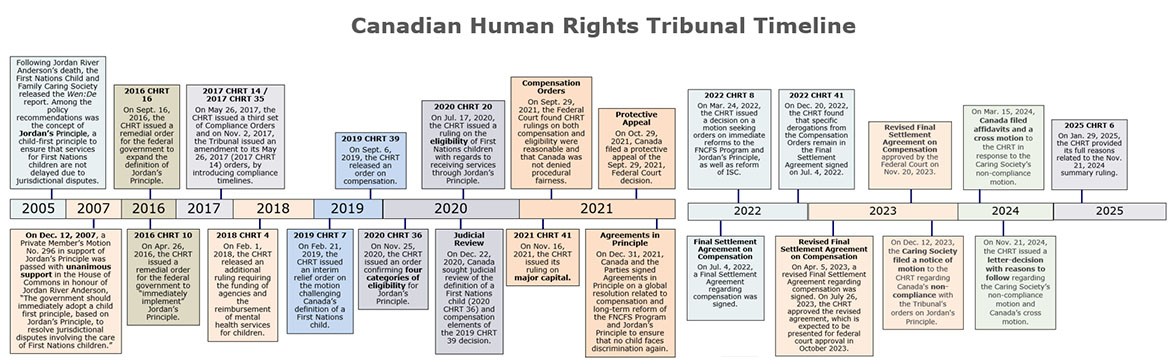
Text alternative for Canadian Human Rights Tribunal (CHRT) Timeline and Key Orders
The graphic summarizes the timeline of the Canadian Human Rights Tribunal (CHRT) Orders and requirements regarding Jordan's Principle;
- 2005:
- The First Nations child and Family Caring Society released the Wen:De report following Jordan River Anderson's death. Among the policy recommendations was the concept of Jordan`s Principle, a child first principle to ensure that services for First Nations children are not delayed due to jurisdictional disputes.
- 2007:
- On Dec. 12th, 2007, a Private Member's Motion No. 296 in support of Jordan's Principle was passed with unanimous support in the House of Commons.
- "The government should immediately adopt a child first principle, based on Jordan's Principle, to resolve jurisdictional disputes involving the care of First Nations children."
- On Dec. 12th, 2007, a Private Member's Motion No. 296 in support of Jordan's Principle was passed with unanimous support in the House of Commons.
- 2016:
- CHRT 10 – On Apr. 26, 2016, the CHRT issued a remedial order for the federal government to "immediately implement" Jordan's Principle.
- CHRT 16 – On Sept. 16, 2016, remedial order was issued for the federal government to expand the definition of Jordan's Principle.
- 2017:
- CHRT 14 – On May 26, 2017, the CHRT issued a third set of Compliance Orders.
- CHRT 35 – On Nov. 2, 2017, an amendment to CHRT 14 by introducing compliance timelines was issued.
- 2018:
- CHRT 4 – On Feb.1st, 2018, the CHRT released an addition ruling requiring the funding of agencies and the reimbursement of mental health services for Children.
- 2019:
- CHRT 7 – On Feb. 21, 2019, the CHRT issued an interim relief order on the motion challenging Canada's definition of a First Nations child.
- CHRT 39 – On Sept. 6, 2019, an order on compensation was released.
- 2020:
- CHRT 20 – On Jul. 17, 2020, the CHRT issued a ruling on the eligibility of First Nations children with regards to receiving services through Jordan's Principle.
- CHRT 36 – On Nov. 25, 2020, an order confirming four categories of eligibility for Jorden's Principle was issued.
- Judicial Review – On Dec. 22, 2020, Canada sought judicial review of the definition of a First Nations child (2020 CHRT 36) and compensation elements (2019 CHRT 39).
- 2021:
- Compensation Orders – On Sept. 29, 2021, the Federal Court found CHRT rulings on both compensation and eligibility were reasonable and that Canada was not denied procedural fairness.
- Protective Appeal – On Oct. 29, 2021, Canada filed a protective appeal of the Sept. 29, 2021, Federal Court decision.
- CHRT 41 – On Nov. 16, 2021, the CHRT issues its ruling on major capital.
- Agreements in Principle – On Dec. 31, 2021, Canada and the Parties signed Agreements in Principle on a global resolution related to compensation and long-term reform of the FNCFS Program and Jordan's Principle to ensure that no child faces discrimination again.
- 2022:
- CHRT 8 – On Mar. 24, 2022, the CHRT issued a decision on a motion seeking orders on immediate reforms to the FNCFS Program and Jordan's Principle, as well as reform of ISC.
- Final Settlement Agreement on Compensation – On Jul. 4, 2022, a Final Settlement Agreement regarding compensation was signed.
- CHRT 41 – On Dec. 20, 2022, CHRT found that specific derogations from the Compensation Orders remain in the Final Settlement Agreement signed on Jul. 4, 2022.
- 2023:
- Revised Final Settlement Agreement on Compensation – On Apr. 5, 2023, a revised Final Settlement Agreement regarding compensation was signed.
- On July 26, 2023, the CHRT approved the revised agreement, which is expected to be presented for federal court approval in October 2023.
- On Nov. 20, 2023, the Revised Final Settlement Agreement on Compensation was approved by the Federal Court.
- On Dec. 12, 2023, the Caring Society filed a notice of motion to the CHRT regarding Canada's non-compliance with the Tribunal's orders on Jordan's Principle.
- 2024:
- On Mar. 15, 2024, Canada filed affidavits and a cross motion to the CHRT in response to the Caring Society's non-compliance motion.
- On Nov. 21, 2024, the CHRT issued a letter-decision with reasons to follow regarding the Caring Society's non-compliance motion and Canada's cross motion.
- 2025:
- CHRT 6 – On Jan. 29, 2025, the CHRT provided its full reasons related to the Nov. 21, 2024, summary ruling.
Annex B : Audit Criteria
To ensure an appropriate level of assurance to meet the audit objectives, the following audit criteria were developed to address the objectives.
Audit Criteria and Sub-Criteria
1. An adequate Management Control Framework has been developed to support the current implementation of Jordan's Principle.
1.1 A formal governance structure is developed to facilitate decision making and oversee the current implementation of Jordan's Principle.
1.2 Roles, responsibilities, and authorities of those involved in implementing Jordan's Principle are clearly defined and communicated.
1.3 Risk management processes for Jordan's Principle are supported by an established risk management framework.
1.4 Procedures and controls are defined and communicated for processing individual and group requests.
1.5 Operational guidance and tools are established and approved to support the current implementation of Jordan's Principle.
1.6 Training and the related material have been developed and delivered to support the current implementation of Jordan's Principle.
2. Key controls identified in the processes for both individual and group request are designed, implemented, and operating effectively.
2.1 Operational controls are designed, implemented and operating effectively to prevent and/or detect errors, ineligibility, as well as monitor a consistent implementation of the management control framework.
2.2 Financial controls are designed, implemented and operating effectively to support Jordan's Principle request processing and adherence with the Financial Administration Act (FAA) and applicable Treasury Board Policies and Directives.
2.3 Appropriate measures are in place to prevent and detect conflict of interest risks; and guidelines and tools are available to assist employees in identifying and declaring conflicts.
3. Oversight and reporting mechanisms are in place to monitor expenditures and progress towards the initiative outcomes.
3.1 Funding management reporting mechanisms to inform decision making are defined and implemented.
3.2 Reporting requirements and oversight activities for administering and managing contribution agreements are defined and implemented.
3.3 Monitoring activities to oversee compliance to contribution agreements and progress towards the initiative outcomes are defined and implemented.
3.4 Information collected through the reporting activities is relevant and used for decision making and measuring progress towards initiatives outcomes.
4. Mechanisms are in place to detect and minimize funding overlap between Jordan's Principle funding and existing services and programs delivered by other Indigenous Services Canada (ISC) programs, other Federal Departments, or Provinces and Territories.
4.1 Mechanisms to detect and report funding overlap with other ISC programs and/or levels of government have been defined.
4.2 Mechanisms to minimize funding overlap are implemented.
Annex C: Departmental Expenditure Risk Levels
As defined in the departmental account verification framework, the departmental approach consists of three risk levels, which will determine the timing and depth of the review:
High-risk expenditures are those that are:
- Highly sensitive;
- Unlikely recoverable when there is an error with the payment;
- Subject to a high degree of professional judgment in the decision to pay;
- Subject to a high probability of overpayment or underpayment;
- Less frequent;
- Manually processed;
- Highly complex;
- Large in dollar value;
- Prone to a high error rate; and
- Lower-risk transactions subject to targeted verification.
Medium-risk expenditures are those that are:
- Less sensitive;
- Subject to a medium to low degree of professional judgment in the decision to pay;
- Have a certain potential for financial loss or overpayment;
- Somewhat complex;
- Lower in dollar value; and
- Prone to a medium error rate.
Low-risk expenditures are those that are:
- Not sensitive;
- Subject to a low degree of professional judgment in the decision to pay;
- Have little potential for financial loss or overpayment;
- Simple, frequent and automated;
- Low dollar value; and
- Low error rate.
Annex D: Examples of Approved Requests
Below are some examples of approved requests noted by regional management, where there was a lack of clarity on what was admissible or not, based on the information provided within the request against Back to Basics (B2B) requirements. Management noted that there were a variety of requests being approved under Jordan's Principle. Based on this, it was noted that it was difficult to see how the B2B policy could be applied to deal with these complex cases using the 'common-sense' approach. It was noted that there was limited required evidence to demonstrate admissibility for the approved requests below:
- Car loan payments.
- Provincial driver's license fees and fines.
- Daytime and nighttime respite care being provided by the child's grandmother exceeding $1M in expenditures.
- Elite hockey training approved for $50k.
- Home renovations exceeding $400k where management suspected the vendor was inflating costs.
- Hotel accommodations being paid for more than 6 months, exceeding $46k in costs. Another instance where 3 months of accommodations costing $23k, with $3.6k in additional damage fees.
- Laptop costing $4,300 being reimbursed for a child who already graduated high school.
- Monthly and on-going rent payments.
- Parents submitting invoices as support workers for their own children.
- Pick-up truck and horse trailer approved for approximately $80k combined.
- Requestors reselling goods paid through Jordan's Principle for a profit (e.g., infant formula).
- Vendors of concern continuing to receive funding for suspected fictitious services noted as 'rehabilitation behavior supports' for fees exceeding $100k.
- Vendors submitting support worker invoices for reimbursement without consent of parents or caregivers.
- Water infrastructure costs being approved for $13k.