2024-2025 Annual Report to Parliament: Access to Information Act
Table of contents
- Introduction
- Performance
- Interpretation of the Statistical Report
- Requests under the Access to Information Act
- Informal requests
- Applications to the Information Commissioner on Declining to Act on Requests
- Requests closed during the reporting period
- Extensions
- Fees
- Consultations Received from other Institutions and Organizations
- Completion time of Consultations on Cabinet Confidences
- Complaints and Investigations
- Court Action
- Resources related to the Access to Information Act
- Training and Awareness
- Monitoring Compliance
- Policies, Guidelines, and Procedures
- Initiatives and Projects to Improve Access to Information
- Interpretation of the Statistical Report
- Proactive Publication
- Highlights
- Annex A
- Annex B
Introduction
roman numeral 1I. Introduction
The purpose of the Access to Information Act (ATIA) is to provide Canadians with access to records under the control of federal institutions, except for records subject to limited and specific exemptions and exclusions.
This report reflects activities of Indigenous Services Canada (ISC), with respect to the stated legislation, for the period of April 1, 2024 to March 31, 2025.
The annual report is tabled in Parliament pursuant to section 94 of the ATIA and in accordance with section 20 of the Service Fees Act. The report describes the activities of ISC that support compliance with access to information legislation.
Indigenous Services Canada's Mandate
The primary mandate of ISC is to work collaboratively with partners to improve access to high quality services for First Nations, Inuit and Métis. The Department aims to support and empower Indigenous Peoples to independently deliver services and address the socio-economic conditions in their communities.
ISC has been given the responsibility to identify the best models for delivering improved services to Indigenous Peoples and improve accountability to Indigenous Peoples for the quality of services delivered by the Department.
As Canada moves towards greater Indigenous self-government, ISC will oversee the provision of existing services to Indigenous Peoples, and particularly First Nations under the Indian Act, including the provision of community infrastructure, emergency management, water, education, moneys and trusts, and registration.
The Department works in collaboration with its partners to create systemic change in how the federal government delivers health services to Indigenous Peoples.
roman numeral 2. Organization
Administration of the Access to Information Act at Indigenous Services Canada
ISC's Access to Information and Privacy Office (ATIPO) receives requests for records from the Canadian public and processes them on behalf of the Minister and the Department. They perform their duties under the ATIA and the Privacy Act (PA) and through a Ministerial delegation order.
The ATIP Office is situated in the Corporate Secretariate.The Corporate Secretary is a member of the ISC Senior Management Table.
The ATIP Office also coordinates and implements policies, guidelines and procedures to ensure departmental compliance with the ATIA and PA. Workshop presentations, training courses and awareness sessions designed to increase access to information and privacy capacity across the Department are also provided.
Under section 96, CIRNAC provides shared ATIP services to Indigenous Servies Canada (ISC) through Service Level Agreements (SLA). ISC's Corporate Secretary manages the SLA for approval and it is updated yearly
Delegation of ministerial responsibilities for the ATIA and PA remains institutionally specific.
Under a shared service model, all ATIP analysts process requests for both ISC and CIRANC. Requests are varied in volume and complexity and treated separately.
The ATIP Office provides advice and guidance to the Department on a number of topics:
- Application of the ATIA and PA;
- Release of sensitive or protected information to the public;
- Education and awareness of access to information and privacy issues throughout the Department; and
- Proactive publications.
The Intake Team triages and coordinates the receipt of requests for records from the Canadian public or persons residing in Canada under the control of the Department and made pursuant to the ATIA and PA.
The Operations Team processes records in line with the ATIA and PA. The Team ensures that responses are provided within the legislated timeframe.
In addition to the ATIP Office, within each of the sectors and regional offices of ISC there are ATIP Liaison Officers (ALOs) who receive callouts from the ATIP Office and subsequently task the requests to areas within their sector to retrieve records. ALOs play a crucial role in ensuring the appropriate records, impact statements and approvals are obtained and communicated to the ATIP Office within the designated time allowances.
ATIP analysts work closely with the relevant program areas in order to ensure that all responsive documents are identified and to ensure that the information contained within those documents are treated in accordance with the Acts. This work ensures departmental records are appropriately disclosed to the Canadian public in support of openness and transparency.
All requests are monitored and processed using the AccessPro case management system. The ATIP Office will be transitioning away from this sunsetting case management system. A new system called ATIPXpress has been procured. This solution was chosen to increase efficiency by reducing processing times and moving away from a more manual system. It will reduce the number of late complaints received due to missing legislative timelines. This new case management system provides a supported, stable, and technologically contemporary tool to manage both Departments' workloads fluidly within one system, further cutting processing time. The solution is expected to be implemented in fiscal 2025-2026.
ATIP Operations is working on updating and formalizing their Developmental Program in order to recruit and retain qualified analysts with specialized skills. The multi-phased program is based on performance benchmarks that clearly state the expectations at each level from CR-04 to PM-06. An employee can choose to participate in the program to develop their skills, build experience and advance their careers within the organization. With guidance from the Team Leaders, analysts can gain specialized expertise related to ISC's unique record sets.
This program is developed with the intent to be open and transparent in order to develop and retain current staff and provide growth opportunities within the ATIP Office and the Department. The pilot Developmental Program has been highly successful. This reporting period, eleven analysts were promoted or provided acting opportunities based on their success in the pilot program.
The Department has continued to meet its proactive publication requirements in this reporting period and has published briefing material titles submitted to the Minister and Deputy Minister on a monthly basis as well as the summaries of the completed requests on the Open Government Portal, thereby continuing to improve communication with applicants and promoting transparency.
The Department continued to use the Microsoft Office 365 tools, to communicate internally and engage with key stakeholders. The ATIP office also leveraged these tools for the transfer of information with sectors to allow for business continuity within the hybrid workplace structure.
To better serve our clients, the Department participates in the Access to Information and Privacy Online Request Service. Canadians can submit requests under the Acts through this online channel administered by TBS.
The ATIPO continues to work in a hybrid model. Since pandemic response conditions substantially reduced the use of paper, the office mostly received electronic requests and records. It provided release packages electronically to applicants with the use of E-post Connect, which was implemented in February 2020.
roman numeral 3. Delegation Order
Under section 95 of the ATIA, the Minister's authority may be delegated to departmental officials in order to administer the ATIA within ISC.
During the reporting period, the delegation order signed by Minister Marc Miller on November 6, 2020, was in effect (Annex A). Under section 95 of the ATIA, the order delegates full authority and responsibility for the ATIA to the following positions:
- Deputy Minister
- Associate Deputy Minister
- Corporate Secretary
- ATIP Coordinator
- ATIP Deputy Directors
Director's Office
The Director (EX-01), as institutional ATIP Coordinator, holds full delegated authority under the ATIA. The Director is supported in day-to-day administrative tasks by the Deputy Director Operations (PM-06), Deputy Director Privacy/Policy (PM-06), an Administrative Assistant (AS-01) and is also supported in reporting by the Systems Administrator (AS-04)
Privacy/Policy Team
The Privacy/Policy Team is led by two Team Leaders (PM-05), who are responsible for ensuring the department is adhering to the collection, use and disclosure of personal information holdings as per the Privacy Act. They also ensure all policies for Access and Privacy align with Treasury Board policies and directives. The Privacy/Policy Team consists of Analysts at the PM-04, PM-03 and PM-02 levels who respond to privacy policy matters (such as privacy breaches, court ordered disclosure requests, Privacy Assessments, etc.) and provide training and Privacy advice. They are supported by an intake Clerk (CR-04).
Operations Team
The Operations Team is led by three Team Leaders (PM-05), who are responsible for the overview of request processing by their team, including the review of completed requests. The Operations Team consists of Analysts at the PM-04, PM-03, and PM-02 levels who process Access and Privacy requests of varying volume and complexity, as well as provide training
Intake Team
The Intake Team is led by one Team Lead (PM-5) and is comprised of various Intake Officers (PM-01s and CR-04s), who enter all applications into the electronic case management system, acknowledge receipt of requests, perform imaging services, interact with and respond to inquiries from the public.
Performance
roman numeral 4. Interpretation of the Statistical Report
ISC's Statistical Report and Supplemental Report were submitted to the Treasury Board Secretariat (TBS) on May 23, 2025 (Appendix B). The Report details various aspects of the requests ISC received and processed during the period of April 1, 2024 to March 31, 2025.
1. Requests under the Access to Information Act
1.1 Number of requests
In the 2024–2025 fiscal year, the department received 484 requests for records from the Canadian public, marking an increase of approximately 33% compared to the 363 requests received in 2023–2024 (see Table 1.1). When combined with the 255 requests carried over from the previous year, the department was responsible for processing a total of 739 requests during the reporting period.
ISC successfully closed 447 requests, a 23% increase, despite this, 292 requests were carried forward into the 2025–2026 reporting period, reflecting ongoing demand and the complexity of some files.
The listing of ISC's completed access to information requests can be found on the Open Canada's website.
| Number of Requests | 2021-2022 | 2022-2023 | 2023-2024 | 2024-2025 |
|---|---|---|---|---|
| Received during reporting period | 444 | 412 | 363 | 484 |
| Outstanding from previous reporting period | 377 | 335 | 312 | 255 |
| Total | 821 | 747 | 675 | 739 |
| Number of Requests | 2021-2022 | 2022-2023 | 2023-2024 | 2024-2025 |
|---|---|---|---|---|
| Closed during reporting period | 484 | 435 | 421 | 447 |
| Carried over to next reporting period | 337 | 312 | 254 | 292 |
1.2 Sources of requests
In 2024–2025, there was a notable shift in the distribution of requesters compared to previous years. Requests from the public surged to 149, marking a 35% increase from 2023–2024 and the highest in the four-year period. Business requests also reached a four-year high at 97, showing steady growth since 2022–2023. Conversely, media requests declined sharply to 52, a 38% drop from the previous year. Organizational requests saw a significant rise to 31, more than quadrupling from the previous year's total of 7. Academia experienced a decline to 19, the lowest in the reporting period. Interestingly, the "Decline to Identify" category rebounded to 136 after a dramatic drop to 30 in 2023–2024, suggesting a renewed preference for anonymity. These trends reflect evolving patterns in access to information and stakeholder engagement across sectors.
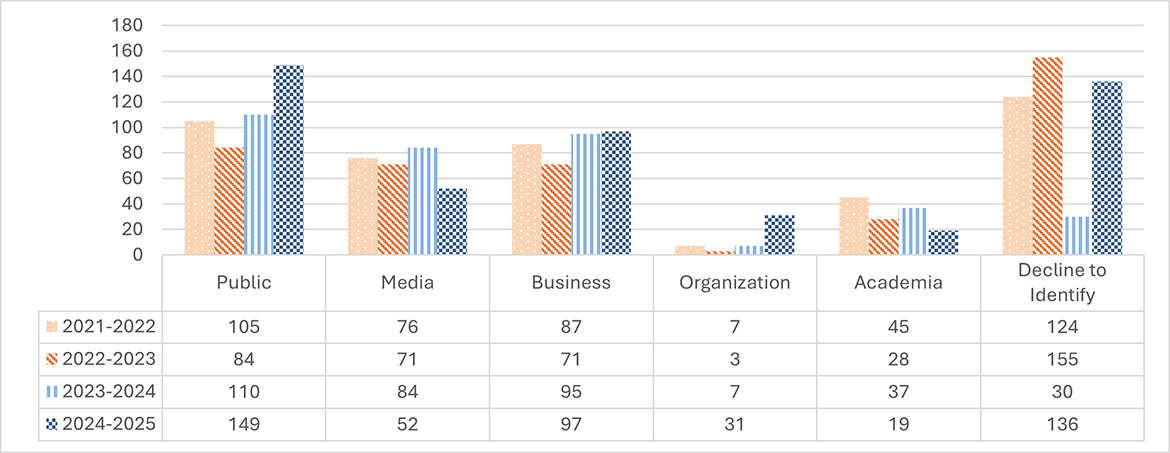
Text alternative for Table 1.2 Sources of Requests 2021 to 2025
| Public | Media | Business | Organization | Academia | Decline to Identify | |
|---|---|---|---|---|---|---|
| 2021-2022 | 105 | 76 | 87 | 7 | 45 | 124 |
| 2022-2023 | 84 | 71 | 71 | 3 | 28 | 155 |
| 2023-2024 | 110 | 84 | 95 | 7 | 37 | 30 |
| 2024-2025 | 149 | 52 | 97 | 31 | 19 | 136 |
1.3 Channels of requests
The Department receives requests through several channels, including the Government of Canada's Open Government Portal, email, mail, phone, fax, and in-person submissions. In 2024–2025, the Online Portal remained the primary method, accounting for 382 out of 484 requests, approximately 79% of all submissions. Email was the second most utilized channel, with 95 requests (20%), while mail accounted for 7 requests (1%). No requests were received via phone, fax, or in person during the reporting period (see Table 1.3).
| Channel | Number of Requests |
|---|---|
| Online | 382 |
| 95 | |
| 7 | |
| In person | 0 |
| Phone | 0 |
| Fax | 0 |
| Total | 484 |
2. Informal Requests
Informal requests refer to requests for copies of previously released records under the Access to Information Act. In accordance with Treasury Board of Canada Secretariat (TBS) policy, federal institutions are required to publicly post summaries of completed access to information requests. Informal requests are not subject to application fees, and there are no legislated timelines for response. Additionally, requesters do not have a statutory right to file a complaint with the Office of the Information Commissioner of Canada (OIC) regarding the handling of informal requests.
2.1 Number of informal requests
During the 2024-2025 reporting period, ISC received 761 informal requests, representing a 133% increase compared to the 327 requests received in 2023–2024. With the addition of the 79 requests that were carried over from the previous year, this reflected a total of 840 informal requests to be processed. The Department completed 316 informal requests (38% of the informal requests) and carried 524 requests into the next reporting period 2025-2026.
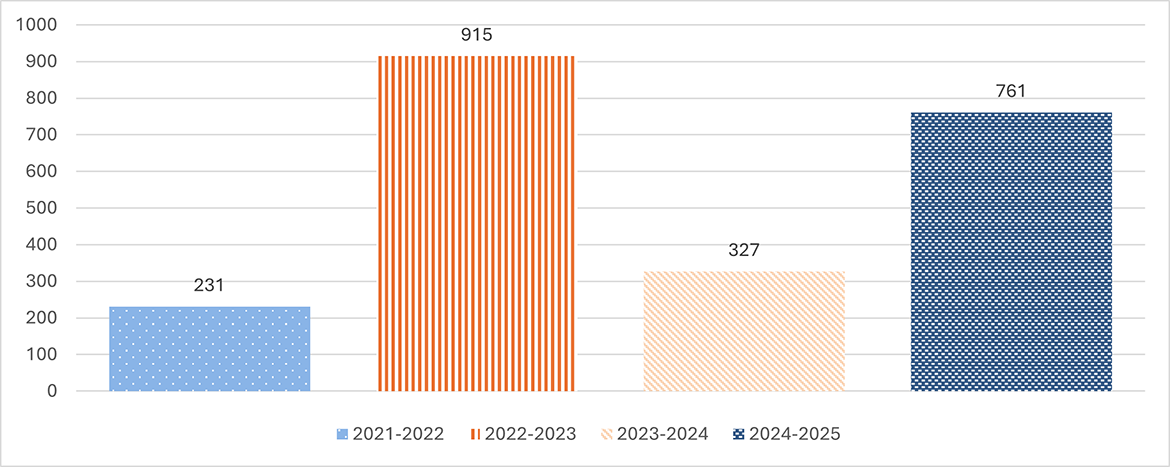
Description of Table 2.1 Number of Informal Requests Received
| Year | Number of Requests |
|---|---|
| 2021-2022 | 231 |
| 2022-2023 | 915 |
| 2023-2024 | 327 |
| 2024-2025 | 761 |
2.2 Channels of informal requests
The channels of informal requests identify the methods used by the Canadian public to submit requests for previously released records. These include the Government of Canada's Online Portal, email, mail, phone, and fax. As part of a new reporting requirement, institutions now track the specific channels through which informal requests are received.
In 2024–2025, all informal requests were submitted either through the Government of Canada Online Portal or by email. Of the 761 informal requests received, 749 (98%) were submitted via the Online Portal, while 12 (2%) were received by email. No informal requests were submitted through mail, phone, fax, or in person during the reporting period.
2.3 Completion time of informal requests
Table 2.3 (below), reports the number of requests/completion time for the 316 informal requests closed during the 2024-2025 reporting period. The table demonstrates the percentage of informal requests closed during the reporting period and the number of days it took to process and close them.
During the 2024–2025 reporting period, ISC closed 316 informal requests. The time required to complete these requests varied, reflecting the complexity and scope of the records involved. A small portion of requests, 28 in total, were completed within 30 days of receipt, indicating that some files were straightforward and readily accessible. However, a larger number, 33 requests, required between 31 and 60 days to process. The majority of informal requests took longer to complete, with 140 finalized within 61 to 120 days. An additional 45 requests were completed within 121 to 180 days, while 55 required between 181 and 365 days. A further 15 requests exceeded 365 days before completion. These figures highlight the operational demands associated with processing informal requests, particularly those involving large volumes of records or complex historical documentation.

Text alternative for Table 2.3 Completion time of informal requests
| Days | Percentage |
|---|---|
| 0 to 15 days | 1% |
| 16 to 30 days | 5% |
| 31 to 60 days | 14% |
| 61 to 120 days | 39% |
| 121 to 180 days | 24% |
| 181 to 365 days | 12% |
| > 365 days | 5% |
2.4 Pages released informally
This section provides information on the number of informal requests closed in relation to pages released. Table 2.4 provides information on the number of informal requests that were closed during the 2024-2025 reporting period that fall under each range of pages released. Of the 316 requests completed, 112 were requests for copies of records previously processed through a formal access to information request.
| Pages Released | Number of Requests | Pages Released |
|---|---|---|
| Less than 100 | 69 | 1,749 |
| 100 to 500 | 29 | 6,239 |
| 501 to 1000 | 8 | 5,466 |
| 1001 to 5000 | 6 | 7,818 |
| Greater than 5000 | 0 | 0 |
| Total | 112 | 21,272 |
2.5 Pages re-released informally
Of the 316 informal requests completed, 204 requests were processed as re-releases. These requests were for copies of previously released records that were processed through informal requests.
| Pages Released | Number of Requests | Pages Released |
|---|---|---|
| Less than 100 | 125 | 3,583 |
| 100 to 500 | 59 | 14,830 |
| 501 to 1000 | 15 | 9,803 |
| 1001 to 5000 | 4 | 7,900 |
| Greater than 5000 | 1 | 54,662 |
| Total | 204 | 90,778 |
3. Applications to the Information Commissioner on Declining to Act on Requests
In accordance with section 6 of the Access to Information Act (ATIA), federal institutions may apply to the Office of the Information Commissioner (OIC) for authorization to decline to act on requests deemed to be vexatious, made in bad faith, or otherwise an abuse of the right of access. During the 2024–2025 reporting period, Indigenous Services Canada (ISC) submitted five applications under this provision. The Department is currently awaiting a decision from the Information Commissioner on these submissions.
4. Requests closed during the reporting period
4.1 Disposition and completion time
Of the 447 formal access to information requests closed during the 2024–2025 reporting period, ISC was able to fully or partially disclose records in 206 cases, representing 46% of all requests. The remaining requests were either fully exempted (3%), resulted in no records found (29%), were abandoned by the requester (21%), or were transferred to another institution (1%) (see Table 4.1.1).

Text alternative for Table 4.1.1 Percentage of completed files relevant to each disclosures
| Dispositions | Percentage |
|---|---|
| All disclosed | 12% |
| Disclosed in part | 34% |
| All exempted | 3% |
| All excluded | 0% |
| No records exist | 29% |
| Request transferred | 1% |
| Request abandoned | 21% |
During the reporting period, the majority of access to information requests were completed within 60 days, with 261 out of 447 requests (approximately 58%) finalized in this timeframe. Specifically, 113 requests were completed within 1 to 15 days, 75 within 16 to 30 days, and 73 within 31 to 60 days. However, a notable portion of requests required extended processing times: 56 took between 61 and 120 days, 24 between 121 and 180 days, and 38 between 181 and 365 days. Additionally, 68 requests exceeded 365 days to complete, representing over 15% of the total workload. These figures highlight both the efficiency in handling a large volume of requests promptly and the challenges posed by more complex or resource-intensive cases that require longer processing times. (Table 4.1.2).
| Disposition of requests | Completion Time (days) | |||||||
|---|---|---|---|---|---|---|---|---|
| 1 to 15 | 16 to 30 | 31 to 60 | 61 to 120 | 121 to 180 | 181 to 365 | > 365 | Total | |
| All disclosed | 2 | 16 | 20 | 11 | 1 | 3 | 3 | 56 |
| Disclosed in part | 1 | 11 | 15 | 28 | 20 | 32 | 43 | 150 |
| All exempted | 0 | 1 | 1 | 3 | 2 | 0 | 6 | 13 |
| All excluded | 0 | 0 | 0 | 1 | 0 | 1 | 0 | 2 |
| No records exist | 46 | 41 | 29 | 8 | 1 | 0 | 4 | 129 |
| Request transferred | 4 | 0 | 0 | 0 | 0 | 0 | 0 | 4 |
| Request abandoned | 60 | 6 | 8 | 5 | 0 | 2 | 12 | 93 |
| Neither confirmed nor denied | 0 | 0 | 0 | 0 | 0 | 0 | 0 | 0 |
| Decline to act with the approval of the Information Commissioner | 0 | 0 | 0 | 0 | 0 | 0 | 0 | 0 |
| Total | 113 | 75 | 73 | 56 | 24 | 38 | 68 | 447 |
4.2 Exemptions
The most commonly invoked exemption applied were pursuant to section 20(1) (third party) which was applied in 170 instances. The next most applied exemption, section 19(1) (personal information) was applied in 142 instances. The third most commonly applied exemption was section 21(1) (advice or deliberations), was applied in 114 instances. Each request under the Act can have more than one exemption applied (Table 4.2).
| Section | Number of requests |
|---|---|
| 13(1)(c) | 7 |
| 13(1)(e) | 1 |
| 14 | 5 |
| 14(a) | 7 |
| 14(b) | 1 |
| 16(1)(c) | 1 |
| 16(2) | 1 |
| 16(2)(c) | 21 |
| 17 | 2 |
| 18(a) | 2 |
| 18(b) | 2 |
| 18(d) | 1 |
| 19(1) | 142 |
| 20(1)(a) | 1 |
| 20(1)(b) | 91 |
| 20(1)(b.1) | 1 |
| 20(1)(c) | 44 |
| 20(1)(d) | 33 |
| 21(1)(a) | 47 |
| 21(1)(b) | 50 |
| 21(1)(c) | 15 |
| 21(1)(d) | 2 |
| 22 | 5 |
| 23 | 20 |
| 23.1 | 20 |
4.3 Exclusions
In 2024-2025, the Department applied 17 mandatory exclusion provisions on requests completed. The most frequent exclusion applied was section 69(1)(g) re (a), which are records containing information related to Memoranda to Cabinet (Table 4.3).
| Section | Number of requests |
|---|---|
| 68(a) | 4 |
| 68.1 | 4 |
| 69(1)(a) | 1 |
| 69(1)(g) re (a) | 6 |
| 69(1)(g) re (e) | 2 |
4.4 Format of information released
Over the course of this reporting period, the majority of responses were provided to the requesters electronically through E-post Connect or through e-mail. On two (2) occasions, individuals who did not have access to retrieve records electronically were provided with paper copies through regular mail.
4.5 Complexity
The following sections details several factors affecting the complexity of requests that were completed throughout 2024-2025.
4.5.1 Relevant pages processed and disclosed
Of the 447 requests closed during the 2024–2025 reporting period, 314 resulted in the processing of records, generating a total of 158,397 pages. Of these, 41,800 pages were disclosed to requesters. This represents a 41.73% decrease compared to the 71,741 pages disclosed in the previous reporting period. The reduction in pages disclosed may reflect changes in the nature or scope of requests received, or the sensitivity of the information processed (see Table 4.5.1).
| Number of Pages Processed | Number of Pages Disclosed | Number of Requests |
|---|---|---|
| 158,397 | 41,800 | 314 |
4.5.2 Relevant pages processed per request disposition for paper and e-records formats by size of requests
During the 2024–2025 reporting period, of the 314 requests that generated records, 200 requests (60%) involved the processing of 100 pages or fewer, indicating that a majority of requests were relatively limited in scope. Another 101 requests required the processing of between 101 and 1,000 pages, reflecting a moderate level of complexity.
However, 35 requests (12%) involved the review of more than 1,001 pages, accounting for a substantial 122,920 pages processed—nearly 69% of the total volume of pages reviewed. These high-volume requests were primarily associated with partial disclosures and abandoned files, underscoring the resource-intensive nature of certain files, particularly those involving historical or large-scale documentation. The data also reflects a mix of both paper and electronic formats processed across all request sizes (see Table 4.5.2).
| Disposition | < 100 pages | 101-500 pages | 501-1000 pages | 1001-5000 pages | > 5000 pages | |||||
|---|---|---|---|---|---|---|---|---|---|---|
| Requests | Pages | Requests | Pages | Requests | Pages | Requests | Pages | Requests | Pages | |
| All disclosed | 43 | 802 | 7 | 1,434 | 3 | 1,727 | 3 | 7,450 | 0 | 0 |
| Disclosed in part | 66 | 2,336 | 38 | 9,446 | 22 | 14,773 | 18 | 33,814 | 6 | 62,711 |
| All exempted | 10 | 416 | 0 | 0 | 2 | 1283 | 1 | 2718 | 0 | 0 |
| All excluded | 2 | 97 | 0 | 0 | 0 | 0 | 0 | 0 | 0 | 0 |
| Abandoned | 79 | 155 | 5 | 1372 | 2 | 1636 | 6 | 10,107 | 1 | 6,120 |
| Neither confirmed nor denied | 0 | 0 | 0 | 0 | 0 | 0 | 0 | 0 | 0 | 0 |
| Declined to act with the approval of the Information Commissioner | 0 | 0 | 0 | 0 | 0 | 0 | 0 | 0 | 0 | 0 |
| Total | 200 | 3,806 | 50 | 12,252 | 29 | 19,419 | 28 | 54,089 | 7 | 68831 |
4.5.3 Relevant minutes processed and disclosed for audio formats
No audio files were provided to the ISC ATIP office in response to an ATIA request.
4.5.4 Relevant minutes processed per request disposition for audio formats by size of requests
No audio files were provided to the ISC ATIP office in response to an ATIA request.
4.5.5 Relevant minutes processed and disclosed for video formats
No video files were provided to the ISC ATIP office in response to an ATIA request.
4.5.6 Relevant minutes processed per request disposition for video formats by size of requests
No video files were provided to the ISC ATIP office in response to an ATIA request.
4.5.7 Other complexities
During the reporting period, the Department consulted other federal institutions 44 times and non-federal government organizations 40 times. The most frequently consulted institutions included Natural Resources, Crown-Indigenous Relations and Northern Affairs Canada, Innovation, Science, & Economic Development, and Privy Council Office. Consultations with third parties were required in 148 instances with First Nations, organizations, and businesses. More than one institution can be consulted per request. Other complexities included requests with high profile subject matter, requests for contents of a database, and instances where records needed to be retrieved from other regions (Table 4.5.7).
| Disposition | Consultation required | Legal advice sought | Other | Total |
|---|---|---|---|---|
| All disclosed | 10 | 0 | 20 | 30 |
| Disclosed in part | 71 | 4 | 78 | 153 |
| All exempted | 6 | 0 | 8 | 14 |
| All excluded | 2 | 1 | 1 | 4 |
| Abandoned | 12 | 1 | 0 | 13 |
| Neither confirmed nor denied | 0 | 0 | 0 | 0 |
| Declined to act with the approval of the Information Commissioner | 0 | 0 | 0 | 0 |
| Total | 101 | 6 | 107 | 214 |
4.6 Closed Requests
4.6.1 Number of requests closed within legislated timelines
The following section reports the number and percentage of requests closed within legislated timelines with or without extensions during the current reporting period. Overall, 301 requests, representing 67% of the 447 requests, were closed within the legislative timelines.
| Number of requests closed within legislated timelines | 301 |
|---|---|
| Percentage of requests closed within legislated timelines (%) | 67.34 |
4.7 Deemed refusals
4.7.1 Reasons for not meeting legislated timelines
During the reporting period, ISC did not respond within the statutory timelines on 146 occasions mostly due to large workloads.
| Number of requests closed past the legislated timelines | Principal Reasons | |||
|---|---|---|---|---|
| Interference with Operations / Workload | External Consultation | Internal Consultation | Other | |
| 146 | 112 | 28 | 2 | 4 |
4.7.2 Requests closed beyond legislated timelines (including any extension taken)
During the 2024–2025 reporting period, a total of 146 requests were closed beyond the legislated timelines. Of these, 52 requests were closed late without any extension applied, while 94 requests had approved extensions under section 9(1) of the Access to Information Act but still exceeded the extended deadlines.
Among the requests without extensions, the majority were delayed by more than 365 days (14 requests), followed by delays of 1- 15 days (13 requests). For requests with extensions, the most significant delays also occurred in the over-365-day category, with 44 requests falling into this range. Additionally, 15 requests were delayed between 181 and 365 days, and 13 between 61 and 120 days. These figures highlight the operational pressures and complexities that can impact timely processing, even when extensions are applied in accordance with the Act.
| Number of days past legislated timelines | Number of requests past legislated timeline where no extension was taken | Number of requests past legislated timeline where an extension was taken |
|---|---|---|
| 1 to 15 days | 13 | 4 |
| 16 to 30 days | 6 | 4 |
| 31 to 60 days | 3 | 6 |
| 61 to 120 days | 7 | 13 |
| 121 to 180 days | 4 | 8 |
| 181 to 365 days | 5 | 15 |
| > 365 days | 14 | 44 |
| Total | 52 | 94 |
4.8 Requests for translation
During the reporting period, there were no instances where a requester asked for responsive records to be translated to another official language.
5. Extensions
5.1 Reasons for extensions and disposition of requests
With a workload of 739 formal access to information requests for 2024-2025, reflecting both requests received and carried over from previous fiscal year, a total of 273 extensions were applied pursuant to section 9(1) of the Act. The most prevalent reason for extending deadlines during this reporting period was for interference with operations (high workload) which was applied 197 times, representing 72% of all extensions. In addition, 6% (16 extensions) were taken due to necessary consultations with other departments and another 22% (60 extensions) due to necessary consultations with third-parties including but not limited to First Nations.
In cases where extensions were applied pursuant to section 9(1)(a), due to volume/interference, it resulted in a full or partial disclosure in 127 times. Where an extension was taken pursuant to either 9(1)(b) or 9(1)(c) due to necessary consultations, records were disclosed in full or in part in 58 out of 76 instances representing 76% (Table 5.1).
| Disposition of Requests Where an Extension Was Taken | 9(1)(a) | 9(1)(b) | 9(1)(c) | |
|---|---|---|---|---|
| Interference Operations / Workload | Consultation | Third-Party Notice | ||
| Section 69 | Other | |||
| All disclosed | 28 | 0 | 1 | 1 |
| Disclosed in part | 99 | 1 | 11 | 44 |
| All exempted | 8 | 0 | 1 | 3 |
| All excluded | 2 | 0 | 0 | 1 |
| Request abandoned | 25 | 0 | 1 | 8 |
| No records exist | 35 | 0 | 1 | 3 |
| Declined to act with the approval of the Information Commissioner | 0 | 0 | 0 | 0 |
| Total | 197 | 1 | 15 | 60 |
5.2 Length of extensions
The majority of extensions, more specifically 244 extensions or 89%, requested and applied during the reporting period were for a length of time of 120 days or less (Table 5.2).
More than one type of extension may be taken for a single request. The number of extensions reported is not necessarily equal to the number of requests involved.
| Length of extensions | 9(1)(a) | 9(1)(b) | 9(1)(c) | |
|---|---|---|---|---|
| Interference Operations / Workload | Consultation | Third party notice | ||
| Section 69 | Other | |||
| 30 days or less | 41 | 0 | 2 | 0 |
| 31 to 60 days | 73 | 0 | 10 | 33 |
| 61 to 120 days | 64 | 1 | 2 | 18 |
| 121 to 180 days | 14 | 0 | 1 | 4 |
| 181 to 365 days | 5 | 0 | 0 | 5 |
| 365 days or > | 0 | 0 | 0 | 0 |
| Total | 197 | 1 | 15 | 60 |
6. Fees
In accordance with the amendments to the ATIA that came into effect on June 21, 2019, ISC is authorized to charge an application fee of $5, as outlined in paragraph 7(1)(a) of the Regulations. However, section 11 of the ATIA provides institutions with the discretion to waive this fee when deemed appropriate.
In November 2023, ISC made the strategic decision to eliminate the $5 application fee for all formal ATIA requests submitted through the ATIP Online Request Portal, effective December 1, 2023. This initiative was implemented in support of advancing Indigenous Reconciliation by improving accessibility to government information. As a result, for the second year in a row, no application fees were collected during 2024–2025.
7. Consultations Received from other Institutions and Organizations
The Access to Information and Privacy Office communicates with other departments in order to ensure legislative timelines are met.
7.1 Consultations received from other Government of Canada institutions and organizations
The Department received 82 consultations from other government institutions for a total of 5,815 pages and 22 consultations from other organizations with another 1,572 pages to review. 8 files from the previous year were carried over, for a total of 112 consultations in 2024-2025 (Table 7.1). A total of 102 consultations were completed, which included the review and release of 6,624 pages.
Consultation received from Other Government of Canada institutions are other government institutions subject to the Act and Other organizations includes provincial governments, territories, and municipalities in addition to consultations received from other countries.
| Consultations | Other Government of Canada Institutions | Pages to Review | Other Organizations | Pages to Review |
|---|---|---|---|---|
| Received during reporting period | 82 | 5,815 | 22 | 1,572 |
| Outstanding from the previous reporting period | 6 | 653 | 2 | 97 |
| Total | 88 | 6,468 | 24 | 1,669 |
| Consultations | Other Government of Canada Institutions | Pages to Review | Other Organizations | Pages to Review |
|---|---|---|---|---|
| Closed during the reporting period | 79 | 5,007 | 23 | 1,617 |
| Carried over to next reporting period | 9 | 1,461 | 1 | 52 |
7.2 Recommendations and completion time for consultations received from other Government of Canada institutions
In 2024-2025, of the 79 consultations completed for other Government of Canada institutions, 56 consultations or 71% were recommended by the Department for full disclosure (Table 7.2). 53 consultations or 67%, were completed within 60 days of their receipt. There were 9 occurrences or 11% where the Department required longer than 120 days to provide a response to their request.
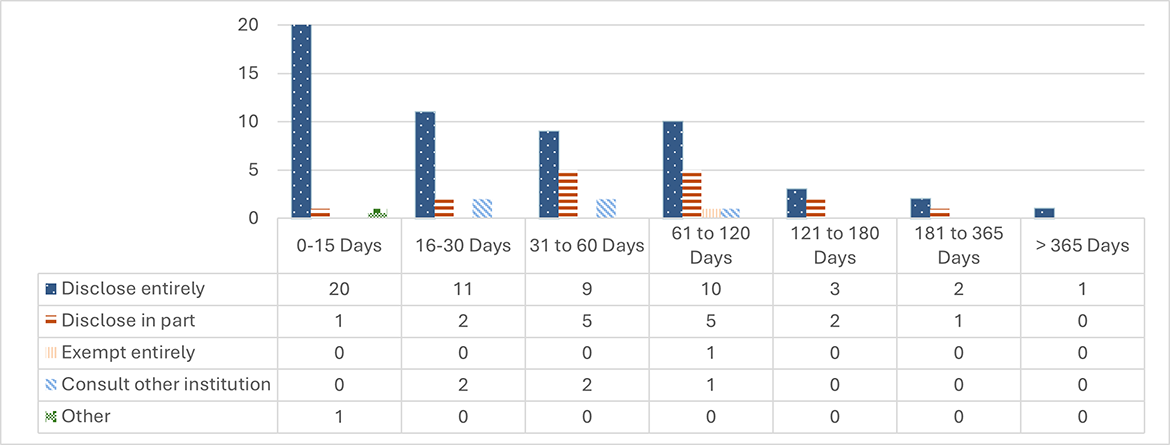
Text alternative for Table 7.2 Consultation and completion time for consultations received from other Government of Canada institutions
| 1 to 15 | 16 to 30 | 31 to 60 | 61 to 120 | 121 to 180 | 181 to 365 | > 365 | |
|---|---|---|---|---|---|---|---|
| Disclose entirely | 20 | 11 | 9 | 10 | 3 | 2 | 1 |
| Disclose in part | 1 | 2 | 5 | 5 | 2 | 1 | 0 |
| Exempt entirely | 0 | 0 | 0 | 1 | 0 | 0 | 0 |
| Exclude entirely | 0 | 0 | 1 | 0 | 0 | 0 | 0 |
| Consult other institution | 0 | 2 | 2 | 1 | 0 | 0 | 0 |
| Other | 1 | 0 | 0 | 0 | 0 | 0 | 0 |
7.3 Recommendations and completion time for consultations received from other organizations outside the Government of Canada
In 2024-2025, the Department received 22 new consultation requests from other organizations and a total of 23 consultations were closed in the course of the same period. 23 consultations were completed, carrying over one request into 2025-2026. Of the 23 consultations, 16 or 70% were recommended by the Department to be disclosed in their entirety as we had no objections to the release of the relevant records provided.
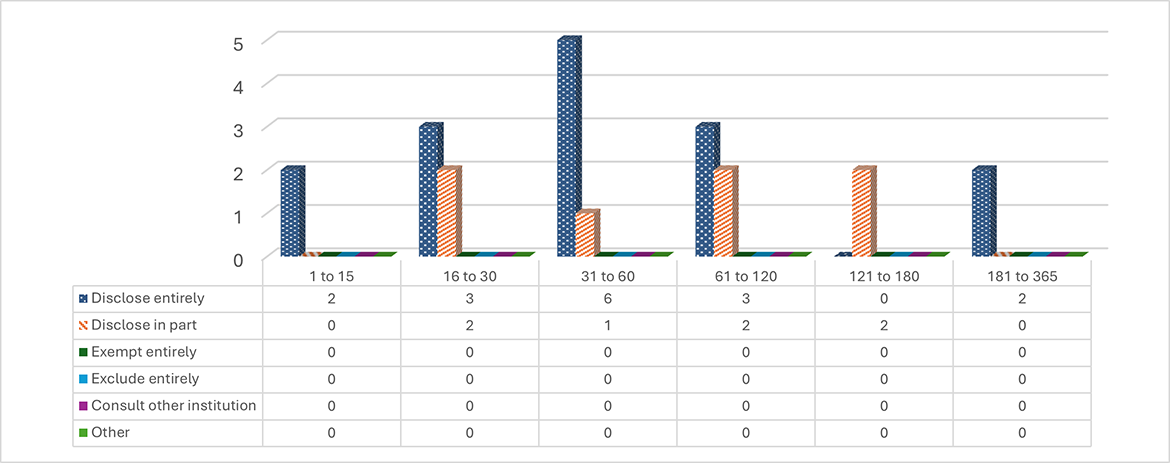
Text alternative for Table 7.3 Recommendations and completion time for consultations received from other organizations
| 1 to 15 | 16 to 30 | 31 to 60 | 61 to 120 | 121 to 180 | 181 to 365 | |
|---|---|---|---|---|---|---|
| Disclose entirely | 2 | 3 | 6 | 3 | 0 | 2 |
| Disclose in part | 0 | 2 | 1 | 2 | 2 | 0 |
| Exempt entirely | 0 | 0 | 0 | 0 | 0 | 0 |
| Exclude entirely | 0 | 0 | 0 | 0 | 0 | 0 |
| Consult other institution | 0 | 0 | 0 | 0 | 0 | 0 |
| Other | 0 | 0 | 0 | 0 | 0 | 0 |
8. Completion time of Consultations on Cabinet Confidences
This section provides details on the number of completed consultations during the current reporting period in regards to the application of Section 69 (cabinet confidences) of the Act. In some instances, a file may have required more than one consultation concerning the application of Section 69. For this reason, the number of consultations may not necessarily reflect the total number of closed requests where consultations on Section 69 were completed.
8.1 Requests with Legal Services
In 2024-2025, 5 consultations were sent for the application of Section 69 of the Act to the Departmental Legal Services Unit, due to possible Cabinet confidences. A response was received within 60 days in 4 instances, with one (1) taking up to 120 days to obtain a response. A total of 13 pages were recommended to be disclosed.
8.2 Requests with Privy Council Office
In 2024-2025, ISC did not send any consultation requests to the Privy Council Office.
9. Complaints and Investigations
To strengthen the approach to complaint resolution, a dedicated Complaint Coordinator has been appointed to oversee all interactions with the Office of the Information Commissioner (OIC). This role ensures the efficient processing and diligent tracking of all complaint files. Regular, structured meetings with the OIC have been institutionalized, providing a forum for collaborative discussion on the status and resolution of ongoing cases. These engagements have significantly contributed to the timely closure of numerous complaint files during the reporting period, reflecting our commitment to transparency, accountability, and continuous improvement. On March 31, 2025, there were 38 active complaints. Of those, 16 were received in this reporting period; 5 were carried over from the previous reporting period of 2023-2024, with the remaining outstanding complaints received in years prior.
The annual statistical report requires institutions to identify sections of the Act under complaint (section 32, 30(5) 35 and 37).
- Section 32 captures a new formal complaint from the OIC;
- Section 30(5) captures when a complaint is discontinued or abandoned;
- Section 35 requires the institution to make representations against a complaint to the OIC;
- Section 37(1) requires a report from the OIC outlining the findings, any intended orders or recommendations, and a deadline for the institution to respond; and
- Section 37(2) requires a final report summarizing the investigation results and any orders or recommendations made.
9.1 Investigations
During the 2024-2025 reporting period, 38 new complaints were registered with the OIC. A majority of complaints received were regarding requests in deemed refusal (late), having not met the legislated timelines to respond. The department received 22 notices pursuant to subsection 30(5), ceased to investigate and one (1) request pursuant to section 35 Formal Representations.
| Section 32 Notice of intention to investigate | SubSection 30(5) Ceased to investigate | Section 35 Formal Representations |
|---|---|---|
| 38 | 22 | 1 |
9.2 Reports of findings
During the current reporting period, the Department worked with the OIC to successfully close 38 complaints. A total of 16,102 pages under complaint were processed during this reporting period. Of the 38 closed complaints, the department received the initial reports for 16 complaints The department received 10 final reports, 4 of which contained orders issued by the information commissioner. The additional 22 complaints did not require a report of findings due to having received an early resolution or cease to investigate notice from the OIC.
| Section 37(1) Initial Reports | Section 37(2) Final Reports | ||||
|---|---|---|---|---|---|
| Received | Containing recommendations issued by the Information Commissioner | Containing orders issued by the Information Commissioner | Received | Containing recommendations issued by the Information Commissioner | Containing orders issued by the Information Commissioner |
| 16 | 0 | 9 | 10 | 0 | 4 |
9.3 Summary of Key Issues and Actions Taken on Complaints
During the reporting period, access to information complaints primarily centered on challenges related to the retrieval of records and the department's ability to process requests in a timely manner. In response to these issues, the institution took concrete steps to improve its performance and address the concerns raised. Notably, the Complaints Team focused its efforts on processing backlog files to reduce delays and improve overall response times in addition to creating a new tracker for complaints and orders issued by the Information Commissioner. Additionally, a senior consultant was assigned to the team to provide strategic oversight, enhance decision-making, and support more efficient file processing. These targeted actions reflect the institution's commitment to improving its access to information services and resolving complaints in a timely and effective manner.
10. Court Action
One application was filed before the Federal Court pursuant to section 41 of the Act during the 2023-2024 reporting period. This court action will be carried over to the 2025-2026 reporting period.
11. Resources related to the Access to Information Act
11.1 Allocated Costs
In 2024-2025, ISC spent a total of $2,097,754 on staffing, overtime, and goods and services. Of this total, $573,508 was spent for goods and services which included developmental training for employees, and professional services contracts. These amounts reflect the level of effort in support of ISC's responsibilities pursuant to the Act (Table 11.1).
| Expenditures | Amount | |
|---|---|---|
| Salaries | $1,460,344 | |
| Overtime | $97,902 | |
| Goods and Services | ||
| Professional services contracts | $656,876 | |
| Other | $7,632 | |
| Total Goods and Services | $573,508 | |
| Total | $2,097,754 | |
11.2 Human Resources
In 2024-2025, ISC allocated a total 19 full time employees (FTE), including the services of two consultants and a casual employee, in the course of the reporting period (Table 11.2).
roman numeral 5. Training and Awareness
Throughout the 2024–2025 reporting period, the ATIP Office delivered ATIP 101 and ATIP 102 training sessions, aimed at enhancing awareness and building capacity across the Department. ATIP 101 focused on foundational knowledge, including the purpose and history of the Access to Information Act and Privacy Act, their general applications, and departmental-specific guidance, such as commonly applied exemptions and best practices for working collaboratively with Indigenous partners.
ATIP 102 provided targeted training for ATIP Liaison Officers, covering sector-specific procedures, compliance requirements, and internal service standards. These sessions are designed to ensure consistent and effective handling of ATIP requests across all departmental sectors. To further strengthen internal collaboration, the ATIP Office hosted biannual Town Hall meetings with Liaison Officers, fostering open dialogue and transparency. 121 employees received training in ATIP 101 and ATIP 102 sessions this year.
During the 2024–2025 reporting period, ATIP Team Leaders and Deputy Directors conducted ad hoc training sessions for staff at all levels, including senior management and the offices of the Deputy Minister and Minister. These sessions covered ATIP awareness overviews, informal briefings on the Access to Information Act and Privacy Act and topic-specific discussions related to departmental priorities.
One-on-one coaching sessions were also provided to senior management, the Director, and Deputy Directors. These targeted engagements ensure consistent application of the Acts and foster open, transparent dialogue across the Department.
roman numeral 6. Monitoring Compliance
The ATIP Office does weekly, monthly, quarterly and ad hoc reporting on all aspects of ATIP Operations and compliance with all levels of staff. During the reporting period there were weekly meetings with Minister's Office, Deputy Minister's Office, Parliamentary Affairs and Communications in order to present the incoming and outgoing requests. Monthly statistical reporting of ATIP Operations is completed and presented to the Corporate Secretary, as well as quarterly reporting on the compliance of sectors and regions that were tasked to retrieve or review records. The Director of ATIP meets on an ad hoc basis to discuss non-compliance with the sector heads. The System Administrator is responsible for all reporting functions including the time taken to process access to information requests and Operations Unit compliance.
All levels of analysts prepare consultations with other government departments, however a Team Leader will review and send the consultation only when there is an intention to disclose in order to limit inter-institutional consultations. Discretion is appropriately exercised and reviewed by a Team Leader each time a consultation is required.
When a request is received by the Intake Unit, a search is done to ensure that the request is unique or novel. Duplicate or similar requests are offered informally to improve access. For frequently requested types of information, the Intake Unit maintains an evergreen list of topics and subjects for ease of reference. This process repeated for each request received to reduce the workload of the Operations unit and sectors, thereby easing the burden on the Department as a whole and improving access for the public.
The ATIP Office has included contracts, information sharing agreements and information sharing arrangements in its process for publishing of programs and activities, and the information holdings related to programs and activities, of government institutions (InfoSource).
roman numeral 7. Policies, Guidelines, and Procedures
In alignment with evolving directives and policies from the Treasury Board of Canada, the ATIP Office remains committed to regularly updating its internal policies and procedures. During the 2024–2025 fiscal year, significant revisions were made to the Proactive Publication procedures to enhance efficiency and streamline operations.
In response to an increased volume of orders from the Office of the Information Commissioner of Canada, the protocols for notifying the Deputy Minister and managing responses were revised to ensure timely and coordinated action. Additional updates were implemented to improve guidance on handling medical files, simple privacy requests, and day school-related inquiries.
The ATIP Manual, which consolidates all unit policies and procedures, was comprehensively updated during this reporting period. Key procedural revisions included: Closing of Requests; Complaints Procedure; Informal Requests chapters; and Release Chart Procedures.
roman numeral 8. Initiatives and Projects to Improve Access to Information
The Department acquired a new case management system, ATIPXpress, which is set to replace the legacy AccessPro platform. The previous system relied heavily on manual processes, contributing to inefficiencies and increased risk of error. ATIPXpress is designed to enhance accuracy, reduce processing delays, and improve overall workflow. Deployment of the new system is planned for the 2025–2026 fiscal year.
Proactive Publication
roman numeral 9. Proactive Publication under Part 2 of the ATIA
Proactive publication is a collaborative, department-wide initiative involving multiple sectors across both Indigenous Services Canada (ISC) and Crown-Indigenous Relations and Northern Affairs Canada (CIRNAC). Key contributors include the Corporate Secretariat, Human Resources and Workplace Services, and the Chief Finances, Results and Delivery Officer sector. The ATIP Office plays a critical role in reviewing select publications—such as briefing binders, briefing note title lists, and briefing material packages—prior to their release. The following table outlines each legislative requirement, corresponding section of the Act, publication timelines, links to published materials, and the department's overall compliance for the 2024–2025 fiscal year. (Table 12.1).
| Legislative Requirement | Section | Publication Timeline | Does requirement apply to your institution? (Y/N) | Link to web page where publishedTable note 1 | % of proactive publication requirements published within legislated timelinesTable note 2 | Internal group(s) or positions(s) responsible for fulfilling requirement |
|---|---|---|---|---|---|---|
| Travel Expenses | 82 | Within 30 days after the end of the month of reimbursement | Y | Government Travel Expenses | 100% | Accounting Operations and Travel Management |
| Hospitality Expenses | 83 | Within 30 days after the end of the month of reimbursement | Y | Government Travel Expenses | 100% | Accounting Operations and Travel Management |
| Reports tabled in Parliament | 84 | Within 30 days after tabling | Y | Reports | 100% | Communications and senior management of respected sector |
|
||||||
| Legislative Requirement | Section | Publication Timeline | Does requirement apply to your institution? (Y/N) | Link to web page where publishedTable note 1 | % of proactive publication requirements published within legislated timelinesTable note 2 | Internal group(s) or positions(s) responsible for fulfilling requirement |
|---|---|---|---|---|---|---|
| Contracts over $10,000 | 86 | Q1-3: Within 30 days after the quarter, Q4: Within 60 days after the quarter | Y | Search Government Contracts over $10,000 | 100% | Procurement Reporting Team |
| Grants & Contributions over $25,000 | 87 | Within 30 days after the quarter | Y | Grants and Contributions | 100% | Financial System and Training |
| Packages of briefing materials prepared for new or incoming deputy heads or equivalent | 88(a) | Within 120 days after appointment | Y | Briefing Note Titles and Numbers | 100% | Corporate Secretariat, Governance and Planning Coordination |
| Titles and reference numbers of memoranda prepared for a deputy head or equivalent, that is received by their office | 88(b) | Within 30 days after the end of the month received | Y | Briefing Note Titles and Numbers | 100% | Executive Correspondence Unit |
| Packages of briefing materials prepared for a deputy head or equivalent's appearance before a committee of Parliament | 88(c) | Within 120 days after appearance | Y | Briefing documents | 100% | Legislative, Parliamentary & RegulatoryAffairs (LPRAD) |
|
||||||
| Legislative Requirement | Section | Publication Timeline | Does requirement apply to your institution? (Y/N) | Link to web page where publishedTable note 1 | % of proactive publication requirements published within legislated timelinesTable note 2 | Internal group(s) or positions(s) responsible for fulfilling requirement |
|---|---|---|---|---|---|---|
| Reclassification of positions | 85 | Within 30 days after the quarter | Y | Proactive Disclosure - Position Reclassification | 100% | Head of Classification |
|
||||||
| Legislative Requirement | Section | Publication Timeline | Does requirement apply to your institution? (Y/N) | Link to web page where publishedTable note 1 | % of proactive publication requirements published within legislated timelinesTable note 2 | Internal group(s) or positions(s) responsible for fulfilling requirement |
|---|---|---|---|---|---|---|
| Packages of briefing materials prepared by a government institution for new or incoming ministers | 74(a) | Within 120 days after appointment | Y | Briefing documents | 100% | Corporate Secretariat, Governance and Planning Coordination |
| Titles and reference numbers of memoranda prepared by a government institution for the minister, that is received by their office | 74(b) | Within 30 days after the end of the month received | Y | Briefing Note Titles and Numbers | 100% | Executive Correspondence Unit |
| Package of question period notes prepared by a government institution for the minister and in use on the last sitting day of the House of Commons in June and December | 74(c) | Within 30 days after last sitting day of the House of Common in June and December | Y | Question Period Notes | N/A | Legislative, Parliamentary & RegulatoryAffairs (LPRAD) |
| Packages of briefing materials prepared by a government institution for a minister's appearance before a committee of Parliament | 74(d) | Within 120 days after appearance | Y | Briefing documents | 100% | Legislative, Parliamentary & Regulatory Affairs (LPRAD) |
| Travel Expenses | 75 | Within 30 days after the end of the month of reimbursement | Y | Government Travel Expenses | 100% | Corporate Secretariat |
| Hospitality Expenses | 76 | Within 30 days after the end of the month of reimbursement | Y | Government Travel Expenses | 100% | Corporate Secretariat |
| Contracts over $10,000 | 77 | Q1-3: Within 30 days after the quarter Q4: Within 60 days after the quarter |
Y | Search Government Contracts over $10,000 | 100% | CFRDO's MAMD-Procurement Reporting Team |
| Ministers' Offices Expenses | 78 | Within 120 days after the fiscal year | N | N/A | N/A | N/A |
| Note: This consolidated report is currently published by TBS on behalf of all institutions. | ||||||
|
||||||
Highlights
roman numeral 10. 2024-2025 Points of Interest
The Department received 484 ATIA requests and closed 447. It processed 158,397 pages of records under the legislation and carried over 292 files into the new fiscal year (2025-2026).
In 2024–2025, requests from the public rose sharply to 149, the highest in four years, while business and organizational requests also reached record highs. In contrast, media and academic requests declined significantly, and the "Decline to Identify" category rebounded to 136 after a sharp drop the previous year. These shifts highlight changing engagement patterns across requester groups.
104 requests for consultation were received from other federal institutions and organizations. This resulted in the completion of 102 consultations, and the processing of 6,624 pages of records.
Furthermore, the Department completed 316 informal requests in the course of the 2024-2025 reporting period, re-reviewing 289,528 pages of records.
The most frequently invoked exemption under the Act was Section 20, which protects third-party information. This was followed by Section 19, concerning personal information, and Section 21(1), which safeguards advice and deliberations.
A total of 273 deadline extensions were applied under Section 9(1) of the Act. The majority—72%—were due to high workload, while 28% stemmed from necessary consultations with other departments or third parties, including First Nations. Notably, 89% of all extensions were for 120 days or less. In cases where extensions were applied, records were disclosed in full or in part in the majority of instances.
In 2024–2025, 38 new complaints were filed with the Office of the Information Commissioner, primarily related to delays in meeting legislated timelines. The department closed 38 complaints during the year, processing over 16,000 pages under review. Of the closed cases, several resulted in formal reports and orders, while over half were resolved early or discontinued without findings.
Pursuant Bill C-58, and the amendments to the ATIA which added a requirement for mandatory proactive publication of specific information produced by government institutions, the Department has remained compliant and continues to ensure publication of all required documents either on the departmental website or Open Canada.
ATIP Office also trained a total of 121 employees on the ATIA and the Privacy Act (PA) in 2024-2025.
The ATIP Office maintains ongoing oversight of all Access to Information Act (ATIA) request files through regular reporting and performance monitoring. Weekly reports track incoming and outgoing requests, while monthly updates focus on outstanding callouts and record retrievals across sectors. Quarterly reports assess departmental compliance with legislative timelines, enabling proactive risk mitigation and are shared with senior management to support informed decision-making.
In 2024-2025, ISC spent a total of $2,097,754 on staffing and goods and services in support of the ATIA. This includes the salaries of 19 Full time employees, 2 consultants and a casual employee.
Annex A
Order of Delegation of the Access to Information Act dated November 6, 2020
Delegation Order
Access to Information Act and Privacy Act
I, the Minister of Indigenous Services Canada, pursuant to section 95 of the Access to Information Act and section 73 of the Privacy Act, hereby delegate the persons holding the positions set out in the Delegation of Authority Schedule attached hereto, or the persons occupying on an acting basis those positions, to exercise the powers, duties and functions of the Minister as head of Indigenous Services Canada, under the provisions of the Act and related regulations set out in the schedule opposite each position. This delegation supersedes all previous delegation orders.
Original document signed on 6 November, 2020
The Honourable Patty Hajdu, P.C., M.P.
Minister of Indigenous Services
Designation Pursuant to Section 73 of the Accees Information Act
- 6
- Advise requesters that we need additional information to proceed with their request
- 7(a)
- Give written notice to requestor that we can proceed with the request
- 8(1)
- Transfer request to another institution or accept transfer from another institution
- 9
- Extend time limits
- 10
- Refuse to acknowledge or deny the existence of records
- 11
- Charge additional fees
- 12
- Provide access in alternate format
- 13
- Exempt information obtained in confidence
- 14
- Exempt information pertaining to federal-provincial affairs
- 15
- Exempt information pertaining to international affairs and/or defence
- 16
- Exempt information pertaining to law enforcement and investigations
- 17
- Exempt information pertaining to the safety of individuals
- 18
- Exempt information pertaining to the economic interests of Canada
- 19
- Exempt personal information
- 20
- Exempt or disclose third party information
- 21
- Exempt information pertaining to advice, decision-making processes of government plans and positions etc.
- 22
- Exempt information pertaining to testing procedures or audits
- 23
- Exempt information pertaining to solicitor-client privilege
- 24
- Exempt information subject to statutory prohibitions or other Acts of Parliament
- 25
- Sever information
- 26
- Exempt information to be published within 90 days
- 27(1)(4)
- Notify third parties of their rights to provide comments/representations regarding the disclosure of their records
- 28
- Receive third party representations; make a decision as to whether to disclose the record or part thereof; and, notify third party of right to appeal to Federal Court
- 29(1)
- Disclose information on Information Commissioner's recommendation
- 33
- Advise the Information Commissioner of any third-party involvement
- 35(2)
- Make representations to the Information Commissioner during an investigation
- 37(4)
- Release information to complainant
- 43(1)
- Issue a notice to a third party of an application for Court review
- 44(2)
- Issue a notice to an applicant that a third party has applied for Court review
- 52
- Request special rules for hearings
- 69
- Exclude Cabinet Confidences
- 71
- Inspect and exempt information in manuals
- 72(1)
- Prepare Annual Report to Parliament
- 77
- Carry out responsibilities conferred to the Head of the institution by the regulations made under section 77 which are not included in the above
| Position | Access to Information Act and Regulations | Privacy Act and Regulations |
|---|---|---|
| Deputy Minister | Full authority | Full authority except: sections 73.1(3), 73.1(5). |
| Associate Deputy Minister | Full authority | Full authority except: sections 73.1(3), 73.1(5). |
| Corporate Secretary | Full authority except: sections 94, 96(3) or 96(5). |
Full authority Sections 72, 73.1(3), 73.1(5). |
| Director, Access to Information and Privacy | Full authority except: sections 94, 96(3) or 96(5). |
Full authority, except: Sections 72, 73.1(3), 73.1(5). |
| Deputy Director, Access to Information and Privacy | Full authority, except: sections 33, 37(1)(c), 37(4), 41(2), 43(2), 44(2) and 52(2)(b) and 52(3), 94, 96(3) or 96(5). |
Full authority except: Sections 8(2)(j), 8(2)(m), 8(5), 9(1), 9(4), 10, 33(2), 35(1)b), 35(4), 36(3)(b), 51(2)(b), (3), 72, 73.1(3), 73.1(5). |
Please see Access to Information Act for more information on the Access to Information Act.
Designation Pursuant to Section 73 of the Privacy Act
Sections and Powers, Duties or Functions
- 8(2)
- Disclose personal information without the consent of the individual to whom it relates
- 8(4)
- Keep copies of requests made under 8(2)(e), keep records of information disclosed pursuant to such requests and to make those records available to Privacy Commissioner
- 8(5)
- Notify the Privacy Commissioner in writing of disclosure under paragraph 8(2)(m)
- 9(1)
- Retain a record of use of personal information
- 9(4)
- Notify the Privacy Commissioner of consistent use of personal information and update index accordingly
- 10
- Include personal information in personal information banks
- 11(a)
- Publish annually an index of all personal information banks and their respective contents
- 11(b)
- Publish annually an index of all personal information held by the institution which is not part of a bank
- 14
- Respond to request for access, within statutory deadline; give access or give notice
- 15
- Extend time limit and notify applicant
- 16
- Where access is refused
- 17(2)(b)
- Language of access or alternative format of access
- 17(3)(b)
- Access to personal information in alternative format
- 18(2)
- May refuse to disclose information contained in an exempt bank
- 19(1)
- Shall refuse to disclose information obtained in confidence from another government
- 19(2)
- May disclose any information referred to in 19(1) if the other government consents to the disclosure or makes the information pubic
- 20
- May refuse to disclose information injurious to federal-provincial affairs
- 21
- May refuse to disclose information injurious to international affairs and/or defence
- 22
- May refuse to disclose information injurious to law enforcement and investigation
- 23
- May refuse to disclose information injurious to security clearances
- 24
- May refuse to disclose information collected by the Canadian Penitentiary Service, the National Parole Service or the National Parole Board
- 25
- May refuse to disclose information injurious to which could threaten the safety of individuals
- 26
- May refuse to disclose information about other individuals, and shall refuse to disclose such information where disclosure is prohibited under section 8
- 27
- May refuse to disclose information subject to solicitor-client privilege
- 28
- May refuse to disclose information relating to an individual's physical or mental health where disclosure is contrary to the best interests of the individual
- 31
- Receive notice of investigation by the Privacy Commissioner
- 33(2)
- Make representations to the Privacy Commissioner during an investigation
- 35(1)
- Receive the Privacy Commissioner's report of findings of the investigation and give notice of action taken
- 35(4)
- Give complainant access to information after 35(1)(b) notice
- 36(3)
- Receive Privacy Commissioner's report of findings of investigation of exempt
- 37(3)
- Receive report of Privacy Commissioner's findings after compliance investigation where the institution has not complied with sections 4 to 8
- 51(2)(b)
- Request that matter be heard and determined in National Capital Region
- 51(3)
- Request and be given right to make representations in section 51 hearing
- 72(1)
- Prepare Annual Report to Parliament
- 77
- Carry out responsibilities conferred on the Head of the institution by the regulations made under section 77 which are not included above
| Position | Access to Information Act and Regulations | Privacy Act and Regulations |
|---|---|---|
| Deputy Minister | Full authority | Full authority except: sections 73.1(3), 73.1(5). |
| Associate Deputy Minister | Full authority | Full authority except: sections 73.1(3), 73.1(5). |
| Corporate Secretary | Full authority except: sections 94, 96(3) or 96(5). |
Full authority Sections 72, 73.1(3), 73.1(5). |
| Director, Access to Information and Privacy | Full authority except: sections 94, 96(3) or 96(5). |
Full authority, except: Sections 72, 73.1(3), 73.1(5). |
| Deputy Director, Access to Information and Privacy | Full authority, except: sections 33, 37(1)(c), 37(4), 41(2), 43(2), 44(2) and 52(2)(b) and 52(3), 94, 96(3) or 96(5). |
Full authority except: Sections 8(2)(j), 8(2)(m), 8(5), 9(1), 9(4), 10, 33(2), 35(1)b), 35(4), 36(3)(b), 51(2)(b), (3), 72, 73.1(3), 73.1(5). |
Please see Privacy Act for more information on the Privacy Act
Annex B: Statistical Report on the Access to Information Act
Name of institution: Indigenous Services Canada
Reporting period: 4/1/2024 to 3/31/2025
Section 1: Requests Under the Access to Information Act
1.1.1 Number of requests
| Number of Requests | ||
|---|---|---|
| Received during reporting period | 484 | |
| Outstanding from previous reporting periods | ||
| Outstanding from previous reporting period | 106 | |
| Outstanding from more than one reporting period | 149 | |
| Total Outstanding from previous reporting periods | 255 | |
| Total | 739 | |
1.1.2 Number of requests
| Number of Requests | ||
|---|---|---|
| Closed during reporting period | 447 | |
| Carried over to next reporting period | ||
| Carried over within legislated timeline | 116 | |
| Carried over beyond legislated timeline | 176 | |
| Total Carried over to next reporting period | 292 | |
1.2 Sources of requests
| Source | Number of Requests |
|---|---|
| Media | 52 |
| Academia | 19 |
| Business (private sector) | 97 |
| Organization | 31 |
| Public | 149 |
| Decline to Identify | 136 |
| Total | 484 |
1.3 Channels of requests
| Source | Number of Requests |
|---|---|
| Online | 382 |
| 95 | |
| 7 | |
| In person | 0 |
| Phone | 0 |
| Fax | 0 |
| Total | 484 |
Section 2: Informal Requests
2.1.1 Number of informal requests
| Number of Requests | ||
|---|---|---|
| Received during reporting period | 761 | |
| Outstanding from previous reporting periods | ||
| Outstanding from previous reporting period | 65 | |
| Outstanding from more than one reporting period | 14 | |
| Total Outstanding from previous reporting periods | 79 | |
| Total | 840 | |
2.1.2 Number of informal requests
| Number of Requests | |
|---|---|
| Closed during reporting period | 316 |
| Carried over to next reporting period | 524 |
2.2 Channels of informal requests
| Source | Number of Requests |
|---|---|
| Online | 749 |
| 12 | |
| 0 | |
| In person | 0 |
| Phone | 0 |
| Fax | 0 |
| Total | 761 |
2.3 Completion time of informal requests
| 0 to 15 Days | 16 to 30 Days | 31 to 60 Days | 61 to 120 Days | 121 to 180 Days | 181 to 365 Days | More Than 365 Days | Total |
|---|---|---|---|---|---|---|---|
| 14 | 14 | 33 | 140 | 45 | 55 | 15 | 316 |
2.4 Pages released informally
| Less Than 100 Pages Released |
100-500 Pages Released |
501-1000 Pages Released |
1001-5000 Pages Released |
More Than 5000 Pages Released |
|||||
|---|---|---|---|---|---|---|---|---|---|
| Number of Requests | Pages Released | Number of Requests | Pages Released | Number of Requests | Pages Released | Number of Requests | Pages Released | Number of Requests | Pages Released |
| 69 | 1,749 | 29 | 6,239 | 8 | 5,466 | 6 | 7,818 | 0 | 0 |
2.5 Pages re-released informally
| Less Than 100 Pages Re-released |
100-500 Pages Re-released |
501-1000 Pages Re-released |
1001-5000 Pages Re-released |
More Than 5000 Pages Re-released |
|||||
|---|---|---|---|---|---|---|---|---|---|
| Number of Requests | Pages Re-released | Number of Requests | Pages Re-released | Number of Requests | Pages Re-released | Number of Requests | Pages Re-released | Number of Requests | Pages Re-released |
| 125 | 3583 | 59 | 14830 | 15 | 9803 | 4 | 7900 | 1 | 54622 |
Section 3: Applications to the Information Commissioner on Declining to Act on Requests
3.1.1 Applications to the Information Commissioner on Declining to Act on Requests
| Number of Requests | |
|---|---|
| Outstanding from previous reporting period | 0 |
| Sent during reporting period | 5 |
| Total | 5 |
3.1.2 Applications to the Information Commissioner on Declining to Act on Requests
| Number of Requests | |
|---|---|
| Approved by the Information Commissioner during reporting period | 0 |
| Declined by the Information Commissioner during reporting period | 0 |
| Withdrawn during reporting period | 0 |
| Carried over to next reporting period | 5 |
Section 4: Requests Closed During the Reporting Period
4.1 Disposition and completion time
| Disposition of Requests | Completion Time | |||||||
|---|---|---|---|---|---|---|---|---|
| 0 to 15 Days | 16 to 30 Days | 31 to 60 Days | 61 to 120 Days | 121 to 180 Days | 181 to 365 Days | More Than 365 Days | Total | |
| All disclosed | 2 | 16 | 20 | 11 | 3 | 3 | 3 | 58 |
| Disclosed in part | 1 | 11 | 15 | 28 | 20 | 32 | 43 | 150 |
| All exempted | 0 | 1 | 1 | 3 | 2 | 0 | 6 | 13 |
| All excluded | 0 | 0 | 0 | 1 | 0 | 1 | 0 | 2 |
| No records exist | 46 | 41 | 29 | 8 | 1 | 0 | 4 | 129 |
| Request transferred | 4 | 0 | 0 | 0 | 0 | 0 | 0 | 4 |
| Request abandoned | 60 | 6 | 8 | 5 | 0 | 2 | 12 | 93 |
| Neither confirmed nor denied | 0 | 0 | 0 | 0 | 0 | 0 | 0 | 0 |
| Declined to act with the approval of the Information Commissioner | 0 | 0 | 0 | 0 | 0 | 0 | 0 | 0 |
| Total | 113 | 75 | 73 | 56 | 26 | 38 | 68 | 449 |
4.2 Exemptions
| Section | Number of Requests |
|---|---|
| 13(1)(c) | 7 |
| 13(1)(e) | 1 |
| 14 | 5 |
| 14(a) | 7 |
| 14(b) | 1 |
| 16(1)(c) | 1 |
| 16(2) | 1 |
| 16(2)(c) | 21 |
| 17 | 2 |
| 18(a) | 2 |
| 18(b) | 2 |
| 18(d) | 1 |
| 19(1) | 142 |
| 20(1)(a) | 1 |
| 20(1)(b) | 91 |
| 20(1)(b.1) | 1 |
| 20(1)(c) | 44 |
| 20(1)(d) | 33 |
| 21(1)(a) | 47 |
| 21(1)(b) | 50 |
| 21(1)(c) | 15 |
| 21(1)(d) | 2 |
| 22 | 5 |
| 23 | 20 |
| 23.1 | 20 |
4.3 Exclusions
| Section | Number of Requests |
|---|---|
| 68(a) | 4 |
| 68.1 | 4 |
| 69(1)(a) | 1 |
| 69(1)(g) re (a) | 6 |
| 69(1)(g) re (e) | 2 |
4.4 Format of information released
| Paper | Electronic | Other | |||
|---|---|---|---|---|---|
| E-record | Data set | Video | Audio | ||
| 0 | 206 | 0 | 0 | 0 | 0 |
4.5 Complexity
4.5.1 Relevant pages processed and disclosed for paper, e-record and dataset formats
| Number of Pages Processed | Number of Pages Disclosed | Number of Requests |
|---|---|---|
| 158,397 | 41,800 | 314 |
4.5.2 Relevant pages processed per request disposition for paper, e-record and dataset formats by size of requests
| Disposition | Less Than 100 Pages Processed |
100-500 Pages Processed |
501-1000 Pages Processed |
1001-5000 Pages Processed |
More Than 5000 Pages Processed |
|||||
|---|---|---|---|---|---|---|---|---|---|---|
| Number of Requests | Pages Processed | Number of Requests | Pages Processed | Number of Requests | Pages Processed | Number of Requests | Pages Processed | Number of Requests | Pages Processed | |
| All disclosed | 43 | 802 | 7 | 1434 | 3 | 1727 | 3 | 7450 | 0 | 0 |
| Disclosed in part | 66 | 2336 | 38 | 9446 | 22 | 14773 | 18 | 33814 | 6 | 62711 |
| All exempted | 10 | 416 | 0 | 0 | 2 | 1283 | 1 | 2718 | 0 | 0 |
| All excluded | 2 | 97 | 0 | 0 | 0 | 0 | 0 | 0 | 0 | 0 |
| Request abandoned | 79 | 155 | 5 | 1372 | 2 | 1636 | 6 | 10107 | 1 | 6120 |
| Neither confirmed nor denied | 0 | 0 | 0 | 0 | 0 | 0 | 0 | 0 | 0 | 0 |
| Declined to act with the approval of the Information Commissioner | 0 | 0 | 0 | 0 | 0 | 0 | 0 | 0 | 0 | 0 |
| Total | 200 | 3806 | 50 | 12252 | 29 | 19419 | 28 | 54089 | 7 | 68831 |
4.5.3 Relevant minutes processed and disclosed for audio formats
| Number of Pages Processed | Number of Pages Disclosed | Number of Requests |
|---|---|---|
| 0 | 0 | 0 |
4.5.4 Relevant minutes processed per request disposition for audio formats by size of requests
| Disposition | Less Than 60 Minutes Processed |
60 - 120 Minutes Processed |
More than 120 Minutes Processed |
|||
|---|---|---|---|---|---|---|
| Number of Requests | Minutes Processed | Number of Requests | Minutes Processed | Number of Requests | Minutes Processed |
|
| All disclosed | 0 | 0 | 0 | 0 | 0 | 0 |
| Disclosed in part | 0 | 0 | 0 | 0 | 0 | 0 |
| All exempted | 0 | 0 | 0 | 0 | 0 | 0 |
| All excluded | 0 | 0 | 0 | 0 | 0 | 0 |
| Request abandoned | 0 | 0 | 0 | 0 | 0 | 0 |
| Neither confirmed nor denied | 0 | 0 | 0 | 0 | 0 | 0 |
| Declined to act with the approval of the Information Commissioner | 0 | 0 | 0 | 0 | 0 | 0 |
| Total | 0 | 0 | 0 | 0 | 0 | 0 |
4.5.5 Relevant minutes processed and disclosed for video formats
| Number of Pages Processed | Number of Pages Disclosed | Number of Requests |
|---|---|---|
| 0 | 0 | 0 |
4.5.6 Relevant minutes processed per request disposition for video formats by size of requests
| Disposition | Less Than 60 Minutes Processed | 60 - 120 Minutes Processed | More than 120 Minutes Processed | |||
|---|---|---|---|---|---|---|
| Number of Requests | Minutes Processed | Number of Requests | Minutes Processed | Number of Requests | Minutes Processed |
|
| All disclosed | 0 | 0 | 0 | 0 | 0 | 0 |
| Disclosed in part | 0 | 0 | 0 | 0 | 0 | 0 |
| All exempted | 0 | 0 | 0 | 0 | 0 | 0 |
| All excluded | 0 | 0 | 0 | 0 | 0 | 0 |
| Request abandoned | 0 | 0 | 0 | 0 | 0 | 0 |
| Neither confirmed nor denied | 0 | 0 | 0 | 0 | 0 | 0 |
| Declined to act with the approval of the Information Commissioner | 0 | 0 | 0 | 0 | 0 | 0 |
| Total | 0 | 0 | 0 | 0 | 0 | 0 |
4.5.7 Other complexities
| Disposition | Consultation Required | Legal Advice Sought | Other | Total |
|---|---|---|---|---|
| All disclosed | 10 | 0 | 20 | 30 |
| Disclosed in part | 71 | 4 | 78 | 153 |
| All exempted | 6 | 0 | 8 | 14 |
| All excluded | 2 | 1 | 1 | 4 |
| Request abandoned | 12 | 1 | 0 | 13 |
| Neither confirmed nor denied | 0 | 0 | 0 | 0 |
| Declined to act with the approval of the Information Commissioner | 0 | 0 | 0 | 0 |
| Total | 101 | 6 | 107 | 214 |
4.6 Closed requests
4.6.1 Requests closed within legislated timelines
| Number of requests closed within legislated timelines | 301 |
|---|---|
| Percentage of requests closed within legislated timelines (%) | 67.33780761 |
4.7 Deemed refusals
4.7.1 Reasons for not meeting legislated timelines
| Number of requests closed past the legislated timelines | Principal Reason | |||
|---|---|---|---|---|
| Interference with operations/ Workload | External Consultation | Internal Consultation | Other | |
| 146 | 112 | 28 | 2 | 4 |
4.7.2 Requests closed beyond legislated timelines (including any extension taken)
| Number of days past legislated timelines | Number of requests past legislated timeline where no extension was taken | Number of requests past legislated timeline where an extension was taken | Total |
|---|---|---|---|
| 1 to 15 days | 13 | 4 | 17 |
| 16 to 30 days | 6 | 4 | 10 |
| 31 to 60 days | 3 | 6 | 9 |
| 61 to 120 days | 7 | 13 | 20 |
| 121 to 180 days | 4 | 8 | 12 |
| 181 to 365 days | 5 | 15 | 20 |
| More than 365 days | 14 | 44 | 58 |
| Total | 52 | 94 | 146 |
4.8 Requests for translation
| Translation Requests | Accepted | Refused | Total |
|---|---|---|---|
| English to French | 0 | 0 | 0 |
| French to English | 0 | 0 | 0 |
| Total | 0 | 0 | 0 |
Section 5: Extensions
5.1 Reasons for extensions and disposition of requests
| Disposition of Requests Where an Extension Was Taken | 9(1)(a) Interference With Operations/ Workload |
9(1)(b) Consultation |
9(1)(c) Third-Party Notice |
|
|---|---|---|---|---|
| Section 69 | Other | |||
| All disclosed | 28 | 0 | 1 | 1 |
| Disclosed in part | 99 | 1 | 11 | 44 |
| All exempted | 8 | 0 | 1 | 3 |
| All excluded | 2 | 0 | 0 | 1 |
| Request abandoned | 25 | 0 | 1 | 8 |
| No records exist | 35 | 0 | 1 | 3 |
| Declined to act with the approval of the Information Commissioner | 0 | 0 | 0 | 0 |
| Total | 197 | 1 | 15 | 60 |
5.2 Length of extensions
| Length of Extensions | 9(1)(a) Interference With Operations/ Workload |
9(1)(b) Consultation |
9(1)(c) Third-Party Notice |
|
|---|---|---|---|---|
| Section 69 | Other | |||
| 30 days or less | 41 | 0 | 2 | 0 |
| 31 to 60 days | 73 | 0 | 10 | 33 |
| 61 to 120 days | 64 | 1 | 2 | 18 |
| 121 to 180 days | 14 | 0 | 1 | 4 |
| 181 to 365 days | 5 | 0 | 0 | 5 |
| 365 days or more | 0 | 0 | 0 | 0 |
| Total | 197 | 1 | 15 | 60 |
Section 6: Fees
6.1 Fees
| Fee Type | Fee Collected | Fee Waived | Fee Refunded | |||
|---|---|---|---|---|---|---|
| Number of Requests |
Amount | Number of Requests |
Amount | Number of Requests |
Amount | |
| Application | 0 | $0.00 | 484 | $2,420.00 | 0 | $0.00 |
| Other fees | 0 | $0.00 | 0 | $0.00 | 0 | $0.00 |
| Total | 0 | $0.00 | 484 | $2,420.00 | 0 | $0.00 |
Section 7: Consultations received from other institutions and organizations
7.1.1 Consultations received from other Government of Canada institutions and other organizations
| Consultations | Other Government of Canada Institutions | Number of Pages to Review | Other Organizations | Number of Pages to Review |
|---|---|---|---|---|
| Received during the reporting period | 82 | 5815 | 22 | 1572 |
| Outstanding from the previous reporting period | 6 | 653 | 2 | 97 |
| Total | 88 | 6468 | 24 | 1669 |
7.1.2 Consultations received from other Government of Canada institutions and other organizations
| Consultations | Other Government of Canada Institutions | Number of Pages to Review | Other Organizations | Number of Pages to Review |
|---|---|---|---|---|
| Closed during the reporting period | 49 | 5007 | 23 | 1617 |
| Carried over within negotiated timelines | 6 | 203 | 1 | 52 |
| Carried over beyond negotiated timelines | 3 | 1258 | 0 | 0 |
| Total Carried over | 9 | 1461 | 1 | 52 |
7.2 Recommendations and completion time for consultations received from other Government of Canada institutions
| Recommendation | Number of Days Required to Complete Consultation Requests | |||||||
|---|---|---|---|---|---|---|---|---|
| 0 to 15 Days | 16 to 30 Days | 31 to 60 Days | 61 to 120 Days | 121 to 180 Days | 181 to 365 Days | More Than 365 Days | Total | |
| Disclose entirely | 20 | 11 | 9 | 10 | 3 | 2 | 1 | 56 |
| Disclose in part | 1 | 2 | 5 | 5 | 2 | 1 | 0 | 16 |
| Exempt entirely | 0 | 0 | 0 | 1 | 0 | 0 | 0 | 1 |
| Exclude entirely | 0 | 0 | 0 | 0 | 0 | 0 | 0 | 0 |
| Consult other institution | 0 | 2 | 2 | 1 | 0 | 0 | 0 | 5 |
| Other | 1 | 0 | 0 | 0 | 0 | 0 | 0 | 1 |
| Total | 22 | 15 | 16 | 17 | 5 | 3 | 1 | 79 |
7.3 Recommendations and completion time for consultations received from other organizations outside the Government of Canada
| Recommendation | Number of Days Required to Complete Consultation Requests | |||||||
|---|---|---|---|---|---|---|---|---|
| 0 to 15 Days | 16 to 30 Days | 31 to 60 Days | 61 to 120 Days | 121 to 180 Days | 181 to 365 Days | More Than 365 Days | Total | |
| Disclose entirely | 2 | 3 | 6 | 3 | 0 | 2 | 0 | 16 |
| Disclose in part | 0 | 2 | 1 | 2 | 2 | 0 | 0 | 7 |
| Exempt entirely | 0 | 0 | 0 | 0 | 0 | 0 | 0 | 0 |
| Exclude entirely | 0 | 0 | 0 | 0 | 0 | 0 | 0 | 0 |
| Consult other institution | 0 | 0 | 0 | 0 | 0 | 0 | 0 | 0 |
| Other | 0 | 0 | 0 | 0 | 0 | 0 | 0 | 0 |
| Total | 2 | 5 | 7 | 5 | 2 | 2 | 0 | 23 |
Section 8: Completion Time of Consultations on Cabinet Confidences
8.1 Requests with Legal Services
| Number of Days | Fewer Than 100 Pages Processed | 100-500 Pages Processed | 501-1000 Pages Processed |
1001-5000 Pages Processed |
More Than 5000 Pages Processed |
|||||
|---|---|---|---|---|---|---|---|---|---|---|
| Number of Requests |
Pages Disclosed | Number of Requests |
Pages Disclosed | Number of Requests |
Pages Disclosed | Number of Requests |
Pages Disclosed | Number of Requests |
Pages Disclosed | |
| 1 to 15 | 0 | 0 | 0 | 0 | 0 | 0 | 0 | 0 | 0 | 0 |
| 16 to 30 | 2 | 4 | 0 | 0 | 0 | 0 | 0 | 0 | 0 | 0 |
| 31 to 60 | 2 | 0 | 0 | 0 | 0 | 0 | 0 | 0 | 0 | 0 |
| 61 to 120 | 1 | 9 | 0 | 0 | 0 | 0 | 0 | 0 | 0 | 0 |
| 121 to 180 | 0 | 0 | 0 | 0 | 0 | 0 | 0 | 0 | 0 | 0 |
| 181 to 365 | 0 | 0 | 0 | 0 | 0 | 0 | 0 | 0 | 0 | 0 |
| More than 365 | 0 | 0 | 0 | 0 | 0 | 0 | 0 | 0 | 0 | 0 |
| Total | 5 | 13 | 0 | 0 | 0 | 0 | 0 | 0 | 0 | 0 |
8.2 Requests with Privy Council Office
| Number of Days | Fewer Than 100 Pages Processed | 100-500 Pages Processed | 501-1000 Pages Processed |
1001-5000 Pages Processed |
More Than 5000 Pages Processed |
|||||
|---|---|---|---|---|---|---|---|---|---|---|
| Number of Requests |
Pages Disclosed | Number of Requests |
Pages Disclosed | Number of Requests |
Pages Disclosed | Number of Requests |
Pages Disclosed | Number of Requests |
Pages Disclosed | |
| 1 to 15 | 0 | 0 | 0 | 0 | 0 | 0 | 0 | 0 | 0 | 0 |
| 16 to 30 | 0 | 0 | 0 | 0 | 0 | 0 | 0 | 0 | 0 | 0 |
| 31 to 60 | 0 | 0 | 0 | 0 | 0 | 0 | 0 | 0 | 0 | 0 |
| 61 to 120 | 0 | 0 | 0 | 0 | 0 | 0 | 0 | 0 | 0 | 0 |
| 121 to 180 | 0 | 0 | 0 | 0 | 0 | 0 | 0 | 0 | 0 | 0 |
| 181 to 365 | 0 | 0 | 0 | 0 | 0 | 0 | 0 | 0 | 0 | 0 |
| More than 365 | 0 | 0 | 0 | 0 | 0 | 0 | 0 | 0 | 0 | 0 |
| Total | 0 | 0 | 0 | 0 | 0 | 0 | 0 | 0 | 0 | 0 |
Section 9: Investigations and Reports of finding
9.1 Investigations
| Section 32 Notice of intention to investigate | SubSection 30(5) Ceased to investigate | Section 35 Formal Representations |
|---|---|---|
| 38 | 22 | 1 |
9.2 Investigations and Reports of finding
| Section 37(1) Initial Reports | Section 37(2) Final Reports | ||||
|---|---|---|---|---|---|
| Received | Containing recommendations issued by the Information Commissioner | Containing an intent to issue an order by the Information Commissioner | Received | Containing recommendations issued by the Information Commissioner | Containing orders issued by the Information Commissioner |
| 16 | 0 | 9 | 10 | 0 | 4 |
Section 10: Court Action
10.1 Court actions on complaints
| Section 41 | ||||
|---|---|---|---|---|
| Complainant (1) | Institution (2) | Third Party (3) | Privacy Commissioner (4) | Total |
| 0 | 1 | 0 | 0 | 1 |
10.2 Court actions on third party notifications under paragraph 28(1)(b)
| Section 44 - under paragraph 28(1)(b) | 0 |
|---|
Section 11: Resources Related to the Access to Information Act
11.1 Allocated Costs
| Expenditures | Amount | |
|---|---|---|
| Salaries | $1,426,344 | |
| Overtime | $97,902 | |
| Goods and Services | ||
| Professional services contracts | $565,876 | |
| Other | $7,632 | |
| Total Goods and Services | $570,508 | |
| Total | $2,097,754 | |
11.2 Human Resources
| Resources | Person Years Dedicated to Access to Information Activities |
|---|---|
| Full-time employees | 16.537 |
| Part-time and casual employees | 0.299 |
| Regional staff | 0.000 |
| Consultants and agency personnel | 2.333 |
| Students | 0.000 |
| Total | 19.169 |
| Note: Enter values to three decimal places. | |