Annual Report to Parliament 2025
Table of contents
- Message from the Minister
- Executive Summary
- A Note on Terminology
- 1.0 Taking Measures toward Closing Socio-economic Gaps
- 2.0 Supporting Transfer of Control and Self-determined Service Design and Delivery
- 3.0 Status of Transfer of Responsibilities Initiatives across the Department
- 3.1 Child and Family Services – Affirming Jurisdiction
- 3.2 Reform of the Child and Family Services Program and Continued Implementation of Jordan’s Principle
- 3.3 Education – Advancing Regional Education Agreements
- 3.4 Health – Co-developing Distinctions-based Health Legislation and Progress toward Health Transformation
- 3.5 Urban Infrastructure and Housing
- 3.6 Housing and Infrastructure On Reserves
- 3.7 Economic Development
- 3.8 Local and Regional Approaches to Emergency Management and Community Safety
- 3.9 Update on the Indian Act Amendment and Replacement Act
- Conclusion: Key Priorities for the Year Ahead
- Appendix
Message from the Minister

I am pleased to present the sixth Annual Report to Parliament. In 2024-25, we worked closely with First Nations, Inuit and Métis partners to make meaningful progress towards closing socio-economic gaps, advancing Indigenous control over services, and building a more equitable future where every person can thrive.
We are working to return control of First Nations lands to their communities, with 20 new First Nations joining the Reserve Land and Environment Management Program this year, bringing the total to 148. Additionally, the Strategic Partnerships Initiative strengthened Indigenous participation in complex economic and natural resource projects, while the Aboriginal Entrepreneurship Program continued to provide funding to Indigenous entrepreneurs. These efforts reduce barriers, level the playing field, and drive Canada's economic growth—reflected in steady increases to Gross Domestic Income through greater Indigenous participation across diverse industries.
Advancing the fiscal relationship between Canada and First Nations remains central to self-determination and reconciliation. In 2024-25, we expanded access to the New Fiscal Relationship 10-Year Grant, which now provides over $1.6 billion annually in flexible funding to 160 First Nations. The program also received 99 new expressions of interest, underscoring its importance as a tool for financial stability and self-determined service delivery rooted in community priorities.
We continued to support self-determination, equity and safety in the areas of health, family and child services, and education. This included renewing $104.9 million to advance First Nations control over health services, signing a $8.5 billion agreement to reform the First Nations Child and Family Program in Ontario, and finalizing 11 regional education agreements benefiting over 25,000 students across five provinces. These measures affirm the right of Indigenous Peoples to shape the well-being of their families and communities.
Today's biggest challenges include the national housing crisis and the impacts of climate change, both of which disproportionately impact Indigenous Peoples. We are responding to the need for safe, modern, and affordable housing for Indigenous Peoples, namely by allocating $275.2 million to build over 3,800 housing units across Canada. We are also supporting community-led emergency response due to the increased severity of wildfires, floods and storms. This is why we announced investments of $2.5 million to establish 34 new emergency management coordinator positions in high-risk communities in British Columbia, bringing the total to 290 positions supported across Canada in 2024-25.
Finally, I extend my sincere thanks to the Assembly of First Nations, Inuit Tapiriit Kanatami, and the Métis National Council for their continued collaboration and contributions to this year's report. Together, we remain committed to co-developing these reports and making sure that the voices and perspectives of Indigenous partners and Peoples are reflected throughout all aspects of our shared work.
The Honourable Mandy Gull-Masty
Minister of Indigenous Services
Executive Summary
Under the Department of Indigenous Services Act, the Minister of Indigenous Services tables an Annual Report to Parliament to outline measures that the Department is taking to achieve two key objectives: (a) closing the socio-economic gaps between First Nations individuals, Inuit and Métis individuals and other Canadians; and, (b) the progress made towards the transfer of control over departmental responsibilities to First Nations, Inuit, and Métis partners.
This report marks the sixth Annual Report to Parliament and serves as a tool to inform Parliamentarians and Canadians of progress being made to achieve the above-mentioned key objectives. It is also to increase transparency and accountability to First Nations, Inuit, and Métis partners and communities that the Department collaborates with.
The 2024-25 Annual Report to Parliament outlines key initiatives, investments, and milestones reflecting ongoing partnership with First Nations, Inuit, and Métis communities to strengthen governance, improve service delivery, and promote economic inclusion.
Recognizing the importance of self-determination and community-driven solutions, the report details investments in areas such as healthcare, education, housing, and infrastructure, alongside efforts to promote financial sustainability and capacity-building. These initiatives aim to ensure that Indigenous communities have the resources and autonomy to shape their own futures, with Indigenous-led governance, infrastructure, and service delivery driving toward sustainable prosperity.
With a focus on quality-of-life improvements and long-term economic development, the Report underscores a commitment to fostering self-determination and addressing systemic challenges through targeted investments. In alignment with Canada's continued commitment to the United Nations Declaration on the Rights of Indigenous Peoples and the United Nations Declaration on the Rights of Indigenous Peoples Act Action Plan, it also highlights the shift from government-led service delivery to Indigenous governance, ensuring programs align with the values, priorities, and aspirations of First Nations, Inuit, and Métis Peoples.
The first section of this report presents statistics aimed at measuring the economic contribution (in terms of Gross Domestic Income) of Indigenous Peoples to the Canadian economy. It covers the period from 2012 to 2021, and it integrates data from multiple sources — including administrative data, surveys, and the Census of Population. This section also outlines how the Department is working with partners to address socio-economic gaps through targeted investments in areas like urban Indigenous services, shelter and transitional housing expansion programs, economic and tourism development, and income assistance. It is important to note that lack of culturally appropriate data on First Nations, Inuit, and Métis well-being and socio-economic status has created challenges for reporting on the closure of socio-economic gaps between the Indigenous and non-Indigenous populations. Census of Population data is limited in that it is only captured every five years; has low participation rates from First Nations, Inuit, and Métis populations; and lacks distinctions-based and cultural relevance. This report also highlights initiatives being implemented in partnership with First Nations, Inuit, and Métis, to address these data gaps and to support Indigenous data sovereignty.
Next, the report highlights key initiatives designed to equip the Department for the transfer of service design and delivery to First Nations, Inuit, and Métis partners. These efforts focus on working with partners to strengthen governance structures, advance financial sustainability, and support the development of necessary data strategies and infrastructure.
Finally, the report details the progress made on the departmental priority to gradually transfer departmental responsibilities to First Nations, Inuit, and Métis partners. These updates are broken down by service area and include information on funding, key milestones, and ongoing commitments. To streamline reporting, this section also fulfills the Minister's legislated reporting requirements related to the Indian Act Amendment and Replacement Act by highlighting work undertaken in partnership with First Nations and other interested parties to develop new legislation to replace or amend the Indian Act.
Overall, this Report covers key milestones, initiatives and investments made in 2024–25 as well as activities and commitments made for 2025–26.
A Note on Terminology
Throughout this report, language referring to First Nations, Inuit, and Métis individuals and communities will be pluralized to reflect the diversity and distinctiveness of their groups and cultures. In the spirit of reconciliation and relationship renewal, care has been taken to avoid colonial and paternalistic language, and to use respectful terms that recognizes the jurisdiction and inherent rights of First Nations, Inuit, and Métis individuals, communities and Nations. Historically harmful and oppressive terms have been avoided, except when citing historical documents, literature or existing laws. Given the unique Constitutional and legislative relationships between the Crown and First Nations, Inuit, and Métis Peoples and communities, this report uses distinction-based language. It also uses "Indigenous" in cases of specific legislation, organizations or specific programs or initiatives.
This report refers to "transfer of departmental responsibilities" and "exercise of jurisdiction" as two distinct but related concepts that contribute to the overarching goal of supporting First Nations, Inuit, and Métis partners in their realization of self-determination. It is important to distinguish between:
- The transfer of departmental responsibilities to First Nations, Inuit and Métis organizations through an agreement between the Minister of Indigenous Services Canada and First Nations, Inuit, and Métis partners; and,
- Efforts on the part of First Nations, Inuit, and Métis organizations to exercise jurisdiction over service delivery to their citizens/members through legislative means, which entails law-making and compliance authorities.
Under the Department of Indigenous Services Act (2019) section 7(b), the Minister is to "take the appropriate measures to give effect to the gradual transfer to Indigenous organizations of departmental responsibilities with respect to the development and provision of [those] services". Thus, this report refers to "transfer of responsibilities" as outlined in the Act, which includes transferring departmental responsibilities related to the development and provision of services to First Nations, Inuit, and Métis partners. The transfer of departmental responsibilities to First Nations, Inuit, and Métis control means that the Department vacates the space of service design and delivery, and an evolved partnership is established where the Department assumes a role that supports the advancement of First Nations, Inuit, and Métis diverse expressions of self-determination. Indigenous Services Canada remains open and committed to further clarifying the definitions and intent of these concepts with Indigenous partners.
Further, Indigenous Services Canada recognizes the inherent right to self-government. To avoid confusing the transfer of departmental responsibilities for programs and/or services with self-government agreements concluded with Crown-Indigenous Relations and Northern Affairs Canada, this report uses "self-determination" or "transfer of departmental responsibilities" unless it refers to legislated self-government agreements.Footnote roman numeral 1
The Department grounds its understanding of co-development in Article 18 of the United Nations Declaration on the Rights of Indigenous Peoples (the Declaration), which states that "Indigenous [P]eoples have the right to participate in decision-making in matters which would affect their rights, through representatives chosen by themselves in accordance with their own procedures, as well as to maintain and develop their [I]ndigenous decision-making institutions." More broadly, the Department understands the implementation of the Declaration as central to its work, including the obligation to consult and cooperate with Indigenous Partners as part of the implementation process. The Department recognizes and respects that First Nations, Inuit, and Métis partners have articulated, and in some cases formalized, expectations around co-development, including principles and best practices. For example, on January 31, 2024, Métis Nation Leaders and Cabinet Ministers agreed to the co-development of guiding principles to determine how Canada and the Métis Nation will work together going forward. Similarly, the Inuit Nunangat Policy provides a framework for federal departments to ensure policies, programs, and services are designed with Inuit priorities in mind, thus supporting Inuit self-determination. The Inuit-Crown Co-development Principles further guide collaborative efforts between Inuit and federal partners, ensuring meaningful engagement and shared decision-making in policy development.
Throughout this report, the term "institution" is used to refer to First Nations, Inuit and/or Métis designed, built and led organizations that Indigenous Services Canada is currently working with, or intends to work with.
The report uses the acronym 2SLGBTQI+ to refer to members of the 2-Spirit (Two-Spirit), lesbian, gay, bisexual, trans, queer, questioning and intersex communities. The "+" sign acknowledges additional identities not covered by the acronym. In addition, the term "Distinctions+" is used to reflect the need to consider diversity among First Nations, Inuit, and Métis across Canada, recognizing that First Nations, Inuit, and Métis' identities and experiences are shaped by many intersecting factors, including gender and sexual identity, age, disability, geography and place of residence, connection to culture and community, unique and distinct community histories and other factors.
1.0 Taking Measures toward Closing Socio-economic Gaps
Socio-economic gaps between Indigenous and non-Indigenous Peoples have typically been measured by comparing various socio-economic indicators, such as employment rates, average income, poverty rates, housing quality, etc., between the two groups. In the last two years, the Department used data from the Census and the Community Well-Being Index to assess these gaps. These sources are updated only every five years, with the next cycle scheduled in 2026.
Until the next cycle of this data becomes available to reassess these gaps, other tools can provide valuable insight in the interim. Other sources such as Indigenous-led reports, case studies, academic literature, and community success stories can offer valuable insights, but they are often limited in scope, frequency, and geographic coverage. Unlike other sources, the Indigenous Peoples Economic Account (IPEA) provides timely and standardized national data aiming to advance reconciliation with Indigenous Peoples by promoting long-term wealth, prosperity and productivity. In particular, the IPEA offers a new strengths-based approach to complement these periodic measures. Developed to provide annual data, the IPEA measures the economic contributions and participation of Indigenous Peoples in Canada's economy, offering valuable, forward-looking insights to support Indigenous-led economic development and decision-making.
This edition of the report uses the IPEA data to highlight the economic contributions of Indigenous Peoples, focusing analysis on current strengths rather than gaps or deficits. Future iterations of the IPEA are expected to support measuring Indigenous productivity and prosperity, along with gaps with non-Indigenous populations, all of which are key drivers of inclusive growth and economic reconciliation.
1.1 Indigenous Economic Contributions
As part of its efforts to fulfill its commitment to advancing economic reconciliation and closing the socio-economic gaps between Indigenous and non-Indigenous people in Canada, Indigenous Services Canada has collaborated closely with Statistics Canada to develop the Indigenous Peoples Economic Account (IPEA)Footnote roman numeral 2.
Developed over the past five years,Footnote roman numeral 3 the IPEA establishes a novel framework for measuring the economic contributions of Indigenous Peoples — including Gross Domestic Income (GDI), output, jobs, and industry-specific data — across time, regions, and by Indigenous groups.
The IPEA equips Indigenous governments, organizations, and communities, as well as policymakers, with the data needed to support self-determined economic growth, improve productivity, and advance long-term prosperity. It also plays a key role in making visible the contributions of Indigenous Peoples, supporting efforts to ensure equitable participation in — and benefit from — Canada's economy, and providing unique insight into progress toward economic reconciliation.
First released in 2022, the IPEA currently covers the period from 2012 to 2022. It integrates data from multiple sources — including administrative data, surveys, and the Census of PopulationFootnote roman numeral 4 — to estimate key macroeconomic indicators related to Indigenous Peoples. Notably, it includes Gross Domestic Income (GDI), which measures income generated through wages and business activity, and is often referred to as income-based gross domestic product, with taxes and subsidies on products and imports excludedFootnote roman numeral 5.
National Trends in Indigenous Economic Contributions
In 2022, Indigenous Peoples generated $60.2 billion in economic activity, representing 2.3% of the national GDI. This underscores the important role that Indigenous Peoples, businesses, and communities play in shaping the country's economic landscape.
The breakdown of GDI by Indigenous groups — First Nations, Métis, Inuit, multiple Indigenous identities, or other Indigenous identityFootnote roman numeral 6 — and by on-reserve versus off-reserve status is only available for Census years (2015 and 2020). In 2020, First Nations contributed the largest share to Indigenous GDI, with $24.6 billion (49.7%), followed by Métis at $20.8 billion (42.0%), Inuit at $2.3 billion (4.7%), and other Indigenous identity groups at $1.8 billion (3.6%). That same year, 90.5% of Indigenous GDI came from individuals living off-reserve. These patterns largely reflect population distribution: in 2021, the Indigenous population totaled 1,807,250, comprising 62.3% First Nations (46.0% Registered Indian and 16.3% non-status Indian), 32.4% Métis, 3.9% Inuit and 1.4% other Indigenous identity. Of the total population, 322,805 individuals (17.9%) lived on reserve and 1,484,445 (82.1%) lived off reserve.
Between 2012 and 2022, the Indigenous GDI steadily increased from $34.5 to $60.2 billion (+74.5%) as shown in Figure 1. This growth rate varied in recent years, with no growth recorded in 2020, primarily due to the COVID-19 pandemic. Indigenous GDI rebounded strongly in 2021, growing by +10.90% as the economy recovered. In other years, annual growth rates ranged from +4.3% to +9.7%, except for 2016, which saw a modest increase of +1.5%. Over the same time, the Indigenous GDI growth rates consistently outpaced national GDI growth rates, except in 2016, 2021 and 2022. This trend reflects the growing economic contribution of Indigenous Peoples, businesses and communities, in both absolute and relative terms.
Indigenous GDI also grew significantly across Indigenous groups between 2015 and 2020. First Nations experienced the largest increase, rising by $5.3 billion (27.5%), followed by Inuit ($0.3 billion or +15.0%), and Métis (2.3 billion or +12.4%).

Source: Indigenous Services Canada, Custom Tabulations, Indigenous Peoples Economic Account, 2012 to 2022.
Text alternative for Figure 1: Indigenous gross domestic income, Canada, 2012 to 2022
| Year | Indigenous GDI (in Billions of Dollars) |
Indigenous GDI growth rate | National GDI growth rate |
|---|---|---|---|
| 2012 | $34.5 | ||
| 2013 | $37.1 | 7.5% | 4.2% |
| 2014 | $39.3 | 5.9% | 4.8% |
| 2015 | $41.0 | 4.3% | -0.6% |
| 2016 | $41.6 | 1.5% | 1.7% |
| 2017 | $43.3 | 6.5% | 5.5% |
| 2018 | $46.9 | 5.9% | 4.7% |
| 2019 | $49.5 | 5.5% | 3.8% |
| 2020 | $49.5 | 0.0% | -3.6% |
| 2021 | $54.9 | 10.9% | 13.6% |
| 2022 | $60.2 | 9.7% | 12.5% |
Regional Indigenous Economic Contributions Trends
Regional variations in Indigenous economic contributions are significant. In 2022, Manitoba, Saskatchewan, Alberta and British Columbia collectively accounted for over 50% of the total Indigenous GDI while Atlantic contributed approximately 7%. This section presents GDI data disaggregated by province and territory. Additional information on jobs held by Indigenous people by gender, industry, and province and territory is available in the Appendix.
Atlantic provinces
The Indigenous population in the Atlantic provinces (Newfoundland and Labrador, Prince Edward Island, Nova Scotia, and New Brunswick) totaled 135,660 in 2021, representing 7.5% of Canada's Indigenous population and 5.7% of the region's total population. Despite their smaller size, these provinces accounted for 6.9% of total Indigenous GDI and 10.7% of the region's overall GDI in 2022.
Within the Atlantic region, Nova Scotia led in Indigenous GDI in 2022. However, from 2012 to 2020, Newfoundland and Labrador was the largest contributor to the region's Indigenous GDI, with consistently high and growing values. This trend reversed in 2021 and 2022, when Nova Scotia took the lead. Despite being smaller in size, Prince Edward Island recorded the highest Indigenous GDI growth in Canada, more than doubling from 2012 to 2022. Meanwhile, Nova Scotia and New Brunswick saw steady increases in their Indigenous GDI over the same period.
Quebec and Ontario
In 2022, nearly one-quarter of Indigenous GDI was generated in Ontario, accounting for 23.7% of the total. However, this represented only 1.4% of Ontario's overall GDI. In Quebec, Indigenous Peoples contributed 11.5% of total Indigenous GDI, also representing 1.4% of Quebec's overall GDI. These shares align with the Indigenous population in the two provinces, which totaled 611,600 in 2021— representing 33.8% of Canada's Indigenous population and 2.7% of the region's total population. Between 2012 and 2022 Indigenous GDI in both provinces grew steadily, though growth slowed in 2020 due to the COVID-19 pandemic, followed by a strong rebound in 2021 — a pattern observed across the country.
Western provinces
Manitoba, Saskatchewan, Alberta and British Columbia together accounted for 53.5% of total Indigenous GDI in 2022. Manitoba had the highest Indigenous GDI relative to provincial GDI at 7.8%, followed by Saskatchewan (4.3%), British Columbia (3.0%), and Alberta at 2.2%. The Indigenous population in these provinces totaled 999,755 in 2021, representing 55.3% of Canada's Indigenous population and 8.7% of the region's total population. Between 2012 and 2022, all four provinces experienced substantial growth in Indigenous GDI with a slowdown in 2020 due to the COVID-19 pandemic and a recovery in 2021. British Columbia recorded the highest Indigenous GDI in the western region in 2022, underscoring its key role in the Indigenous economy in Canada.
Territories
In 2022, Indigenous GDI in the territories accounted for 4.5% of total Indigenous GDI but represented a much larger share of each territorial economy. That year, Indigenous GDI made up 27.7% of Nunavut's total GDI, followed by 19.6% in the Northwest Territories and 12.9% in Yukon. As with other regions, these contributions align with population figures: in 2021, the Indigenous population in the territories totaled 60,235, representing and 51.7% of the region's population and 3.3% of Canada's Indigenous population. Across the territories between 2012 and 2022, Yukon recorded the highest Indigenous GDI while Nunavut had the highest Indigenous GDI in 2022.
Sectoral Analysis of Indigenous GDI
Key industries
Indigenous Peoples in Canada contribute to a wide range of industries, with the public administration sector playing a leading role in the Indigenous GDI. Other key sectors include real estate and rental and leasing, construction, health care and social assistance, and educational services.
Indigenous GDI Contribution by Industry, Proportion over total Indigenous GDI (In Percent)

Source: Indigenous Services Canada, Custom Tabulations, Indigenous Peoples Economic Account, 2022.
Text alternative for Figure 2: Indigenous GDI contributors, by Industry, Canada, 2022
| Industry | Proportion over total Indigenous GDI (in Percent) |
|---|---|
| Public administration | 20.2 |
| Real estate and rental and leasing | 10.9 |
| Construction | 10.2 |
| Health care and social assistance | 10.0 |
| Educational services | 6.7 |
| Other Industries | 42.0 |
Regional sectoral differences in GDI
In 2022, the public administration was the largest contributor to Indigenous GDI across all regions. In the western provinces, the real estate and rental and leasing sector was also prominent, ranking as the second largest contributor to Indigenous GDI in British Columbia, Manitoba and Saskatchewan.
Natural resource industries played a particularly significant role in resource-rich regions. In Alberta, Nunavut, the Northwest Territories and the Yukon, mining, quarrying, and oil and gas were among the top contributors to Indigenous GDI. This reflects the strong link between Indigenous economic activity and the geographic distribution of natural resources, as many Indigenous communities and traditional territories are located in regions rich in minerals, oil, and gas.
The agriculture, forestry, fishing and hunting sector also remains vital to many Indigenous communities. In 2020, this sector contributed $1.1 billion to Indigenous GDI, or 2.2% of the total. Of this, $0.6 billion was attributable to First Nations population, accounting for 51.2% of the sector's Indigenous GDI. As of 2022, this sector continued to play an important role in provinces, including British Columbia, Alberta, Manitoba, Saskatchewan, Ontario, and Quebec.
Construction was consistently ranked one of the top five contributors to Indigenous GDI in nearly every province and territory, with the exception of Nunavut. The sector had particularly notable shares in Alberta, British Columbia, and Quebec.
In the healthcare and social assistance sector, strong Indigenous employment in healthcare and community services made it a key contributor to Indigenous GDI, especially in regions with larger Indigenous populations, such as the western provinces. This sector also contributed significantly to Indigenous GDI in the Atlantic provinces, Quebec and Ontario.
Educational services similarly made a significant contribution to Indigenous economic activity in other provinces and territories, ranking among the top four sectors contributing to Indigenous GDI in Nunavut, Manitoba, Saskatchewan, New Brunswick and Nova Scotia.
Manufacturing played a key role in Quebec and Ontario reflecting the importance to the Indigenous economy, businesses and communities, particularly in regions with established industrial and production hubs. In addition, transportation and warehousing contributed a moderate share to Indigenous GDI in British Columbia, supported by the region's strong logistics and trade networks.
Looking Ahead
The IPEA provides a valuable perspective on Indigenous People's contributions to Canada's economy, highlighting steady growth in Indigenous GDI and increasing participation across various industries. Importantly, it has also provided new insights into contributions and participation by region and by industry—information that was not previously available. This detailed data informs evidence-based policy development and strategies to promote inclusive growth and shared prosperity.
Continued collaboration on this tool between Indigenous Services Canada and Indigenous organizations will enhance the collection and availability of relevant, detailed data—and enable the exploration of related key dimensions such as Indigenous productivity and prosperity.
1.2 National Outcome-Based Framework
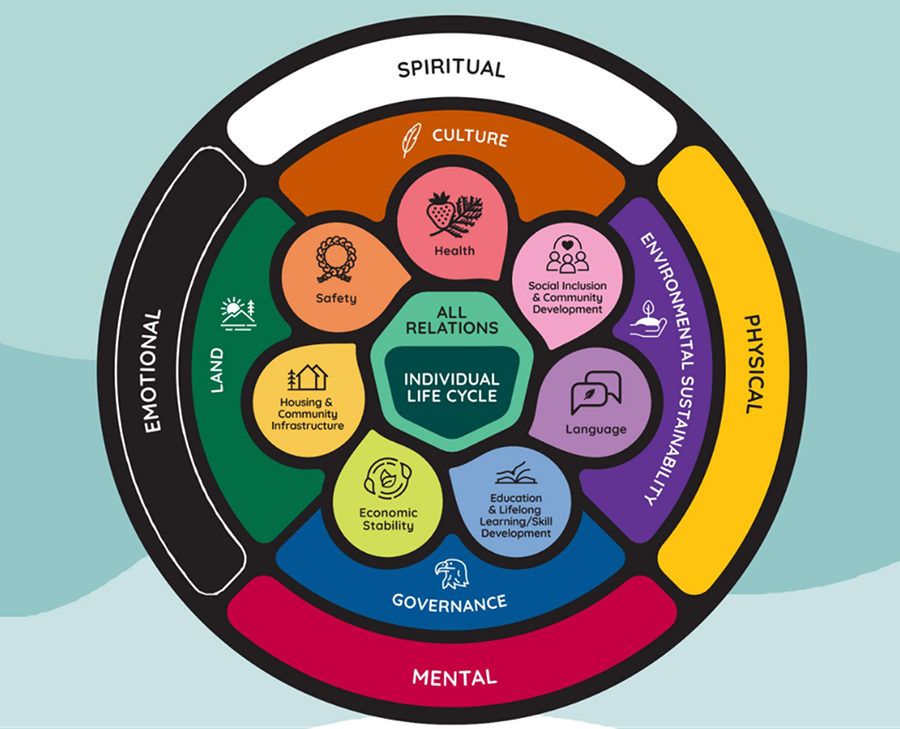
Text alternative for Figure 3: Completion of the Government-led engagement and Final Products
This circular diagram presents a culturally relevant framework developed through consultation with First Nations leaders. It was created to support First Nations-led outcome-based reporting, with a visual that reflects First Nations perspectives.
The visual framework is shaped like a medicine wheel, with individual First Nations people at the center, surrounded and supported by their community.
The visual is composed of multiple concentric layers that reflect the conditions necessary to support First Nations ways of being, understanding, and traditional living—both within communities and among Nations. The overarching themes are:
- Governance
- Environmental Sustainability
- Culture
- Land
These intersect with seven additional domains essential to well-being:
- Health
- Safety
- Housing & Community Infrastructure
- Economic Stability
- Education & Lifelong Learning / Skills Development
- Language
- Social Inclusion & Community Development
Encasing the life domains are four broader categories that support and shape well-being:
- Spiritual
- Physical
- Mental
- Emotional
Together, these elements emphasize a balanced life, integrating the body (physical), mind (mental), heart (emotional), and spirit (spiritual)—where the Seven Sacred Teachings are learned and lived.
Figure 3: First Nations leaders were consulted on creating a culturally relevant visual depiction for an approach that supports First Nations-led outcome-based reporting. They emphasized the importance of designing a visual that reflects First Nations' perspectives. The visual framework is shaped like a medicine wheel, with individual First Nations people at the center, surrounded and supported by their community. Overarching themes of governance, environmental sustainability, culture, and land intersect with seven additional themes. This visual represents the conditions necessary to support First Nations ways of being, understanding, and traditional living within the community and among Nations. It emphasizes a balanced life, integrating the body (physical), mind (mental), heart (emotional), and spirit (spiritual), where the Seven Sacred Teachings are learned. Colonization led to an erosion of identity, wellness, relationships, culture, language, and generational continuity. To restore balance, it is crucial to understand the impacts of colonization and examine how existing mainstream systems affect First Nations, such as access to services, discrimination, education, and family separation. Necessary changes must be identified. Guided by the wisdom, teachings, and knowledge of Elders and Knowledge Holders, this journey aims to restore balance and wellness for future generations.
What is the National Outcome-Based Framework (NOBF)?
First Nations governments require tailored, sustainable supports to build First Nations-led data capacity for effective service delivery and outcome-based reporting to citizens. Implementation will vary by community, requiring flexible, long-term investments.
It is a set of adaptable resources, informed through five years of engagement with First Nations citizens, data experts, leaders, and organizations, designed as an optional tool for First Nations governments to use in their own outcome-based reporting to their citizens – measuring and reporting on their community's well-being and success based on their own priorities and ways of knowing and doing.
Where Have We Been: Engagement with First Nations and Data Experts
For many years there have been consistent calls on the Government of Canada to address and measure the socio-economic gaps, including the need to measure First Nations well-being at the national level.
A 2016 Memorandum of Understanding (PDF) between the Assembly of First Nations and Indigenous and Northern Affairs Canada called for the design of a new fiscal relationship that moves toward sufficient, predictable, and sustained funding for First Nations, strengthens financial management practices including exploring institutional development, and respects mutual accountability.
The Memorandum of Understanding also included a recommendation that ISC jointly produce options for closing socio-economic gaps, including appropriate metrics and performance indicators. In response, Indigenous Services Canada worked with First Nations citizens, data experts, leaders, and organizations such as the Assembly of First Nations from 2019–24, to explore the concept of an approach that supports First Nations-led reporting on socio-economic outcomes.
Key Findings from Engagement Sessions
- Further development of a National Outcome-Based Framework concept would need to be driven by First Nations governments themselves, and therefore this work can be adapted to the needs of First Nations governments as they advance their Indigenous data sovereignty, including informing their own evidence-informed program and service design, based on community-driven information.
- First Nations governments require sufficient and sustainable resources to support robust reporting to citizens. There were mixed opinions about the goal of "mutual accountability," with some liking the idea of working in partnership with the Government of Canada, while others were concerned that First Nations would be held accountable without the capacity to measure and improve citizen outcomes without sufficient and sustainable funding.
- There is no pan-First Nations approach to this work, and any aggregation at a regional or national level would need to be designed and supported by First Nations governments themselves, including whether or not comparison of First Nations information is OCAP® compliant, statistically relevant, or even appropriate.
- First Nations progress should be measured according to their own identified benchmarks of well-being rather than against Canadian standards.
- Many did not like the term "National Outcome-Based Framework" because they felt it was not meaningful to First Nations People and may not capture a strengths-based move towards well-being.
- There is a general agreement that the term "closing the gaps" may be inappropriate and, instead, well-being should be examined.
Why is this work considered completed, if outcome-based reporting at a national level has not yet been achieved?
Indigenous Services Canada funded engagement for five years, listened to the direction received from First Nations, and is therefore pointing to work currently underway to support Indigenous-led data capacity for effective service delivery and outcome-based reporting to citizens.
Where We are Going: What is Needed Moving Forward
First Nations require sufficient, predictable and flexible funding to lead outcome-based reporting, including the ability to plan, define and report on priorities.
This work is being advanced and supported through recent developments in the Indigenous data landscape, including the First Nations-led Transformational Approach to Indigenous Data and the United Nations Declaration on the Rights of Indigenous Peoples Act Action Plan (United Nations Declaration Act Action Plan) Shared Priority 30, which focuses on continuing to support Indigenous Data Sovereignty. These initiatives emphasize the importance of Indigenous Peoples, including First Nations, having sufficient, sustainable data capacity to control, manage, protect, and use their data effectively.
This shift from government prescribed reporting to First Nations-led outcome-based reporting is a step toward a transformed relationship with First Nations communities, supporting them in delivering effective services to their citizens, telling their own stories, participating as equal partners in federal decision-making processes on matters that impact them, and realizing their respective visions for self-determination.
1.3 Addressing Socio-economic Gaps Through Quality Services
Efforts to support First Nations, Inuit, and Métis Women and 2SLGBTQI+ Peoples
The Government of Canada continues to collaborate with partners on initiatives to support First Nations, Inuit, and Métis women, girls and 2SLGBTQI+ Peoples in response to the National Inquiry on Missing and Murdered Indigenous Women and Girls and the Calls for Justice.
The Family Violence Prevention Program funds Indigenous organizations to support operations of emergency shelters and transition homes across Canada, and to provide protection and prevention-based services and programming. This work also responds to the National Inquiry on Missing and Murdered Indigenous Women and Girls and the Calls for Justice 1.8, 7.3, 17.20, and 17.23. Through the Continuum of Care, Indigenous women, children, and 2SLGBTQI+ People escaping violence receive emergency shelter and support to transition into independent living, including developing the necessary skill set to enter the job market and become financially independent. The Program works with its regional offices and Indigenous partners to identify and address service gaps. An assessment of sustainable funding needs is currently underway, in collaboration with Shelter Directors and the National Indigenous Circle Against Family Violence.
In 2024-25, the Family Violence Prevention Program, in partnership with the Canada Mortgage and Housing Corporation, made considerable progress through the Indigenous Shelter and Transitional Housing Initiative, advancing the National Inquiry on Missing and Murdered Indigenous Women and Girls and the Calls for Justice 3.4, 4.7, 16.19, 16.29, 17.20, 18.25. To date, 37 emergency shelters and 32 transitional housing projects have been selected by Indigenous and Inuit led Steering and Selection Committees throughout Canada. Through this initiative, partners gain oversight and agency over shelter and transitional housing services to address needs and expand access to a continuum of supports for First Nations, Inuit, and Métis women, children, and 2SLGBTQI+ People facing gender-based violence, across the country, including on reserve, in the North, and in urban areas.
Prior to the expanded eligibility under this initiative, funding was only available for shelters on First Nation reserves. To better understand Inuit and Métis shelter needs across the country, the Program provided financial support to Pauktuutit Inuit Women of Canada, Les Femmes Michif Otipemisiwak, and the Congress of Aboriginal Peoples to assess their communities needs for shelter spaces. Funding to help support the capacity of all communities in developing applications was made available by Canada Mortgage and Housing Corporation's seed funding, and pre-development funding at Indigenous Services Canada (Family Violence Prevention Program).
In 2024-25, through the Comprehensive Violence Prevention Strategy a total of $65.6 million was provided to Indigenous organizations to support them in designing and delivering community supports and services. With some initiatives, such as Circling Buffalo in Manitoba, Indigenous aggregate organizations direct funding to the areas most needed in their communities. By providing funding to these partner organizations as well as the National Indigenous Circle Against Family Violence, the Family Violence Prevention Program supports Indigenous institutions in enhancing their own capacity so that they can continue to provide services and guide the Program's delivery to communities.
Investments for 2024-25:
- Budget 2024 provided a total of $27 million over two years (starting in 2024-25) for the operation of emergency shelters on reserve, and to renew one year of funding for the Moose Hide Campaign, an Indigenous-led grassroots movement of Indigenous and non-Indigenous people standing up against violence towards women and children.
National Indigenous Circle Against Family Violence
The National Indigenous Circle Against Family Violence (NICAFV) is a key partner and has a critical role in building the capacity of Indigenous-led shelters. Annually, the organization facilitates two General meetings at the national and regional level for Shelter Directors as a means to enhance their collaboration and partnerships.
NICAFV's mission is to champion the safety, well-being, and empowerment of Indigenous communities, individuals and families affected by domestic violence. The organization is dedicated to providing comprehensive services, to help survivors rebuild their lives with dignity and hope. Through innovative inclusive programs, community partnerships, and national public awareness initiatives, NICAFV strives to break the cycle of violence and foster a culture of respect, equality, and non-violence. NICAFV's commitment is to create a safe and just society where every Indigenous person can thrive free from fear and abuse.
The National Indigenous Circle Against Family Violence supports newly constructed shelters in becoming operational through mentorship, developing policies and procedures, networking, training, and resource sharing. It also assists existing shelters in navigating urgent situations. For example, when a legacy shelter was lost due to a fire, the Circle helped provide direct support to the impacted community by liaising with department officials, identifying and communicating their urgent needs, and connecting them with the appropriate funding programs.
The National Indigenous Circle Against Family Violence encourages the advancement of reconciliation and emphasizes the need for all levels of government to commit to the Truth and Reconciliation's recommendations, the National Inquiry on Missing and Murdered Indigenous Women and Girls and the Calls for Justice by addressing the inequities and insufficiencies in women's shelters' funding. As such, the organization plays an important role in advocating and providing recommendations to governments, including the Financial Parity Report (PDF)for 2023.
An Update on Pathways to Safe Indigenous Communities Imitative
Responding to National Inquiry on Missing and Murdered Indigenous Women and Girls and the Calls for Justice 5.4 and 17.15, the Pathways to Safe Indigenous Communities Initiative funds First Nations, Inuit and Métis communities and partners (on and off reserve) to implement First Nations, Inuit, and Métis-designed programs, interventions, and services that improve community safety and well-being. It allows for greater community control, innovation and alternative approaches that recognize the importance of traditional knowledge and practices in contributing to greater community safety and well-being. It also specifically supports programs, services and interventions that address needs relating to the safety and well-being of First Nations, Inuit and Métis women and girls and 2SLGBTQI+ People.
In 2024-25, the Pathways to Safe Indigenous Communities Initiative provided approximately $30.5 million in funding to 53 community-led safety and well-being projects. These projects supported a variety of First Nations, Inuit, and Métis-led programs and activities, including expansion of a safety patrol team to provide mental health interventions, creation of a Family Systems Navigator to support Indigenous women fleeing partner violence, reduction of barriers to the enforcement and prosecution of First Nations by-laws; and development of culturally relevant safety and well-being programming to support Indigenous women, girls and 2SLGBTQI+ People in urban centres.
Social Development and New Approaches to Social Services
Indigenous Services Canada funds the on-reserve Income Assistance program so eligible on-reserve residents and Status First Nations living in Yukon can cover their essential living expenses as well as offering case management and pre-employment supports for individuals transitioning to employment or education.
In recent years, the Government of Canada has announced multiple investments for the on-reserve Income Assistance program, including in Budget 2024, which announced $927.3 million in investments for the Program over five years starting in 2024-25, and $169 million ongoing to provide income support on reserve and expand programming to meet demand.
As part of this investment, Budget 2024 is providing new funding, beginning in 2024-25, for Income Assistance beneficiaries with disabilities, ensuring they are able to not only cover essential living expenses like food, clothing and shelter, but also the many other disability-related costs that often prevent persons with disabilities from full, equal participation in the social and economic life of their communities. The work is also referenced specifically in Action Plan Measure 2.14 of the United Nations Declaration Act Action Plan.
Updates from the Maritime Provinces
- In New Brunswick, the Wolastokqlyik/Mi'kmaq Social Development Support Lodge was funded in 2024 to implement Case Management and Pre-Employment Supports for First Nations on reserve.
- In Nova Scotia, the Mi'kmaq (represented by the Ta'n Etli-tpi'tmk Association) have been negotiating a sectoral self-government agreement with Canada and the Province of Nova Scotia with the intent to exercise Section 35 jurisdiction over the Income Assistance program.
- Additionally, the Ta'n Etli-tpi'tmk Association has been provided funding to implement Case Management and Pre-Employment Supports for First Nations on reserve since 2022-2023.
- In Prince Edward Island, First Nations began implementing their enhanced Income Assistance Program policies in April 2019. They initially received a five-year funding commitment, with funding being extended for one additional year. These policies will be considered for review and renewal in 2025-2026. Additionally, First Nations in Prince Edward Island completed reports in 2024 that reviewed their enhanced Income Assistance program policies to determine if the current policy and additional funding are meeting the needs of the communities and their clients.
Supporting Access to Economic Opportunities
The Strategic Partnerships Initiative (SPI) provides a way for federal partners to coordinate their efforts, reduce administrative burden and pool resources in support of Indigenous communities. This approach fills gaps in other funding programs that might create a barrier to Indigenous involvement in economic opportunities. Initiatives can span multiple years, have regional economic impacts and serve multiple communities.
Important milestones
- The Strategic Partnerships Initiative received critical funding through Budget 2024, including $36 million over three years for clean energy capacity development and $2.5 million to advance Indigenous tourism.
- As a result, the program funded 22 Indigenous-led initiatives in key sectors like mining, clean energy, forestry, and tourism, while expanding its federal network to 23 Departments/Agencies with the inclusion of the Canadian Food Inspection Agency.
- As of December 31, 2024, the Strategic Partnership Initiative's Clean Energy funding supported the British Columbia Indigenous Clean Energy Initiative and developed five regional clean energy Strategic Partnerships Initiatives in Alberta, Saskatchewan, Manitoba, Quebec, and Atlantic regions which have funded a total of 183 Indigenous-led clean energy projects.
- SPI-Clean Energy also entered into a partnership with Indigenous Clean Energy social enterprise to ensure strategic, well-prioritized investments.
In 2024, Indigenous Services Canada, in close collaboration with Innovation, Science and Economic Development Canada (ISED), began work to advance the co-development of a national Indigenous tourism strategy with Indigenous partners, which will chart a vision for the Indigenous tourism industry as a whole, foster a stable and sustainable ecosystem to support Indigenous tourism and define a coordinated whole-of-government approach to support the Indigenous tourism industry in an equitable manner across the country. Funding is required to support the co-development of the strategy, including the engagement process which would be Indigenous-led.
The Indigenous Business Navigator Service, responded to over 300 inquiries, facilitating partnerships and economic opportunities. This service was put in place to assist Indigenous individuals, businesses, organizations and communities in accessing Government of Canada programs and services that could support their business and economic-development needs.
Closing the connectivity gap
Rapid and reliable internet provides opportunities for First Nations to participate fully in the modern digital economy, including building online businesses, engaging in remote work, and developing digital skills. Furthermore, access to high-speed internet supports the effective operation and maintenance of vital community infrastructure, such as water and wastewater systems and enhances the delivery of socio-economic services such as education, healthcare, and emergency and public safety services. It also plays a central role in enabling modern governance and intergovernmental communications.
Innovation, Science and Economic Development Canada (ISED) is the federal lead for broadband and mobile connectivity. Through a suite of initiatives—including the $3.225 billion Universal Broadband Fund, $1 billion in financing through the Canada Infrastructure Bank, $600 million for Telesat's Low Earth Orbit satellite system, and additional legacy programs like Connect to Innovate—the federal government has committed a total of $5.2 billion to support broadband and mobile infrastructure. These investments advance the goals outlined in Canada's Connectivity Strategy and the federal objective of connecting 98% of Canadians by 2026 and 100% by 2030. They also respond to the National Inquiry on Missing and Murdered Indigenous Women and Girls and the Calls for Justice 5.5roman numeral 1.
While Indigenous Services Canada does not have dedicated funding for connectivity, high-speed internet and mobile projects are eligible under the connectivity asset category of the First Nations Infrastructure Fund (FNIF). In 2024-2025, five connectivity projects were funded for a total of $850,000. Of these, four projects were identified in Alberta (with three ongoing and one completed) and one project in Quebec.
Urban Programming for Indigenous Peoples
In 2024-25, Indigenous Services Canada supported First Nations (status and non-status), Inuit and Métis populations by providing $60.5 million to over 200 urban Indigenous service delivery organizations that serve well over one million people per year across Canada. These organizations help address the critical needs faced by Indigenous Peoples in urban centres, including supporting the most vulnerable and at-risk urban Indigenous populations (women, girls, youth, seniors, 2SLGBTQI+ peoples, persons with disabilities and persons with addictions).
Indigenous Services Canada's Urban Programming for Indigenous Peoples Program contributes to the United Nations Declaration on the Rights of Indigenous Peoples Act Action Plan (United Nations Declaration Act Action Plan) Shared Priority 84, which is to "Continue to support Friendship Centres and other urban Indigenous organizations and coalitions in their work to identify and address local needs and priorities of urban/off-reserve Indigenous Peoples in a manner that is safe, secure, accessible and culturally relevant." Friendship Centres produce considerable social value such as improved quality of services, physical and mental wellness, and enhanced assistance programs and delivery. These Centres offer culturally relevant programs and services to help Indigenous Peoples adapt to urban life, access essential resources, and maintain their cultural identities. They act as a bridge between Indigenous communities and mainstream society, facilitating social connections and providing culturally safe spaces.
2.0 Supporting Transfer of Control and Self-determined Service Design and Delivery
2.1 Advancing Data Sovereignty: Update on Transformational Approach to Indigenous Data
Transferring control over the design, delivery, and management of programs and services from Indigenous Services Canada to Indigenous partners involves more than just shifting authority and funding. It also means supporting First Nations, Inuit, and Métis as they develop the data strategies and infrastructure, they deem necessary to manage these programs effectively.
Budget 2021 provided $81.5M over three years to launch the Transformational Approach to Indigenous Data. This multi-phase, multi-stream initiative aims to support the establishment of First Nations, Inuit, and Métis-led statistical organizations or functions, ready the Department for the data transition required to support the transfer of responsibilities and increase the visibility of Indigenous Peoples in national statistics. The Transformational Approach to Indigenous Data advances Indigenous Data Sovereignty, also affirmed in the United Nations Declaration Act Action Plan 2023-2028 (PDF) and the 2023-2026 Data Strategy for the Federal Public Service. Action Plan measure 1.30 of the United Nations Declaration Act Action Plan calls for the government to support "the sufficient, sustainable data capacity they need to control, manage, protect, and use their data".
The Transformational Approach to Indigenous Data initiative recognizes data's essential role in informing policy development, program design, and service delivery. It also emphasizes the importance of measuring the impacts of investments in these programs and offers critical support for the implementation of these federal commitments. It also helps measure, and therefore address, socio-economic gaps by making Indigenous Peoples more visible in national statistics and breaking down data to better understand how different groups like Indigenous Peoples, all genders, youth and the elderly, are affected.
Since the program launch in 2022–23, each of the following streams of work has made significant strides.
Readying Indigenous Services Canda for data transition
Indigenous Services Canada has improved its departmental data governance and data sharing capacities as a critical step for the success of the Department's transfer of responsibilities mandate by releasing its Guide to External Data Sharing, along with associated tools and templates, and providing training on its use. A Departmental Policy on External Data Sharing is also being developed. The Department receives many data requests from Indigenous partners, through various avenues including Access to Information and Privacy (ATIP) requests and via Information Sharing Agreements and is currently administering about 40 Information Sharing Agreements with external partners. These include important data in areas such as Child and Family Services, Jordan's Principle, and Indian Land Registration System.
Strengthening First Nations Data Capacity
The First Nations Information Governance Centre (FNIGC) established one national and 10 regional Data Champion Teams as the foundation for the future network of Regional Information Governance Centres. As envisioned by the First Nations Data Governance Strategy, this network of shared service centers will support the information governance and statistical needs of communities, their governments, and their service delivery and advocacy organizations as directed by them.
These First Nations-led Data Champion Teams are building momentum across leadership tables, communities, and First Nations national and regional mandated organizations. They are working to identify priority data capacity needs for their centers and how governance and oversight mechanisms will be structured. The First Nations Information Governance Centre has formed strong collaborative relationships with both Indigenous Services Canada and Statistics Canada, outlining a series of priority demonstration projects, such as inventorying and accessing key datasets at ISC and Statistics Canada, working towards First Nations-led enumeration, and exploring new data governance frameworks for long-term partnerships. All this will lead to a detailed proposal to support a cohesive implementation of a First Nations-led statistical institution founded in a robust Data Governance Strategy, including consideration for establishing a network of Regional Information Governance Centres.
First Nations-led Health Data Clearing House Table
The First Nations Information Governance Center and Indigenous Services Canada worked together to create a technical and apolitical First Nations-led Health Data Clearing House Table. This initiative explores and demonstrates how First Nations can actively participate in, contribute to, and benefit from the modernization of Pan-Canadian public health information systems. It brings together First Nations health organizations and federal health departments and agencies to address key health data challenges and implement solutions. The Table exemplifies how First Nations and Canada can work together to strengthen data governance, close health information gaps, and achieve long-term positive outcomes through First Nations-led data projects.
The First Nations Information Governance Centre is an independent, apolitical, and technical non-profit organization whose mission is to assert data sovereignty and support the development of information governance and management at the community level through regional and national partnerships. FNIGC became an independent, incorporated non-profit entity on April 22, 2010, but its history can be traced back to 1996, when the Assembly of First Nations formed a National Steering Committee to design a new national First Nations health survey in response to a decision from the Federal Government to exclude First Nations people living on reserve from three major population surveys.
Strengthening Inuit Data Capacity
Inuit Tapiriit Kanatami (ITK) has made significant progress in designing a Data Strategy that will promote Inuit Data Sovereignty by clearly articulating Inuit data rights and principles. To ensure the strategy reflects the regional diversity of Inuit, Inuit Treaty Organizations conducted needs assessments, identifying areas for improvement in data stewardship, digital information management, information technology, and education for data skills. Inuit Tapiriit Kanatami plans to release its data strategy in the Fall of 2025.
Inuit Data Literacy Intake
To strengthen data governance, Inuit Tapiriit Kanatami offered a series of data workshops to enhance staff data literacy on using, understanding, and engaging with data. Additionally, they developed a resource library covering each milestone of the future Inuit Data Strategy.
Strengthening Métis Data Capacity
The Métis National Council (MNC), the Métis Nation of Ontario (MNO) and the Otipemisiwak Métis Government (OMG) are on target to complete their Métis Nation Data Strategy in 2025. The Métis Nations-Saskatchewan (MN-S) and the Métis Nation of British Columbia (MNBC) are developing their own data strategies, reflecting their specific priorities. They have collaborated to conduct baseline assessments aimed at clarifying the present state of data governance, identifying critical gaps, and exploring opportunities for strategic partnerships and projects. This collaborative approach ensured alignment with the needs and priorities of the Métis Nation while supporting the development of cohesive strategies. Their data strategies are also informed by early demonstration projects that begin testing their implementation plans, helping to enhance data preparedness, and provide practical tools for data use.
In addition, the Manitoba Métis Federation (MMF) completed and is in the final stage of approving its Red River Métis Data Management and Governance Strategy. This strategy lays the foundation for a robust data community, aiming to enhance data governance capabilities and improve data management effectiveness. Through surveys assessing data maturity, the Manitoba Métis Federation has identified key areas for growth. The roadmap, with defined targets and outcomes, supports the development of a business case for transforming data analytics. This comprehensive understanding of data needs and capacities is crucial for the Manitoba Métis Federation to achieve data sovereignty, foster collaboration, and provide data-informed services to serve the Red River Métis community better.
Métis Data Dashboard
A key Métis National Council demonstration project is their Data Dashboard. This centralized hub enhances the accessibility and utility of census data for Governing and Participating Members. The Dashboard enables them to store, find, and document data from federal systems in order to inform current and future government program allocations.
Engaging Statistics Canada to Support Indigenous Data Capacity
Statistics Canada co-developed over 40 projects with Indigenous partners and initiated 22 new data collection activities. They also delivered 76 data and statistics-related courses to 1457 participants to date. These new data products and processes have increased the visibility of Indigenous data in the national statistical system and improved the availability of relevant data for First Nations, Inuit, and Métis. For example, the Indigenous Peoples Economic Account, highlighted in section 1.0 of this report, is a suite of economic statistics that aims to measure the economic contribution, in terms of gross domestic income and jobs, of Indigenous Peoples to the Canadian economy.
Working with numerous partners, Statistics Canada developed the Survey Series on First Nations Peoples, Métis and Inuit to fill key data gaps with timely and culturally relevant data. The first two surveys have released data on healthcare access and experiences among Indigenous Peoples as well as the effects of rising prices on their well-being. The upcoming third survey will focus on Emergency Preparedness and Extreme Weather.
Statistics Canada, in collaboration with Indigenous Services Canada, also developed an Index of Remoteness to measure the geographic isolation of communities based on their distance from population centers, through assessing factors such as transportation difficulties. Evidence indicates that remoteness can be a significant barrier to positive socio-economic and health outcomes. Due to this, Indigenous Services Canada and Nishnawbe Aski Nation have explored how this index can inform policy decisions and funding allocations by highlighting the specific needs of remote communities.
2.2 Modernization of the Indigenous Governance and Capacity Program
The Indigenous Governance and Capacity program provides funding to support the core governance and administrative operations of First Nations. In addition, the program provides funding for First Nations and Inuit communities to access support in advancing and developing their governance and institutional capacities.
The program has four streams of funding:
- Band Support Funding, provided to First Nations governments in the form of grants. This offers flexibility for First Nations to distribute funds according to the individual needs and priorities of their local governments;
- Tribal Council Funding, which provides core operational funding to Tribal Councils for the aggregation of program and service delivery in First Nations communities, and the capacity development of their member First Nations;
- Employee Benefits, available to First Nations and Inuit employers to support the recruitment and retention of qualified staff necessary to manage and deliver programs and services available to First Nations and Inuit communities;
- Professional and Institutional Development, which funds projects submitted by First Nations governments, Inuit communities and supporting organizations for the capacity development of governance functions.
Strong governance capacity is crucial for the transfer of control over program and service design and delivery. Sufficient funding is needed to ensure First Nations have the basic professional and institutional capacity in place to exercise jurisdiction and self-determination, and oversee resource, infrastructure, and other development projects in their territories. The modernization of the Indigenous Governance and Capacity program is ongoing. The Governance Modernization Working Group, co-chaired with the Assembly of First Nations, continues to identify challenges and develop potential new models and approaches to supporting First Nations governance.
- Total investments for fiscal year 2024-25: $455.6 million with 11.4% of this dedicated to capacity development.
2.3 New Fiscal Relationship 10-Year Grant
Indigenous Services Canada is continuing to work with First Nations partners on the co-development of a new fiscal relationship, including a 10-year grant that moves toward sufficient, predictable and flexible funding.
The New Fiscal Relationship 10-Year Grant supports self-determination by providing flexible and predictable funding, including escalation to keep up with increased costs due to inflation and population growth. As a flexible funding mechanism, the Grant helps advance self-determination as the terms include provision for community-led design and delivery of services based on community priorities.
In October 2024, Indigenous Services Canada announced the expansion of eligibility in the Grant to First Nations-led service delivery entities such as Tribal Councils and health authorities. This means that First Nations receiving services through these entities will be able to benefit from the specialization and economies of scale their service providers offer as well as the flexibility and predictability offered by the Grant. This expansion helps reduce barriers for small or remote First Nations, which can now access the benefits of the Grant through their chosen service providers.
Important milestones for fiscal year 2024-25:
- 18 additional First Nations joined the Grant, bringing the total number of First Nations receiving funding through the Grant to 160;
- Average Grant escalator rate in 2024-25 was 5.1%, resulting in an additional $40 million being provided to Grant recipients, and a cumulative escalation total of over $100 million annually;
- As of March 2025, 59 First Nations and 40 First Nations-led Service Delivery Organizations have expressed interest in joining the Grant for fiscal year 2025-26;
- With the expansion of the Grant, approximately 80 Tribal Councils, 38 health authorities and 170 other service delivery entities may now be eligible.
3.0 Status of Transfer of Responsibilities Initiatives across the Department
3.1 Child and Family Services – Affirming Jurisdiction
Indigenous Services Canada continues to collaborate with First Nations, Inuit, and Métis governing bodies representing communities that wish to exercise jurisdiction over child and family services.
An Act respecting First Nations, Inuit and Métis children, youth and families (the Act), which came into force on January 1, 2020, provides a framework for First Nation, Inuit and Métis groups, communities and Peoples to exercise jurisdiction in relation to child and family services. On February 9, 2024, the Supreme Court of Canada (SCC) rendered its opinion that the Act is constitutionally valid as an exercise of Parliament's jurisdiction under s. 91(24) of the Constitution Act, 1867, clarifying that providing Indigenous child and family services is the responsibility of both levels of government. The opinion also referenced that affirming the legislative authority of Indigenous groups, communities and Peoples were an important part of implementing aspects of the United Nations Declaration Act. However, the opinion does not impose a fiscal obligation on provinces and territories to contribute. At this time, not all provincial governments are participating in coordination agreement discussions nor allocating funds for Indigenous-led child and family service delivery models. The United Nations Declaration on the Rights of Indigenous Peoples Act Action Plan (United Nations Declaration Act Action Plan) Measures 1.29 and 4.5 commit to the continued implementation of this legislation.
The Act supports the work of Indigenous communities to keep children within their families and communities and contributes to the National Inquiry on Missing and Murdered Indigenous Women and Girls and the Calls for Justice 12.14. As per Census 2021, a staggering 54% of children in foster care across Canada are Indigenous, while nationally less than 8% of all children under the age of 14 are Indigenous. The Act affirms the inherent right of self-government, which includes jurisdiction in relation to child and family services and sets out national principles guiding the provision of child and family services in relation to Indigenous children. The Act provides Indigenous governing bodies the legal authority to enact their own child and family services laws that will apply to their member communities, families and children; these Indigenous laws will supersede provincial laws/jurisdiction.
Currently, there are 18 ongoing coordination agreement discussions with governing bodies seeking to create and implement their own laws for their communities and take control over child and family service delivery to their members. Twenty-seven (79%) of the 34 Indigenous governing bodies that have submitted a request to enter into coordination agreement discussions pursuant to subsection 20(2) of the Act have previously received capacity-building funding from Indigenous Services Canada.
The first coordination agreement under the Act was signed between Cowessess First Nation (Treaty 4 Territory) and the province of Saskatchewan on July 6, 2021. Since then, other agreements have been concluded with the following communities, including the first Inuit agreement:
- Tŝilhqot'in National Government and Council of Tl'etinqox Government;
- Driftpile Cree Nation – bilateral agreement;
- Atikamekw of Opitciwan – bilateral agreement (Loi de la Protection Sociale Atikamekw d'Opitciwan (PDF) (not available in English));
- Tsq̓éscen' First Nation (T'k̓wenm7íple7tens re Kíkwe (PDF));
- Cowichan Tribes (Snuw'uy'ulhtst tu Quw'utsun Mustimuhw u' tu Shhw'a'luqw'a I' Smun'eem [The Laws of the Cowichan People for Families and Children (PDF)]);
- Algonquins of Pikwàkanagàn First Nation (Nigig Nibi Ki-win (PDF));
- Inuvialuit Regional Corporation;
- Gwa'sala-‘Nakwaxda'xw Nations;
- Sts'ailes (Snowoyelh te Emi:melh te Sts'ailes (PDF));
- Founding First Nations (Loon River First Nation, Lubicon Lake Band and Peerless Trout First Nation) (Awas'ak Wiyasiwewin (PDF));
- Splatsin (Spallumcheen Indian Band Care of our Children By-law);
- Kitchenuhmaykoosib Inninuwug First Nation (Kitchenuhmaykoosib Inninuwug Dibenjikewin Onaakonikewin);
- Inuvialuit Regional Corporation, (Child Wellbeing), Alberta and Yukon;
- Peguis First Nation (Honouring Our Children, Families and Nation Act (PDF));
- Louis Bull Tribe – bilateral agreement (AMO Law - Asikiw Mostos O'pikinawasiwin Society);
- Wabaseemoong Independent First Nations (Wabaseemoong Independent Nations Customary Care Code (PDF)).
There are 16 Indigenous child and family service laws that have been brought into force under the framework of the Act. As of March 31, 2025, 54,271 Indigenous people – including 6,054 children with about 900 in care or in out-of-home placements (based on varying Indigenous and provincial definitions) – are now receiving community-driven, culturally appropriate social and well-being services aimed at supporting families and limiting interactions with non-Indigenous agencies.
Investments for fiscal year 2024-25:
- As of March 31, 2025, Canada is investing $2.4 billion in grants over 11 years to advance community-led Indigenous laws to support long-term system transformation.
- Since the Act came into force, 259 First Nations, Inuit and Métis recipients have received more than $283.2 million in funding for 446 Indigenous communities, to help them prepare to take control over child and family services. As of March 2025, nearly $50 million in funding has been allocated to support participation in coordination agreement discussions.
- A total of eight agreements (six trilateral and two bilateral) were signed in 2024-25 with nine Indigenous governing bodies: Tŝilhqot'in National Government and Council of Tl'etinqox Government (March 22, 2025); Algonquins of Pikwàkanagàn First Nation (March 14, 2025); Atikamekw of Opitciwan (March 11, 2025); Driftpile Cree Nation (February 27, 2025); Inuvialuit Regional Corporation (September 30, 2024); Gwa'sala-‘Nakwaxda'xw Nations (September 12, 2024); and Sts'ailes (September 06, 2024).
- Indigenous Services Canada began pre-engagement for its first mandatory five-year review of An Act respecting First Nations, Inuit and Métis children, youth and families. The review provides an opportunity for the Department to engage, consult and gather meaningful feedback from First Nations, Inuit and Métis partners, communities and individuals on provisions contained in the legislation and the operation of the Act. The Department has continued to engage with Indigenous rights-holders, partners and others to establish long-term distinctions-based funding approaches to promote greater predictability for First Nations, Inuit and Métis to plan their program and service delivery needs.
- As part of the Government of Canada's Progress on 6 points of action to address the over-representation of Indigenous children and youth in care, in late 2024, the Inuit Data Strategy Working Group – co-established by Inuit Tapiriit Kanatami and ISC and featuring the participation of eight Provinces and all three Territories – co-developed a Data Discussion Paper: Inuit-specific child welfare data (PDF) that was approved by the Inuit Crown Partnership Committee.
- This initiative included the first inventory scan of data involving Inuit children which evaluated the types of child and family services data collected by provinces, territories and Inuit Treaty Organizations, along with the degree to which Inuit identity is distinguishable.
- As one of the next steps, Working Group members are populating a tracking document with timelines for the inclusion of distinct identity-based data fields within their child and family services data and information systems.
Cowichan Tribes: Reclaiming Snuw’uy’ulhtst tu Quw’utsun Mustimuhw u’ tu Shhw’a’luqwa’a’ i’ Smun’eem (The Laws of the Cowichan People for Families and Children)
On June 24, 2024, Cowichan Tribes signed an agreement with British Columbia and Canada to reclaim jurisdiction over child and family services. This coordination agreement will support the implementation of Snuw'uy'ulhtst tu Quw'utsun Mustimuhw u' tu Shhw'a'luqw'a I' Smun'eem (The Laws of the Cowichan People for Families and Children) (PDF) for Cowichan citizens across Vancouver Island and the Gulf Islands, with the potential for future expansion across British Columbia and Canada. The Law's implementation includes the full transfer of all child and family services, operations and programs to Cowichan Tribes' responsibility and control.
"Our Quw'utsun smun'eem (children) deserve to thrive within their families and our culture. I am heartened to sign this historic coordination agreement on behalf of Quw'utsun Mustimuhw. I am thinking today of the generations of our children who experienced the trauma of being removed from their families and our community. The implementation of our Child Law recognizes our inherent right to govern our children in accordance with our snuw'uy'ulh (teachings) and ensure a better future for our people."
The Law is grounded in traditional guiding principles whose goal is to secure the physical, emotional and psychological safety, security and well-being of a Smun'eem. It also mandates prevention and provisions for people in need, which means that Cowichan-centric services will be offered to families facing challenges. This holistic approach focuses on enabling family wellness, safeguarding children's best interests, and ensuring generational teachings and values are passed on to future generations.
With over 5,500 members, Cowichan Tribes are the largest single First Nation Band in British Columbia by population. They are known as the Hul'q'umi'num people which means people who speak the Hul'q'umi'num language, and are a part of a larger first nations group referred to as the Coast Salish People.
3.2 Reform of the Child and Family Services Program and Continued Implementation of Jordan’s Principle
The Government of Canada continues to collaborate with First Nations partners to eliminate systemic discrimination and address past harms related to child and family services. In January 2016, the Canadian Human Rights Tribunal ordered Canada to cease its discriminatory practices and reform the First Nations Child and Family Services Program (FNCFS). This order, along with others, stemmed from a human rights complaint filed by the First Nations Child and Family Caring Society of Canada and the Assembly of First Nations (AFN) in 2007. The Chiefs of Ontario (COO) and the Nishnawbe Aski Nation (NAN) later joined the complaint.
A final agreement on the reform of the FNCFS Program was reached in July 2024 between Canada, AFN, COO, and NAN. That agreement provided for a fully reformed FNCFS Program with a funding methodology developed through a First Nations-led and evidence-based approach. That agreement would have resulted in $47.8 billion in stable and predictable funding over ten years, aimed at reducing the number of First Nations children in care and keeping children connected to their families, communities, and cultures. It would have afforded a bigger role for First Nations in the delivery and oversight of child and family services in their communities.
In October 2024, the Final Agreement on Long-Term Reform was ultimately rejected by a vote of the Assembly of First Nations Chiefs-in-Assembly, which also adopted two resolutions calling for the establishment of a National Children's Chiefs Commission to renegotiate the agreement. Canada remains committed to reforming the FNCFS Program to eliminate discrimination, including through the incremental reforms to the FNCFS program that have been made to date.
The agreement between Chiefs of Ontario, Nishnawbe Aski Nation and Canada provides secure, predictable and flexible funding to support First Nations child and family services in Ontario. This Agreement addresses the specific needs of Ontario First Nations, as well as taking into account the increased costs of services in remote communities.
The Agreement includes funding for capital, post-majority support services, First Nation representative services, and prevention, all of which support the objective of keeping First Nations children and youth in the care of their loved ones.
Finally, the agreement allocates $258 million for First Nations to purchase, build, and renovate housing to prevent First Nations children from being taken into care and to support reunification efforts between children and their families.
On December 31, 2021, Canada established a fund of $2 billion distributed over a 5-year period for First Nations to purchase, construct and/or renovate housing units in their First Nations communities in relation to the needs of First Nations under Jordan's Principle and child and family services. On March 31, 2025, Canada had disbursed $622.5 million nationally.
On February 26, 2025, the Chiefs of Ontario, Nishnawbe Aski Nation and Canada signed a nine-year, $8.5 billion landmark agreement to reform the First Nations Child and Family Services Program in Ontario. The Ontario-specific agreement represents the share of the $47.8 billion Ontario First Nations and service providers would have received under the national agreement. The program aims to ensure the continued well-being of families and communities while preserving cultural and community connections for First Nations children in Ontario. This agreement shows how collaboration with First Nations partners can bring positive impacts to the lives of children and families. At the time of this report, the Agreement remains subject to approval by the Canadian Human Rights Tribunal.
A key element of program reform has been affirming the jurisdiction of First Nations in Child and Family Services. At the time of the 2007 CHRT complaint, First Nations were not recipients of the FNCFS program, which focused on child protection services delivered by provincial and territorially delegated agencies, or directly by provinces and territories. The reform of the program has moved to a focus on prevention and addressing the structural drivers that lead to children coming into care, which has involved increasing First Nations control in this area. Efforts made in this area contribute to the National Inquiry on Missing and Murdered Indigenous Women and Girls and the Calls for Justice 1.2roman numeral 5, 1.3, 2.2roman numeral 2, 2.3, 12.1, 12.3, 12.4, 12.5, 12.6, 12.7, 12.8, 12.10, 12.11, 12.13 and 12.14, among other related distinctions based Calls for Justice. Since 2022 the program has allocated funding on a per capita formula basis for First Nations and First Nations Child and Family Services Agencies to develop, plan, and deliver community-based services based on First Nations' needs, circumstances, and priorities. The implementation of FNCFS post-majority support services in 2022 enabled funding to flow directly to First Nations and FNCFS service providers to support First Nations youth aging out of care and young adults formerly in care in their transition to adulthood, up to the 26th birthday. The national expansion of FNCFS program funding for First Nations Representative Services in 2022, also supports all First Nations to take part in cases where their children and families are involved, or at risk of becoming involved, in the child and family services system. Additionally, through the governance provisions in the Ontario Final Agreement, Ontario First Nations will control how child and family services are delivered on reserve in Ontario.
Jordan’s Principle
Named after Jordan River Anderson from Norway House Cree Nation in Manitoba, Jordan's Principle is a human rights principle and legal obligation under the Canadian Human Rights Tribunal that ensures that First Nations children do not experience gaps or delays in accessing government-funded health, social or educational services and supports, and that they are not denied government services because they identify as First Nations.
To date, nearly $10 billion in Jordan's Principle funding has been secured, and more than 9.4 million health, social and educational products, services, and supports have been approved since 2016.However, requests through Jordan's Principle have grown at an extremely fast pace, most notably in the last few years. Between April 1, 2024 and March 31, 2025, alone, 2,839,149 products, services, and supports were approved for First Nations children. Of the total number of products, services, and supports approved, 153,864 products, services, and supports were through individual requests and 2,685,285 were through group requests.
In light of the increased volume, in February 2025 the Government of Canada announced changes to operating procedures to make sure requests align with the long-term sustainability of Jordan's Principle. These changes provide further clarity and consistency around the services available for First Nations children through Jordan's Principle, as well as the required documentation that is needed in the processing of requests.
Indigenous Services Canada remains committed to ongoing dialogue with First Nations partners to advance the implementation of Jordan's Principle.
Assembly of Manitoba Chiefs (AMC) and Canada sign a Memorandum of Understanding (MOU)
In June 2024, the Grand Chief of the Assembly of Manitoba Chiefs (AMC) signed a formal Memorandum of Understanding (MOU) with Canada to enhance the implementation of Jordan's Principle for First Nations children, youth and families in Manitoba. This agreement signifies a joint commitment to addressing systemic issues in service delivery, promoting a more equitable approach and supporting the rights and well-being of AMC-member First Nations across the region.
"The MOU represents a historic step forward in our ongoing efforts to ensure that First Nations children receive the services and support they deserve. It acknowledges the legacy of Jordan River Anderson and the importance of upholding human rights decisions that emphasize non-discrimination in service provision."
Early stages of work are underway to implement the provisions of the MOU, including formalizing collaboration mechanisms.
The Assembly of Manitoba Chiefs was formed in 1988 by the Chiefs in Manitoba to advocate for issues commonly affecting First Nations in Manitoba. AMC represents all 63 First Nations in Manitoba, with more than 172,000 First Nations citizens in the province, accounting for approximately 12 per cent of the provincial population. AMC represents a diversity of Anishinaabe (Ojibway), Nehetho (Cree), Oji-Cree, Dene and Dakota people and traditions.
Inuit Child First Initiative
Modeled after Jordan's Principle, the Inuit Child First Initiative ensures Inuit children in Canada have equal access to essential government funded health, social and educational products, services and supports they need, regardless of where they live in Canada.
The Inuit Child First Initiative was approved in Cabinet in 2018 as an interim measure with a mandate to co-develop a long-term Inuit-specific approach with Inuit partners. Since then, Inuit Tapiriit Kanatami, Inuit Treaty Organizations and Canada have been working to co-develop a National Framework and regional approaches that would set common parameters and ultimately govern the implementation of a new Inuit-specific long-term approach.
From April 1, 2019, to January 31, 2025, 34,907 requests were approved for Inuit children for 273,647 products, services, and supports through the Inuit Child First Initiative.
Through Budget 2024, $167.5 million was secured over two years, starting in 2023-24, with $121.7 allotted for 2024-25. In March 2025, an additional $121.7 million of funding was committed to extend the Inuit Child First Initiative until March 31, 2026.Important milestones accomplished through the Inuit Child First Initiative:
- In January 2023, a Co-development Steering Committee was established, comprising of representatives from Indigenous Services Canada, Inuit Tapiriit Kanatami and the four Inuit Treaty Organizations;
- As part of the co-development process, in the fall of 2023 the Inuit Tapiriit Kanatami and the four Inuit Treaty Organizations brought forward a Shared Responsibility Model and Guiding Principles that laid out their vision for the long-term approach to Inuit Child First Initiative;
- In July 2024, Canada endorsed the principle of a shared responsibility model and committed to co-develop with Inuit partners a National Framework that would include flexible regional delivery approaches and guide the progressive transfer of administration and delivery of the initiative to Inuit Treaty Organizations;
- In January 2025, a two-day Co-development Steering Committee meeting took place to review the draft of the National Framework, and discuss next steps.
- In March 2025, funding was committed to extend the Inuit Child First Initiative for one year until March 31, 2026.
The transfer of the Inuit Child First Initiative will increase Inuit control over time, in alignment with the Inuit Nunangat Policy. It will also respect the Government's Modern Treaties and Self-Government Agreement obligations and align with the department's mandate to support self-determination and transfer of control over services. Under this new model, Inuit Treaty Organizations will assume administrative control for the delivery of supports, ensuring that Inuit children are best served.
Implementing the Inuit Nunangat Policy
In 2024-25, Indigenous Services Canada worked closely with the Inuit Nunangat Policy Secretariat to advance efforts to enhance implementation of the policy in the Department. The policy aims to promote prosperity and support community and individual wellbeing throughout Inuit Nunangat, which benefits all Canadians. The Secretariat responsible for overseeing the whole-of-government implementation of the Policy is at Crown-Indigenous Relations and Northern Affairs Canada.
The Inuit Nunangat Policy has provided opportunities to strengthen and transform the department's policies and programs in the application of a distinctions-based approach to its policy and program development and budget allocations. Integral to this work has been the collaboration between the federal government and Inuit partners that supports Inuit self-determination. This progress includes the co-development of a coordination agreement for Inuit-led child and family services with Inuvialuit Regional Corporation and continued support of the National Inuit Suicide Prevention Strategy.
There are Inuit-focused teams across Indigenous Services Canada that work in alignment with the Inuit Nunangat Policy. Some teams' existing distinction-based approaches and close collaboration with Inuit partners pre-date the policy. The fact that these historical approaches match the vision and intent of the Inuit Nunangat Policy reinforces its potential for impact. In 2024-25, these teams participated in working groups or engaged with Inuit partners on various initiatives to advance the priorities of the Inuit-Crown Partnership Committee. There remain other teams at the Department that have the potential to further incorporate the Inuit Nunangat Policy within their work in the upcoming years.
The Department also participated in an implementation scan over the summer of 2024, which helped informed the Cabinet Directive on the Implementation of the Inuit Nunangat Policy, announced in February 2025.
The Cabinet Directive outlines an accountability framework, identifies roles and responsibilities, and establishes a reporting and evaluation mechanism across all federal departments and agencies, and includes a commitment for Crown-Indigenous Relations and Northern Affairs Canada to co-develop with Inuit partners, a supporting guidance document that will further specify how to implement the Inuit Nunangat Policy across Departments. For Indigenous Services Canada, this Directive increased expectations of compliance and accountability through the development of an implementation plan that includes progress tracking.
To further demonstrate the Department's efforts to increase uptake of the policy, Indigenous Services Canada undertook efforts to assess the progress of its implementation, including identifying successfully aligned programs and initiatives as well as challenges encountered.
3.3 Education – Advancing Regional Education Agreements
Indigenous Services Canada and First Nations partners continue to collaborate on increasing First Nations control over First Nation education and self-determined education approaches as mandated in the United Nations Declaration on the Rights of Indigenous Peoples Act Action Plan (United Nations Declaration Act Action Plan) Measure 2.19. This is partly accomplished through the signing of regional education agreements, which facilitate greater control through First Nation's designed education delivery systems and provide a pathway that can contribute to the future transfer of control with the establishment of education governance systems in place.
As of March 2025, the Government of Canada has signed eleven regional education agreements, nine of which remain active and collectively support approximately 25,000 students across five provinces. The most recent agreement was signed with Little Red River Education Authority in 2025.
Alberta
- Kee Tas Kee Now Tribal Education Authority, 2019-2029
- Sunchild First Nation, 2019-2024
Atlantic
- Elsipogtog First Nation Education Authority, 2025-2030
British Columbia
- British Columbia Tripartite Education Agreement, 2018-2025
Saskatchewan
- Athabasca Denesuline Education Authority, 2019-2029
- Peter Ballantyne Cree Nation Education Authority, 2020-2025
- Treaty Education Alliance, 2021-ongoing
- East Central First Nations Education Authority, 2023-2028
- Whitecap Dakota Tripartite, 2019-2024
- Little Red River Education Authority, 2025-2030
Quebec
- First Nation Education Council, 2022-2027
As of April 1, 2024, close to 50 First Nation organizations from across Canada accessed regional education agreement development funding to either participate at a regional technical table or to engage in regional education agreement development discussions. Active discussions are ongoing with more than 15 organizations, some of which have reached table agreement.
Regional education agreements not only support First Nations control over First Nations education; they also respond to the education goals and priorities set by participating First Nations communities.
First Nations control over First Nations education: British Columbia’s First Nations Education Steering Committee
In 2018, the British Columbia Tripartite Education Agreement: Supporting First Nation Student Success was signed between the First Nations Education Steering Committee, Canada, and British Columbia. This Agreement formally recognizes the capacity of First Nations and First Nation schools to build and implement a relevant First Nations education system. It covers on-reserve First Nation students in British Columbia, including students attending provincial schools, and commits to ongoing collaboration to benefit all First Nations students in British Columbia, regardless of where they attend school.
Since the implementation of this agreement, there have been several achievements and positive outcomes that demonstrate the value of First Nations control of First Nations education.
- Data collection and management: As part of this Agreement, data is published annually to monitor the achievements of First Nation students in the province. This data offers community-specific data about students' progress, which informs discussions between First Nations and School Boards about mechanisms to support First Nations learners.
- Cultural competency and learning to encourage systemic changes: The Agreement establishes an Indigenous-focused graduation requirement for all students in British Columbia, which fosters widespread education about First Nations' rights, histories and traditions. It also mandates provincial school districts to provide an Indigenous-focused professional learning day to all teachers in public schools to prioritize Indigenous student achievement and further integrate Indigenous worldviews and perspectives into public education learning environments.
- Increased First Nations language and cultural education: The Agreement acknowledges the importance of investing in the revitalization, preservation, and maintenance of First Nations languages, thus providing funding for First Nations designed and delivered language and culture programs.
- Co-developed education policies: The Agreement commits parties to work together to co-develop regional education policies and guidelines. In 2023, as a result of this commitment, British Columbia announced new co-developed amendments to the BC School Act to improve outcomes for Indigenous students. Developed collaboratively with the First Nations Education Steering Committee, the legislation requires all school boards to establish an Indigenous education council to ensure Indigenous people have input into decisions; ensures that First Nations have the option to apply a model local education agreement with a board of education should a First Nation request it; and, implements a school-of-choice provision enabling First Nations to decide which school First Nations students who live on reserve will attend.
The First Nations Education Steering Committee (FNESC) is a policy and advocacy organization that represents and works on behalf of First Nations in BC. FNESC has a mandate to support First Nations in their efforts to improve the success of all First Nations students and advance First Nations education in BC by disseminating information, undertaking research, administering programs and services, and advocating and negotiating with the provincial and federal governments and other key stakeholders at the direction of First Nations.
Co-development on Education Priorities for Inuit and Métis Nation
Indigenous Services Canada continues to participate in the Inuit-Crown Partnership Committee (ICPC) and Canada - Métis Nation Permanent Bilateral Mechanisms with Inuit and Métis Nation partners to identify joint priorities, explore policy options and monitor progress.
Through these Permanent Bilateral Mechanisms and as mandated under the United Nations Declaration Act's education-specific commitments (Action Plan Measures #13 and #21), the Department is engaging with Inuit and Métis Nation partners to co-develop distinctions-based, federal policies on elementary and secondary education. Both policies seek to supplement and enhance Inuit and Métis Nation-specific programming offered to elementary and secondary students.
3.4 Health – Co-developing Distinctions-based Health Legislation and Progress toward Health Transformation
Health Transformation
Health Transformation is a collaborative initiative between the Government of Canada, First Nations and provincial governments whose goal is to transfer control over federal programs and services to First Nations-led organizations that have secured a mandate from their leadership to deliver health services on their behalf. This means that First Nations-led organizations take control over the design, delivery, and management of health programs and services for their communities.
Based on a renewed relationship with First Nations, the Health Transformation initiative means that Canada vacates the space of control to become a governance partner and funder. This shift is grounded on relationship building, mutual accountability and respect for First Nations' inherent rights to self-determination, including their rights to determine and respond to the needs and priorities of their communities.
The Health Transformation initiative is modeled on the successful transfer of control over health services to the British Columbia First Nations Health Authority in 2013, which since then has demonstrated the value of a health care system designed by First Nations, for First Nations. As shown in the Evaluation of the First Nations Health Authority: Case Study Technical Report (PDF), the transfer of control to the Authority has led to a system-wide and holistic transformation of the health care system that means not just providing services to communities, but also addressing the root causes of health disparities. Since its establishment, the First Nations Health Authority has become a valuable partner and collaborated with provincial and federal governments in promoting cultural safety and a broader paradigm shift.
There are currently six active Health Transformation projects underway:
- Battleford Agency Tribal Council in Saskatchewan;
- Keewatinohk Inniniw Minoayawin Inc. in Northern Manitoba;
- Southern Chiefs' Organization in Southern Manitoba;
- Nishnawbe Aski Nation in Ontario;
- First Nations of Quebec and Labrador Health and Social Services Commission in Quebec; and
- Tajikeimɨk in Nova Scotia.
Important milestones for 2024-25:
- In June 2024, the Southern Chiefs' Organization and Canada signed a Health Transformation Agreement-in-Principle.
- The Health Transformation Symposium was held in September 2024, bringing together First Nations and provincial Health Transformation partners to discuss best practices, lessons learned and possible paths moving forward. The event provided a platform for over 200 participants, including First Nations leaders, health officials, and advocates, to focus on promoting First Nation control over healthcare, fostering partnerships, and supporting the development of community-driven health systems.
- Funding for Health Transformation was renewed, with Budget 2024 allocating $104.9 million over 5 years to support the initiative. Funds will be used to support partners to build capacity towards creation of a First Nation-governed health services delivery model, one that will eventually take control of health services currently provided by Indigenous Services Canada.
- In March 2025, Keewatinohk Inniniw Minaoyawin Inc. in Manitoba and Canada signed a Health Transformation Agreement-in-Principle.
- Consensus was reached amongst the First Nations of Quebec and the Labrador Health and Social Services Commission on a new health and wellness governance model for First Nations in Quebec at the Special Chiefs Assembly of the Assembly of First Nations Quebec-Labrador (AFNQL), First Nations Chiefs on March 26, 2025, setting the stage for an Agreement-in-Principle and a future framework agreement.
Agreement-in-Principle between the Southern Chiefs’ Organization (SCO) and Canada
"The signing of the Agreement-in-Principle is an important step we are taking with our Treaty partners to decolonize health care. SCO is pleased to be the second entity in Canada to enter into an Agreement-in-Principle with Canada. There is an 11-year gap in life expectancy for First Nation citizens when compared with all others in Manitoba. It is critical that we provide safe, culturally supportive, and holistic care to our citizens to address this health inequity. The Southern First Nations Health Authority will have a governance structure that ensures our citizens and Nations lead decision making and can guide the development of programs and services that are a priority for them."
The Agreement-in-Principle on Health Governance document outlines how health programs and services will be transferred from Indigenous Services Canada to the soon-to-be-established Southern First Nations Health Authority that will serve the 32 Anishinaabe and Dakota Nations in Manitoba.
As such, this document sets the stage for establishing the largest transformational health process in Manitoba and involves the transfer of federal First Nation health and capital program services to the Southern First Nation Health Authority. It also paves the way for a Tripartite Framework Agreement with Canada and Manitoba that will transfer mechanisms for funding to the Southern First Nation Health Authority. This will include developing health programs and services that address the unique needs and priorities of each SCO member Nation. Programs and services will incorporate traditional Anishinaabe and Dakota teachings, medicines, and knowledge to support the holistic health of southern First Nation citizens.
SCO's Health Transformation vision is outlined in in their report Decolonization: Recognizing First Nations Sovereignty 2024 (PDF).
The Southern Chiefs' Organization represents Anishinaabe and Dakota Nations and more than 87,000 citizens in what is now called southern Manitoba. SCO is an independent political organization that protects, preserves, promotes, and enhances First Nations peoples' inherent rights, languages, customs, and traditions through the application and implementation of the spirit and intent of the Treaty-making process.
Agreement-in-Principle between Keewatinohk Inniniw Minoayawin Inc. (KIM) and Canada
"The fear about our future is lifting, not because we have all the answers, but because of the faith and determination of First Nations people. This is not just about health-care systems; it's about sovereignty, self-determination, and ensuring that future generations have the care they deserve. First Nations are leading the way, as they should. KIM Inc. exists because of their leadership. Their faith in KIM is humbling and our efforts will continue to support their individual and collective vision."
This is the second Health Transformation Agreement-in-Principle (AIP) to be signed in the past year in Manitoba, meaning that 155,000 First Nations people in Manitoba would be supported through these new, self-determined and innovative health models.
This Agreement laid the foundation for KIM, a northern First Nations led-health organization, to design and build a stronger, culturally informed health system that will meet the needs of 23 First Nation communities in northern Manitoba. With the Province of Manitoba's commitment to support the Tripartite Framework Agreement process, work will be underway to ensure that the control of services is transferred to KIM. This document also outlines the vision, the governance structure that KIM has put in place, and a commitment by the Parties to work towards the full transfer of First Nation health programming and resources, and to establish critical partnerships, system integration, and services that support the 23 Northern First Nations in Manitoba.
Keewatinohk Inniniw Minoayawin Inc. became an incorporated entity in 2020 by the Manitoba Keewatinowi Okimanak Inc. (MKO) Chiefs Task Force on Health. They were tasked by the MKO Chiefs in Assembly to establish a northern First Nations-led aggregate health transformation entity in August of 2018. KIM supports health and wellness services for 23 First Nation communities in northern Manitoba with a focus on equitable care, addressing racism in the health care system, responsiveness to emerging needs, and filling gaps in the health care system. This is accomplished through advocacy, collaboration, and integration with the First Nation communities, and federal/provincial partners.
Indigenous Health Equity Fund
Starting in 2024-25, the Government of Canada is providing $2 billion over ten years (approximative funding of $200 million annually) through the Indigenous Health Equity Fund to First Nations, Inuit, and Métis communities. Indigenous Services Canada in partnership with First Nations, Inuit, and Métis partners during the last fiscal year worked to roll-out this Fund that aims to support Indigenous-led approaches to increasing access to culturally safe health services, responding to the National Inquiry on Missing and Murdered Indigenous Women and Girls and the Call for Justice 7.1. This funding has two components:
- Distinctions-Based Funding: $190 million per year directed to First Nations, Inuit and Métis communities, providing a long-term, predictable base of funding support for their health priorities.
- Targeted Initiatives: $10 million per year directed to select Indigenous organizations in support of short-term, innovative, activity-driven projects on cross-cutting Indigenous health priorities.
While it is still early in the implementation of the Indigenous Health Equity Fund, many First Nations, Inuit and Métis communities have already indicated support for the program's flexibility and long-term, predictable base of funding.
In 2024-25, through Targeted Initiatives, Indigenous Services Canada supported more than 31 innovative, Indigenous-led health projects within a wide range of Indigenous organizations.
Distinctions-based Health Legislation
Indigenous Services Canada and partners continue to work on the co-development of distinctions based First Nations, Inuit and Métis health legislation.
In October 2024 as a response to significant feedback from Indigenous partners, Indigenous Services Canada received the authority to work on separate approaches with First Nations, Inuit, and Métis partners to co-develop policy and/or legislative options and adjust the co-development process to improve transparency and collaboration. This decision was communicated to National Indigenous Organizations (NIOs) and, since then, several meetings have been held to discuss and strategize on next steps.
Ongoing settler-colonialism, policy barriers, and lack of coordinated approaches to address the health needs of First Nations, Inuit, and Métis among all levels of government, including Indigenous governments, remain an ongoing challenge. These challenges continue to create health inequities and impact First Nations, Inuit and Métis people's ability to access culturally safe and sensitive health services free of racism and discrimination. In this context, advancing work to co-develop separate First Nations, Inuit, and Métis health policy and/or legislative options is an opportunity to:
- Jointly establish overarching principles as foundation of federal health services for First Nations, Inuit and Métis;
- Collaborate with First Nations, Inuit and Métis partners to increase Indigenous-led health service delivery;
- Continue to advance the Government of Canada's commitment to reconciliation and a renewed nation-to-nation, Inuit-Crown and government-to-government relationship based on the respect of inherent rights, co-operation, and transparent partnership.
Addressing Anti-Indigenous Racism
The Addressing Anti-Indigenous Racism initiative provides funding to Indigenous partners to design and implement Indigenous-led initiatives that work to address racism experienced by Indigenous patients within Canada's health systems, and to implement Joyce's Principle.
More specifically, the initiative supports efforts to increase Indigenous representation within the healthcare system, as well as the hiring and retention of Indigenous patient advocates, health system navigators, midwives, and birth support workers in positions across the healthcare spectrum to provide immediate support to Indigenous patients. The initiative also allocates capacity funding to National Indigenous Health Organizations such as the National Collaborating Center for Indigenous Health and the Indigenous Physicians Association of Canada, to support systems level change and efforts to address anti-Indigenous racism at the national level.
Since its inception in 2021, the Addressing Anti-Indigenous Racism in Canada's Health Systems initiative successfully funded over 100 partners to implement over 150 projects across all provinces and territories, across distinction-based groups and in urban settings with a focus on services for Indigenous women, 2SLGBTQI+ people, people with disabilities and other groups who may experience intersecting discrimination. A few examples of projects funded include:
- Funding of $2 million was provided to the Atikamekw Nation and the Atikamekw of Manawan to help create the Joyce's Principle Office, and to advocate for the implementation of Joyce's Principle across the country.
- Indigenous Patient Advocates supported approximately 100 patients in accessing provincial and territorial complaints resolution processes;
- Two new community-based midwifery education programs have been established for the Innu in Labrador and the Cree of James Bay;
- Approximately 100 First Nations community members have received doula or birth support worker training in the last three years. In addition, the First Nations University of Canada has developed an Indigenous Birth Support Worker Certificate-level Program that students can take on-site or remotely. The First Nations University of Canada is currently expanding training through the Wasakama Project that will offer Certificate-level and Micro-credential options related to Indigenous Birth Supports, Sexually Transmitted and Blood-borne Infections, and Grief and Loss.
- The first of its kind federally funded standalone birthing centre in Sturgeon Lake First Nation in Saskatchewan is in the late stages of construction and is scheduled to open in September 2025;
- The establishment of Indigenous-led health organizations, such as the Indigenous Pharmacy Professionals of Canada.
Building on the success from Budget 2021 investments, Budget 2024 invested $167.6 million over five years, starting in 2024-25, to continue combating anti-Indigenous racism in Canada's health systems and advancing the National Inquiry on Missing and Murdered Indigenous Women and Girls and the Calls for Justice 1.8 and 7.6. The renewed funding continues to support Indigenous patient advocates, health system navigators, midwives and birth support workers, as well as efforts to increase Indigenous representation in health professions.
A few examples of initial results funded through Budget 2024 include:
- The advocacy efforts of the Joyce's Principle Office continue to be supported.
- The Federation of Sovereign Indigenous Nations (FSIN) continues to support Indigenous patients through the First Nations Health Ombudsperson's Office, the first Indigenous-led office in Canada to help address healthcare complaints and systemic racism in healthcare, and a model for similar offices that could be established in other regions;
- The Atlantic Policy Congress of First Nations is developing jurisdictional roadmaps and trilateral committees to further support coordination between health professionals working on addressing anti-Indigenous racism in health systems;
- The National Association of Friendship Centres continues to support Indigenous health system navigators in Friendship Centres across Canada in urban settings;
- Métis Nation of British Columbia (MNBC) has maintained its capacity to support the Métis Health Experience Program (MHEP) that assists Métis Citizens facing healthcare harms and navigating British Columbia's healthcare complaints system.
Indigenous Services Canada will continue to work with partners to improve access to quality health services and reduce health disparities by enhancing nurse safety, recruiting healthcare workers, and collaborating with First Nations and Inuit in tailoring mental health and wellness initiatives. The Department's Mental Wellness and Health Promotion programming is centred around providing funding to Indigenous communities and organizations to design, deliver, and manage the services that meet the needs and priorities of their community members.
3.5 Urban Infrastructure and Housing
Budget 2022 provided $300 million over two years to co-develop and launch an Urban, Rural, and Northern Indigenous Housing Strategy and to address urgent, unmet housing project in urban, rural and northern areas. Of this investment, $281.5 million and an additional $5.6 million from Budget 2023 were allocated to Indigenous Services Canada to ensure funds could be delivered quickly via existing programming.
In addition, Budget 2023 provided $4 billion, over seven years, starting in 2024-25, to implement a co-developed Urban, Rural, and Northern Indigenous Housing Strategy in partnership with the Canada Mortgage and Housing Corporation. Of the $533.3 million in funding allocated to First Nations south of the 60th parallel in the provinces, Indigenous Services Canada (ISC) successfully distributed $39.2 million in fiscal year 2024–25—representing all of the funding available that year. In 2024–25, ISC onboarded 11 new First Nations partners under the Strategy. Projects supported through this funding include the acquisition of units for use as student housing, repairs to existing affordable housing units, rent subsidies for community members living in urban, rural, and northern areas, and data collection on Indigenous homelessness to inform future planning and investment. The $494.1 million in targeted investments will be allocated in 2025-26 through 2030-31 and contribute to reducing core housing needs and increasing the supply of affordable housing for Indigenous peoples.
In June 2023, a contribution agreement was signed to have this funding delivered by the National Indigenous Collaborative Housing Incorporated. Through the national process, $275.2 million out of a total funding amount of $281.5 million is being distributed to 74 projects across the country aimed at building more than 3800 units. This includes:
- $9.6 million in funding for 6 projects in Quebec;
- Nearly $13 million in funding for 3 projects in Nunavut;
- $21.5 million in funding for 8 projects in Manitoba
- More than $22.3 million in funding for 5 projects in Alberta;
- More than $26 million in funding for 7 projects in the Northwest Territories;
- Close to $26.8 million in funding for 16 projects in British Columbia;
- More than $33.5 million in funding for 6 projects in Atlantic Canada;
- Almost $34 million in funding for 8 organizations in Saskatchewan;
- $34,494,500 in funding for 4 new housing projects in the Yukon;
- More than $58 million in funding for 12 projects in Ontario.
Support for projects will include funding for acquisitions of new properties and buildings; construction of new facilities; repairs and renovations; housing-related training; growing organizational capacity; and administration costs.
Access to safe and affordable housing is critical to improving health and social outcomes. This funding initiative is part of the Government of Canada's commitment to improve partnerships with First Nations, Inuit, and Métis partners and support their expressions of self-determination and solutions to improve the social determinants of health as affirmed under Articles 21 and 23 of the United Nations Declaration Act on the Rights of Indigenous Peoples. The United Nations Declaration Act Action Plan Measure 1.88 also commits the Government of Canada to this work.
"For Indigenous, By Indigenous": The National Indigenous Collaborative Housing Incorporated
Since 2013, Urban, Rural and Northern Indigenous organizations have committed decades of working with and for Indigenous Peoples in the area of housing and wrap-around services. On November 25, 2022, the group agreed to participate in a For Indigenous, By Indigenous Housing Coalition to transparently uphold and advance housing as a human right for all Indigenous Peoples living in urban, rural and northern communities from coast-to-coast-to-coast. National Indigenous Collaborative Housing Incorporated was formed out of a coalition of well-established independent national, regional, and local housing and service provider organizations, leveraging an extensive inventory of housing knowledge, skills, expertise, and experience in key areas.
With a "For Indigenous, By Indigenous" approach, the National Indigenous Collaborative Housing Incorporated brings together Indigenous-led housing, homelessness, and housing-related service delivery organizations to provide lasting solutions that address diverse housing inadequacies, including homelessness for Indigenous Peoples living in urban, rural and northern areas.
Composed of over 100 representatives from housing, homelessness, and housing-related organizations, the National Indigenous Collaborative Housing Incorporated is an Indigenous-led national housing organization working to ensure that all Indigenous Peoples across Canada have access to supports and services that provide safe, affordable, secure and dignified housing.
Indigenous Community Infrastructure Fund
Budget 2021 announced $4.3 billion over four years, starting in 2021-22 for the Indigenous Community Infrastructure Fund. The Indigenous Community Infrastructure Fund (ICIF) is a distinctions-based fund to support the immediate demands, as determined by Indigenous partners for ongoing, new and shovel-ready projects in First Nations communities, including Indigenous Self-Government and Modern-Treaty partners, Inuit, Métis Nation communities and northern First Nation and northern Métis communities.
The Urban Component of the Indigenous Community Infrastructure Fund provides capital infrastructure support specifically targeted to improving the physical capacity, safety, security and accessibility of facilities for urban Indigenous Peoples.
A total of 47 Indigenous projects have received funding under the Urban component of the Indigenous Community Infrastructure Fund. Indigenous Services Canada entered into funding agreement with all approved recipients, and transferred funds to the selected community organizations responsible for planning, designing and managing the execution of their infrastructure projects. This initiative supports Indigenous organizations to assume control over service delivery and develop projects that meet the unique social and cultural needs of their community members.
3.6 Housing and Infrastructure On Reserves
Since 2018, Indigenous Services Canada and partners have worked towards the shared goal of transferring control over the development and provision of departmental housing and community infrastructure services to mandated First Nations organizations. This approach recognizes First Nations' Inherent Right to self-determination over housing and community infrastructure. It also responds to calls for Canada to advance economic Reconciliation by supporting self-determination as First Nations pursue their own pathways to improved housing and infrastructure while increasing economic participation. Canada is also committed to continuing to support lifting short- and long-term water advisories in First Nations communities as affirmed in the United Nations Declaration Act Action Plan measure 2.16 and related articles within the Declaration including articles 20-23.
Supporting this work, Budgets 2017 and 2021 committed $108.89 million (until 2025–26) to support engagement, institution building, and implementation activities related to the transfer of housing and infrastructure services to First Nation-led organizations. Additionally, Budget 2022 announced $173.2 million over 10 years to support the Atlantic First Nations Water Authority (AFNWA) as it takes control of operating and maintaining water and wastewater systems on reserve in Atlantic First Nations that choose to participate and have supported the Authority throughout its institution building phase.
With support from the Department, First Nation organizations are determining new models of housing and infrastructure service delivery that meet their own diverse priorities and aspirations. This includes engaging with communities, with the support of leadership, to identify needs and to develop and refine a scope of services. To date, progress has been made with the following partners:
British Columbia
- The First Nations Housing and Infrastructure Council of British Columbia is currently refining its service delivery model.
- The Nuu-chah-nulth Tribal Council is conducting initial engagements to develop a model for community infrastructure and education facilities.
Alberta
- The Treaty 8 First Nations of Alberta is conducting a feasibility study to establish a water authority for their member communities.
Saskatchewan
- The First Nations Capital and Infrastructure Agency of Saskatchewan signed a framework agreement with Indigenous Services Canada in 2021. They are currently working to finalize a detailed service delivery model and business case with the objective of delivering all technical support to Saskatchewan First Nations under housing and infrastructure.
- The Saskatchewan Aboriginal Lands Technicians is engaging to develop a service delivery model to provide support on solid waste management with plans to expand to land management more broadly.
- The First Nations Technical Services Alliance is conducting initial engagements to develop a model for housing and infrastructure service delivery.
Manitoba
- The Southern Chiefs Organization is currently engaging, gathering data and building a service model and scope for their proposed water service delivery model.
- The Assembly of Manitoba Chiefs is conducting initial engagements, scoping and modelling the development phase for a housing and community infrastructure model.
Ontario
- The Nishnawbe Aski Nation began its exploration of service delivery transfer in 2024 for water and wastewater as well as the provision of support for Tribal Councils, and is developing a model for a water authority and support water operator staffing shortages.
- Missanabie Cree First Nation is at the early stages of governance development and scope definition. They are looking at a model to deliver and manage emergency response and management services for Ontario First Nations members.
- Anishinaabeg of Kabapikotawangag Resource Council is a Tribal Council in Ontario and Manitoba and is exploring service delivery transfer for housing and infrastructure for their First Nations, with a focus on developing a centralized housing model. In December 2022, it received a funding allocation to engage with the member First Nations to establish a Centralized Housing Services Model.
Atlantic region
- The Atlantic First Nations Water Authority and the Minister of Indigenous Services signed a historic final service delivery transfer agreement on November 7, 2022. The Authority has effectively taken control of the operations, maintenance and investment in water and wastewater services, including training and ensuring operators have the required certification for the systems they manage; implementing their asset management and capital investment plans; and identifying high risk projects, including renovating lift stations in a community where there was an issue with effluent.
- The Confederacy of Mainland Mi'kmaq signed a Framework Agreement with Indigenous Services Canada in 2023 and is in the process of defining their service delivery model, identifying capacity requirements and engaging with First Nations community leadership in seeking their support towards a draft Service Delivery Transfer Agreement to deliver housing and infrastructure services, excluding water and wastewater and education to its member communities.
- The Union of Nova Scotia Mi'kmaq is conducting initial engagements to develop a model for housing and infrastructure service delivery.
- The North Shore Mi'kmaq Tribal Council / Weso'tmk Samqwan Incorporated signed a framework agreement with Indigenous Services Canada in February 2025, and is now in the second phase of transfer which involves negotiations and institution building with the goal of developing a water and wastewater delivery hub.
- The Atlantic Policy Congress is engaging First Nations across the Atlantic to gather information on housing needs, to develop strategies and service delivery model options to empower communities.
Ongoing initiatives continue to demonstrate the benefits of transferring control over service delivery to First Nations-led organizations. Regarding community housing and infrastructure, there are two key areas that may support the closing of socio-economic gaps: investments in on-reserve skills and training development and increased employment opportunities, and well-managed, sustainably funded infrastructure which provides the foundation for positive health and economic outcomes. Moreover, the Department supports projects for rapid and reliable internet that provides opportunities for First Nations to participate fully in the modern digital economy, including building online businesses, engaging in remote work, and developing digital skills. Access to high-speed internet enables the effective operation and maintenance of vital community infrastructure, such as water and wastewater systems and enhances the delivery of socio-economic services such as education, healthcare, and emergency and public safety services.
Aggregated service delivery as supported by transfer paves the way for economies of scale from bundled construction and centralized services such as procurement, accounting, insurance, technical capacity, and training opportunities, some of which may contribute to positive socio-economic outcomes for First Nations families and communities.
Additionally, transfer partners create opportunities for long-term and market value employment within communities, thus reclaiming a space to lead the change they envision for their own communities. For example, since the First Nations Capital and Infrastructure Agency of Saskatchewan is owned and operated by First Nations, it has generated long-term employment for community members and created career development in the public works, water and wastewater sector through their long-term pilot projects within six First Nations communities.
Weso’tmk Samqwan Incorporated signs agreement with Government of Canada to establish Mi’kmaw-led water services in New Brunswick
Weso'tmk Samqwan Incorporated, an Indigenous organization focused on providing safe, reliable and sustainable water and wastewater services, has signed a framework agreement with Indigenous Services Canada. The agreement sets the stage to transfer the support services for water and wastewater systems from the Government of Canada to Weso'tmk Samqwan Incorporated, marking an important step toward self-determination for First Nations in New Brunswick.
"When Indigenous communities take the lead in managing essential services, we create a stronger, more sustainable future for our people, ultimately by our people. This agreement is about reclaiming responsibility for the water systems that sustain us, ensuring they are managed with the highest standards and with Mi'kmaq values at the core."
This initiative reinforces Canada's commitment to safe drinking water on-reserve through measures that strengthen infrastructure and support First Nation water laws and governance.
Weso'tmk Samqwan Incorporated is a Mi'kmaw-led, not-for-profit organization committed to providing water and wastewater services related to technical support, capacity-building, and financial planning for participating First Nations across New Brunswick. Incorporated in 2023, Weso'tmk Samqwan Incorporated was developed with strategic direction from the North Shore Mi'kmaq Tribal Council, representing seven Mi'kmaq Nations in New Brunswick.
The North Shore Mi'kmaq Tribal Council was incorporated in 1987 as a not-for-profit organization that primarily serves its seven Member Nations – Ugpi'ganjig, Oinpegitjoig, Natoaganeg, Metepenagiag, L'nui Menikuk, Tjipõgtõtjg, and Amlamgog First Nations – while extending support to 25 additional First Nations across Atlantic Canada. The Council provides service delivery, technical support, and capacity-building in water and waste management, housing and infrastructure, post-secondary education funding, training and employment, community development, clean energy opportunities, environmental stewardship, and health service coordination. The mission of the North Shore Mi'kmaq Tribal Council is to foster the health, sustainability, and economic prosperity of its Member Nations.
3.7 Economic Development
The Department continues to work in partnership with Indigenous governments, organizations, and institutions to identify and support opportunities that advance Indigenous economic priorities, in alignment with the principle of self-determination.
Promoting Economic Development by Unlocking the Potential of First Nations Lands
The Government of Canada continues to work with First Nations to expand their reserve land base through the Additions to Reserve process, and with partners on initiatives that return control and decision-making over the use of First Nations lands back to First Nations communities. With more land and resources under their control, First Nations can exercise greater self-determination in economic planning and community development.
An addition to reserve is the process of adding land to the existing reserve land base of a First Nation or creating a new reserve for First Nations without an existing reserve. Additions to reserve help grow the Indigenous economy, support self-determination, and ensure that Canada meets it legal obligation by returning lands owed to First Nations under historic treaties and other settlement agreements.
First Nations are interested in adding land to reserve to take advantage of economic development opportunities, especially in urban settings, or to accommodate housing and other public infrastructure as their community populations continue to grow. Expanding reserve lands can create wealth and economic sustainability for First Nations by creating opportunities for investments, business, tourism, agriculture, and natural resource development, ultimately generating revenue and employment opportunities.
Budget 2021 provided Indigenous Services Canada with $32.2 million over four years (2021-22 to 2024-25) to accelerate the Additions to Reserve process and reduce the Additions to Reserve backlog. Through this investment, Canada has enhanced addition to reserve-specific capacity both internally and at the First Nation level resulting in an annual increase of approved files in 2024-25. A one-year renewal of this funding was secured through the fiscal framework for 2025-26.
Important milestones for 2024-25:
- Canada approved 67 additions to reserve, adding approximately 132,150 acres of land to reserve, which surpassed the previous 5-year average of 40 approvals per year.
- Canada further supported over 40 First Nations with various technical components (environmental site assessments, surveys, title searches, legal services, etc.) of the addition to reserve process.
- Canada funded the National Aboriginal Lands Managers Association and three of its regional affiliates to provide training and technical support on additions to reserve for member First Nations.
It is important to note that the Additions to Reserve process is not only a vehicle for economic development. This process returns lands to First Nations to meet Canada's domestic and international legal obligations, protect First Nations' cultural heritage including by returning control over sacred sites, preserve environmentally sensitive areas, and provide space for housing and infrastructure.
Indigenous Services Canada also supports two initiatives that rightfully returns decision-making over reserve lands back to First Nation communities.
The Reserve Land and Environment Management Program provides First Nations with funding to support the training and hiring of land managers in communities, who can then take on some of Indigenous Services Canada's responsibilities when it comes to the management of reserve lands, resources and the environment under the Indian Act. Land managers help First Nations communities grow economically by assuming control over leasing, permits, surveys, and land use planning. This turns the potential of First Nations lands into real economic opportunity. While the administration of the Program is not currently being transferred to partners, its training component, the Professional Lands Management Certification Program, is fully administered by the National Aboriginal Lands Managers Association.
- Budget 2023 provided $30 million in funding over five years (2023-24 to 2027-28) to expand and improve the Reserve Land and Environment Management Program. With this investment, a base level of funding was established in 2024-25 for program participants ($70,000 for First Nations at the Operational Level). The program can now support between 25 to 44 new participants by 2027-28. As of March 2025, the program welcomed 20 new participants, bringing the total number of participating First Nations to 148.
In 2024-25, the program and its Indigenous partners, the National Aboriginal Lands Managers Association and the Regional Lands Associations, also began discussions toward a shared vision of new roles and responsibilities, and stronger relationships between the delivery partners. This supports the Department's mandate of service transfer and brings Indigenous partners' voices to the forefront within the program.
For First Nations who wish to manage their lands outside the Indian Act, the Framework Agreement on First Nation Land Management is a nation-to-nation agreement through which First Nations reclaim jurisdiction and control over their reserve lands, natural resources, and environment. By opting out of the 44 lands-related sections of the Indian Act, participating First Nations exercise their Inherent Rights and responsibilities to respond to community priorities related to lands, pursue economic development opportunities, implement their own laws for land use and management, and improve the administration of land interests and tenure. In managing their own lands, First Nations pursue economic development opportunities where they can move at the speed of business, encouraging increased economic activities and investments on their reserve lands. This First Nation-led initiative is primarily delivered by partners, the Lands Advisory Board and the First Nations Land Management Resource Centre, which provide outreach, training, capacity building, technical services, and ongoing support to operational First Nations.
- Budget 2023 provided $187 million over five years, starting in 2023-24, and $34.5 million per year ongoing to continue supporting the implementation of the Framework Agreement on First Nation Land Management, including facilitating 50 new entrants.
- As of March 2025, there are 217 First Nations signatories to the Framework Agreement, with 118 in the operational phase, managing their lands through community-approved land codes.
While the Framework Agreement on First Nation Land Management Act is the responsibility of the Minister of Crown-Indigenous Relations and Northern Affairs, Indigenous Services Canada maintains responsibility for the implementation of the Framework Agreement and provides operational support to First Nations and partners.
Indigenous Services Canada continues to explore opportunities to transfer responsibility for programming and supports related to the implementation of the Framework Agreement to partners. Indigenous Services Canada has transferred the delivery of Developmental Funding, Proposal-Based Funding, and Land Use Planning Funding to the First Nations Land Management Resource Centre. In 2023 the First Nations Land Management Resource Centre also assumed responsibility of the assessment of new First Nation entrants to the Framework Agreement.
Supporting the Advancement of Business Development
The Aboriginal Entrepreneurship Program supports the advancement of economic development by lowering barriers for First Nations, Inuit, and Métis entrepreneurs, and increasing access to capital to promote the establishment or expansion of Indigenous businesses across the country. The Aboriginal Entrepreneurship Program – Access to Capital stream is delivered by the National Aboriginal Capital Corporations Association's network of over 50 Indigenous Financial Institutions, as well as the five Métis Capital Corporations.
In 2015, the administration of the program was transferred to the National Aboriginal Capital Corporations Association at their request, meaning they now manage the program and its budget in addition to program delivery.
In 2019, a Métis delivery model was developed, and two of the five sub-components of the program were transferred to the Métis Capital Corporations. For fiscal year 2024-25, it is expected that the five Métis Capital Corporations will administer and deliver all sub-components of the program. The establishment of the Métis specific portion of the Aboriginal Entrepreneurship Program – Access to Capital stream represents a significant advancement of distinctions-based programming.
Discussions are ongoing between Indigenous Services Canada and Inuit partners to explore the possibility of an Inuit specific delivery model.
The Aboriginal Entrepreneurship Program – Access to Capital stream is also an enabling program that is helping Indigenous Financial Institutions access capital from sources such as National Aboriginal Capital Corporations Association' Indigenous Growth Fund launched in 2021. The program provides supports to Indigenous Financial Institutions to offset the interest costs associated with accessing capital from the Indigenous Growth Fund, which helps them to recover the cost of borrowing. The Fund is now investing in Indigenous Financial Institutions across the country, increasing their lending capacity and helping Indigenous businesses obtain affordable capital. In this way, the Aboriginal Entrepreneurship Program – Access to Capital stream is helping address the built-up demand for loans from Indigenous businesses, as well as for larger businesses, with the goal of increasing the number of Indigenous entrepreneurs across Canada.
Following the Budget 2024 announcement which provided an additional $350 million in funding over five years, Indigenous Services Canada and partners are working together to modernize the Aboriginal Entrepreneurship Program – Access to Capital stream to better reflect the priorities of Indigenous entrepreneurs. This includes introducing new sub-components to improve program access for Indigenous Peoples who have been traditionally underrepresented in this Program, such as women and youth. An updated policy manual is currently being co-developed.
Advancing Assertion of Jurisdiction of Oil and Gas on First Nations Lands
In 1996, the Department signed a Memorandum of Understanding with the Indian Resource Council with the shared objective of transferring control of oil and gas resources on reserve lands to First Nations. This Memorandum of Understanding laid the foundation for a phased approach to transferring jurisdiction, aligned with the recognition of First Nations' inherent rights to self governance.
This past year, Indian Oil and Gas Canada continued its collaboration with First Nations and the Indian Resource Council to advance the objective.
This initiative supports First Nations in asserting jurisdiction over oil and gas resources on their lands. Indian Oil and Gas Canada and the Indian Resource Council are now preparing for the next phases of the Memorandum of Understanding (Phase roman numeral 2 and roman numeral 3). The focus will continue on co-development of strategies and options for a path forward. While much work remains, Indian Oil and Gas Canada continues to support a First Nations led approach.
Supporting First Nation and Inuit Community Economic Development South of the 60th Parallel
After a community identifies an economic opportunity, proposal-based programs such as the Community Opportunity Readiness Program can fill the gap in funding to assist the community to acquire, create or expand a business, or develop economic infrastructure that will lead to two or more new businesses. These community-owned businesses generate revenues that are used to fund other programs and services for members.
The Community Opportunity Readiness Program funds an average of 23 projects per year across the country through the national envelope. In 2024-25, up to 494 sustainable full-time jobs were projected to be created over eight years through Indigenous Services Canada's investments.
As part of the Economic Development Capacity and Readiness evaluation of the Lands and Economic Development Services Program and Community Opportunity Readiness Program in 2023-2025, key informants from communities were asked about their vision and support for transfer of the community economic programs. This feedback will be used to plan the program approach to transfer. The final evaluation report and management action plan will be available in 2025-26.
Environmental Protection
The environmental protection and integrity of reserve lands has long been identified as a key priority by First Nations, and is fundamental to the social, cultural and economic health of communities.
The Contaminated Sites On-Reserve Program supports the assessment and remediation of contaminated sites on reserve. The program aims to reduce and, where possible, eliminate risks to human health and the environment posed by environmental contaminants such as lead, arsenic, mercury, petroleum hydrocarbons and polychlorinated biphenyls. The program has closed a total of 2,435 suspected and known contaminated sites on reserve since 2005. Assessing and remediating contaminated sites on reserve is important to restore communities' ability to safely use their land, supporting economic opportunities, social well-being, and traditional activities. Through a transfer payment program, First Nations gain hands-on experience and technical expertise in the delivery of projects, strengthening their skills in the management of contaminated sites.
- From April 1, 2024, to December 31, 2024, the program undertook assessment activities on 39 sites, risk management/remediation activities on 105 sites, and had successfully closed 113 sites.
The First Nations Waste Management Initiative provides funding for First Nations to develop sustainable waste management systems through modern infrastructure, operations and maintenance, training, and partnerships. Investments in solid waste are critical to protecting sources of drinking water, mitigating harm to the environment and human health and benefit mental health and wellbeing.
Since the Initiative's inception in 2016, the percentage of First Nation communities with an adequate waste management system has increased from 2% to 50%. The First Nations Waste Management Initiative funds First Nations, Tribal Councils, or First Nation organizations to provide waste management services and projects, and support capacity building on First Nation reserves. Successful partnerships with First Nation organizations to deliver waste services to member communities and multi-year agreements have enabled the program to begin to move away from proposal-based funding toward a community-led investment planning model.
- Between 2016 and December 31, 2024, the First Nations Waste Management Initiative has invested $659.5 million to support 1,304 solid waste management projects benefitting 610 First Nations and serving approximately 480,000 people.
Indigenous Services Canada is working with First Nations and Indigenous representative organizations to explore options to enhance environmental protection on reserve lands, recognizing the need to ensure that appropriate legislative, regulatory and capacity supports are in place to meet First Nations' goals and support stewardship over their lands. This work will begin with waste management and unauthorized dumping.
In November 2024, Indigenous Services Canada established a Joint Table on First Nations Waste Management comprised of federal officials, First Nations representative organizations, and First Nations technical experts. The Joint Table has been meeting regularly to develop options to enhance waste management practices and address unauthorized dumping on reserve lands. As part of this work, the Joint Table is exploring a range of mechanisms to support effective waste management in communities, including regulations, enforcement, compliance, and capacity development. This work will help to address one of the key sources of contamination on reserve lands, inform the path forward on how to improve waste management on reserve and provide First Nations with greater control over the management of reserve lands and local environment.
3.8 Local and Regional Approaches to Emergency Management and Community Safety
First Nation governments are leading the assessment of the immediate needs of their communities and determining the appropriate course of action during emergencies. As emergency events such as wildfires, floods, and hurricanes, are increasing in frequency and intensity, having dedicated community-level emergency management coordinators is vital.
Indigenous Services Canada is building on the investments stemming from Budget 2019 to help address gaps in emergency management capacity. The Department is actively working to enhance emergency management capacity in First Nation communities to better respond to the growing number of emergencies. This includes increasing dedicated emergency management positions and establishing multilateral agreements that support stronger, more coordinated response efforts. Through dedicated investments, Indigenous Services Canada is supporting First Nations in assuming leadership over emergency preparedness, response, and recovery. This approach ensures that emergency management services are culturally appropriate, community-driven, and sustainable.
Indigenous Services Canada is supporting the enhancement of emergency management initiatives that align with the needs, visions, and individual contexts of First Nations partners. Over the last year, the Department has made progress in several jurisdictions to advance engagement toward developing multilateral emergency management service agreements across Canada. This work aligns with the Minister's mandate to transfer the care and control of services to First Nation governments as well as to invest in the growth of governance and service delivery for First Nations emergency management.
The development of new emergency management multilateral service agreements intends to:
- Include First Nations as full and equal partners with Canada and provincial and territorial governments in emergency management;
- Support First Nations' right to self-determination;
- Support the inclusion of all partners in decision making and implementation mechanisms;
- Set a foundation for the service transfer mandate;
- Ensure that high quality and culturally appropriate emergency management services are provided to First Nations and are comparable to those provided off-reserve.
Through the Emergency Management Assistance Program, in 2024-25 Indigenous Services Canada supported over 260 Emergency Management Coordinator positions in First Nations communities and organizations with the number expected to increase to over 290 positions in early 2025-26. Emergency Management Coordinators play a key role during emergency events and are often the main point of contact between the community, the Department, provincial and territorial agencies, and other service providers. Their presence enhances preparedness, facilitates communication, and helps tailor emergency plans to effectively address the unique challenges faced by the community, ultimately improving resilience and response outcomes.
In August 2024, Indigenous Services Canada announced a total of $2.4 million over five years to be provided to the Confederacy of Mainland Mi'kmaq for the enhancement of emergency management assistance in communities. More specifically, with this announcement, eight First Nation communities in Nova Scotia will be supported to prepare for and respond to emergency events while having access to emergency response services comparable to other residents in their jurisdiction. The Department already provides funding for three coordinators with the Confederacy of Mainland Mi'kmaq and the Union of Nova Scotia Mi'kmaq. This new funding brings the total to eleven coordinators, more than doubling the current capacity. This new investment will be divided equally between Annapolis Valley, Bear River, Glooscap, Millbrook, Pictou Landing, Sipekne'katik, Wasoqopa'q (Acadia) First Nations and Paqtnkek Mi'kmaq Nation.
An early outcome of several of the multilateral tables across the country was the decision by First Nation partners to direct available Emergency Management Assistance Program funding towards the creation of new Emergency Management Coordinator positions at the First Nation and Tribal Council levels. In 2025-26, the Department is projecting to further increase the number of positions supported. Indigenous Services Canada is also focused on expanding access to Emergency Management Coordinator positions for communities identified as being at high risk of emergencies. Currently, over 80% of these high-risk communities have access to a coordinator, either within their community or through their Tribal Council.
3.9 Update on the Indian Act Amendment and Replacement Act
During 2024-25, legislative efforts were made to advance Bill C-38, An Act to amend the Indian Act (new registration entitlements) and Bill C-61, First Nations Clean Water Act.
Bill C-38, An Act to amend the Indian Act (new registration entitlements)
In 2021, the Nicholas v. AGC Charter litigation was filed by 16 plaintiffs who were impacted by enfranchisement. This litigation sought to end the inequities and exclusion faced by individuals with a family history of enfranchisement under earlier versions of the Indian Act. In response, Indigenous Services Canada held engagement activities from August to December 2022 to inform the drafting of legislative amendments to the Indian Act.
On December 14, 2022, Bill C-38, An Act to amend the Indian Act (new registration entitlements), was introduced in Parliament. The Bill was awaiting resumption of debate at second reading in the House of Commons when Parliament was dissolved on March 23, 2025.
Bill C-38 sought to address four areas related to enfranchisement, individual deregistration, natal band re-affiliation and membership, and outdated and offensive language related to dependent persons. The proposed legislation also responded to longstanding concerns raised by First Nations and other individuals affected by the residual inequities that still remain in the Indian Act. For example, the Bill would have ensured First Nations individuals with family histories of enfranchisement would be entitled to registration under the Indian Act, as well as transferred the right for registration to their descendants.
- If passed, proposed amendments would have:
- Ensured persons with a family history of enfranchisement will be treated the same as those without;
- Enabled persons who wish to have their names removed from the Indian Register to apply for deregistration;
- Enabled women who were automatically transferred to their husbands' First Nation and their descendants to seek reaffiliation with their natal First Nation;
- Removed dated language regarding dependent persons from the Indian Act.
Detailed information about Bill C-38 can be found at the 2023 Annual Report on Registration under the Indian Act, First Nations Membership and Status Cards.
In addition to enfranchisement and the issues in the former Bill C-38, First Nations persons continue to experience other inequities in registration related to the second-generation cut-off, among others.
Criticism of the narrow scope of former Bill C-38 has been mitigated by the launch of the Collaborative Process on the Second-Generation Cut-off and Section 10 Voting Thresholds in November 2023 to address some of the remaining inequities in registration and membership.
Detailed information about the former Bill C-38 and other Indian Act reform can be found on the ISC website.
Bill C- 61, An Act respecting water, source water, drinking water, wastewater and related infrastructure on First Nation lands
The 2021 Safe Drinking Water for First Nations Class Action Settlement Agreement committed Canada to making all reasonable efforts to develop and introduce, in collaboration with First Nations, proposed legislation to replace the repealed 2013 Safe Drinking Water for First Nations Act.
In December 2023, after an Indigenous-led engagement process, Bill C-61, First Nations Clean Water Act, was introduced in Parliament. Bill C-61 sought to recognize and affirm First Nations Inherent Right to self-govern in relation to water, source water, drinking water, wastewater and related infrastructure on, in and under First Nations' lands. The Bill was awaiting report stage in the House of Commons when the 44th Parliament was dissolved on March 23, 2025.
The proposed legislation was developed through engagement with First Nations. Indigenous Services Canada engaged directly with First Nation rights-holders, including Modern Treaty and Self-Governing First Nations, through their own representative institutions and First Nation organizations, including the Assembly of First Nations and the First Nations Advisory Committee on Safe Drinking Water, to help ensure the Bill was reflective of First Nations needs and priorities.
- If passed, Bill C-61 would have:
- Recognized and affirmed the existing Inherent Right of First Nations to self-government and jurisdiction in relation to water, source water, drinking water, wastewater and related infrastructure on First Nation lands;
- Supported First Nations in protecting source water and maintaining drinking water and wastewater infrastructure in a self-determined way;
- Held the federal government accountable to continued investments in water infrastructure through sustainable and adequate funding;
- Led to the application of minimum standards for clean drinking water in every First Nation and lay the groundwork for the creation of a First Nation-led water institution to support communities.
Conclusion: Key Priorities for the Year Ahead
While the department, in close collaboration with Indigenous Peoples and organizations, has made progress this year toward advancing the departmental mandate of transfer of responsibilities and closing socio-economic gaps, there remains much more work to do in the coming year. Moving forward, the Department will continue to advance its mandate, grounded in the recognition of the rights of First Nations, Inuit, and Métis in alignment with Section 35 of the Constitution and the implementation of the United Nations Declaration on the Rights of Indigenous Peoples Act. This work will be carried out in full partnership with First Nations, Inuit, and Métis partners to advance and realize their rights through a distinctions-based approach. Additionally, the Department will support Indigenous-led processes for advancing self-determination and the exercise of jurisdiction in priority areas such as education, health, child and family services, and community safety. This report presents an opportunity to take a closer look at past transfer initiatives and assess how the department supports these efforts, ensuring both internal efficiencies and the effective realization of the self-determination vision of Indigenous partners.
Indigenous Services Canada will continue to support the advancement of Indigenous-led data initiatives, and support advancement toward closing socio-economic gaps by improving existing services. The Department will continue to work with Indigenous partners to reform the child welfare system and implement an Act respecting First Nations, Inuit and Métis children, youth and families, and to advance the transfer of jurisdiction in the area of child and family services through coordination agreements. Continuing to fund Jordan's Principle and the Inuit Child First Initiative will remain central to these efforts, ensuring Indigenous children have access to high-quality, culturally safe services. Additionally, the Department will seek to increase investments in Indigenous mental health, healing and wellness centers, and friendship centers, ensuring critical supports are available to those in need.
Building a strong economy means ensuring that everyone has opportunity. Education and skills training are fundamental pathways to economic development, yet too many Indigenous Peoples still face systemic barriers. To address this, the government will accelerate funding for access to post-secondary education, allowing more First Nations, Inuit, and Métis students to pursue their studies while investing in associated infrastructure. Supporting partners in their work toward self-determined education as mandated in the United Nations Declaration on the Rights of Indigenous Peoples (the Declaration), remains a key priority for the Department. To this end, Indigenous Services Canada will continue to support K-12 education on reserve so that First Nations children can learn in environments enriched by their language, culture, and communities.
Indigenous Services Canada remains steadfast in supporting Indigenous Peoples in advancing their self-determination. Strengthening relationships with Indigenous partners remains central to ongoing efforts to transfer responsibility for services and close socio-economic gaps. The Department will continue working with First Nations, Inuit, and Métis Peoples to advance economic reconciliation through a distinctions-based approach, including reforms that enable Indigenous-led initiatives. This work is essential for supporting Indigenous communities in overcoming long-standing economic injustices caused by ongoing settler-colonialism and ensuring they have the tools necessary to shape their own economic futures.
Appendix
| Provinces and Territories | Number of paid worker jobs (In thousands) |
Proportion of paid worker jobs by gender (In percentage of total) |
|||
|---|---|---|---|---|---|
| Men | Women | Total | Men | Women | |
| Newfoundland and Labrador | 9.0 | 10.3 | 19.3 | 46.6 | 53.4 |
| Prince Edward Island | 0.6 | 0.8 | 1.4 | 42.9 | 57.1 |
| Nova Scotia | 11.2 | 12.6 | 23.8 | 47.1 | 52.9 |
| New Brunswick | 7.1 | 7.2 | 14.3 | 49.7 | 50.3 |
| Quebec | 49.9 | 46.7 | 96.6 | 51.7 | 48.3 |
| Ontario | 99.1 | 99.8 | 198.9 | 49.8 | 50.2 |
| Manitoba | 49.1 | 49.9 | 99.0 | 49.6 | 50.4 |
| Saskatchewan | 33.4 | 36.3 | 69.7 | 47.9 | 52.1 |
| Alberta | 64.8 | 64.1 | 128.9 | 50.3 | 49.7 |
| British Columbia | 70.7 | 70.1 | 140.8 | 50.2 | 49.8 |
| Yukon | 2.7 | 3.3 | 6.0 | 45.0 | 55.0 |
| Northwest Territories | 5.9 | 6.4 | 12.3 | 48.0 | 52.0 |
| Nunavut | 8.6 | 7.2 | 15.8 | 54.4 | 45.6 |
| Canada (Total) | 412.1 | 414.7 | 826.8 | 49.8 | 50.2 |
| Source: Indigenous Services Canada, Custom Tabulations, Indigenous Peoples Economic Account, 2022. | |||||
| Industry | Number of paid worker jobs (In thousands) |
Proportion of paid worker jobs by gender (In percentage of total) |
|||
|---|---|---|---|---|---|
| Men | Women | Total | Men | Women | |
| Agriculture, forestry, fishing and hunting | 9.6 | 3.1 | 12.7 | 75.6 | 24.4 |
| Mining, quarrying, and oil and gas extraction | 18.4 | 4.3 | 22.7 | 81.1 | 18.9 |
| Utilities | 4.5 | 1.3 | 5.8 | 77.6 | 22.4 |
| Construction | 65.0 | 12.3 | 77.3 | 84.1 | 15.9 |
| Manufacturing | 30.9 | 10.5 | 41.4 | 74.6 | 25.4 |
| Wholesale trade | 15.2 | 6.4 | 21.6 | 70.4 | 29.6 |
| Retail trade | 40.2 | 49.4 | 89.6 | 44.9 | 55.1 |
| Transportation and warehousing | 25.6 | 10.8 | 36.4 | 70.3 | 29.7 |
| Information and cultural industries | 4.7 | 3.6 | 8.3 | 56.6 | 43.4 |
| Finance and insurance | 5.5 | 12.0 | 17.5 | 31.4 | 68.6 |
| Real estate and rental and leasing | 6.6 | 4.8 | 11.4 | 57.9 | 42.1 |
| Professional, scientific and technical services | 12.3 | 12.9 | 25.2 | 48.8 | 51.2 |
| Management of companies and enterprises | 0.3 | 0.4 | 0.7 | 42.9 | 57.1 |
| Administrative and support, waste management and remediation services | 20.1 | 15.3 | 35.4 | 56.8 | 43.2 |
| Educational services | 17.1 | 41.9 | 59.0 | 29.0 | 71.0 |
| Health care and social assistance | 22.2 | 91.9 | 114.1 | 19.5 | 80.5 |
| Arts, entertainment and recreation | 6.0 | 6.3 | 12.3 | 48.8 | 51.2 |
| Accommodation and food services | 23.6 | 36 | 59.6 | 39.6 | 60.4 |
| Other services (except public administration) | 13.4 | 17.2 | 30.6 | 43.8 | 56.2 |
| Public administration | 70.9 | 74.3 | 145.2 | 48.8 | 51.2 |
| All industries | 412.1 | 414.7 | 826.8 | 49.8 | 50.2 |
| Source: Indigenous Services Canada, Custom Tabulations, Indigenous Peoples Economic Account, 2022. | |||||