Economic Development and Capacity Readiness Evaluation (EDCR)
Table of contents
- Acknowledgements
- List of abbreviations and acronyms
- Executive Summary
- Management Response and Action Plan
- 1. Introduction
- 2. EDCR Description
- 3 Evaluation Scope and Methodology
- 4. Key Findings
- 5 Conclusions
- 6 Recommendations
- Annex A: 2018 Logic Model
- Annex B: Past Evaluations
- Annex C: Evaluation Questions
- Annex D: Matrix Connecting Evaluation Findings, Questions, and TBS Categories of Relevance, Effectiveness, and Efficiency
- Annex E: Program Indicators, Targets, and Data, by Fiscal Year (2014-15 to 2022-23)
- References
Acknowledgements
The evaluation team worked from locations across what is now called "Canada", on the traditional and ancestral territories of diverse Inuit, First Nations, and Métis peoples. We acknowledge and respect the enduring presence, stewardship, and cultural contributions of Indigenous peoples who have cared for these lands and waters since time immemorial and we are grateful for the opportunity to live and work here. We strive to ground our work in Indigenous worldviews, to honour Indigenous knowledge systems, and to strengthen connections with Indigenous peoples and communities whose insights shape our understanding.
We acknowledge that this evaluation would not have been possible without the investment in relationship building, the contributions of the members of our governance structure, and the openness and willingness of representatives of First Nations and Inuit communities to host us and share their stories. We were privileged to receive teachings from a First Nations Elder throughout the evaluation’s lifespan which grounded our work in a good, heart-centered way. We were honoured to work with the Indigenomics Institute, economic development officers working in First Nation communities, and a volunteer reviewer whose contributions enabled us to advance an evaluation centering Indigenous worldviews. The warm and welcoming reception we received from the First Nations and Inuit communities we were privileged to visit was invaluable in informing the evaluation and we are truly grateful for their time, insights, and honesty. We thank the program staff, both within Headquarters and across regional offices, for their support and openness to advance our practice together in this new way and acknowledge their commitment to continuous improvement prior to and during this evaluation. The evaluation has benefited from these good relationships; this is reflected in the strength of the findings. We thank you all for walking this path with us and generously sharing your gifts to advance this project in a good way.
Lastly, the evaluation team consciously holds and reflects on the value embodied in the Theory of Living, which states: "there is no such thing as right or wrong or failure, but that it is an experience and learning process. And like an ecosystem, reflection and feedback allow for the program to be responsive and in reciprocal relationships with the communal needs, for the good of the greater system, much like a tree that responds to the needs of the wider forest ecosystem" (Indigenomics Institute 2021a:14). While embarking on this journey, we respect that there were mistakes and missteps along the way. We hope that we were able to acknowledge our mistakes, and repair relationships that were harmed, and we continue to welcome opportunities to learn from our mistakes. Simultaneously, we respect that the learnings from this process are as much an outcome as is this evaluation report itself, and these learnings will shape us as individuals and evaluators well beyond this evaluation’s end date.
We close this acknowledgement by expressing our sincere gratitude to all who walked this path with us. Your generosity, teachings, and commitment have not only informed this evaluation but also left a lasting imprint on our practice. We remain humbled and honoured to have shared this journey with you.
List of abbreviations and acronyms
- CIRNAC
- Crown-Indigenous Relations and Northern Affairs Canada
- CORP
- Community Opportunity Readiness Program
- CORP-PF
- Community Opportunity Readiness Program – Prioritization Framework
- EDCR
- Economic Development Capacity and Readiness
- EDO
- Economic Development Officer
- GCIMS
- Grants and Contributions Information Management System
- HQ
- Headquarters
- ISC
- Indigenous Services Canada
- LEDSP
- Lands and Economic Development Services Program
- NFR
- New Fiscal Relationship
- OSR
- Own-Source Revenue
- PMEC
- Performance Measurement and Evaluation Committee
- SPI
- Strategic Partnerships Initiative
- TBS
- Treasury Board Secretariat
Executive Summary
The evaluation of the Economic Development Capacity and Readiness (EDCR) program was conducted as outlined in Indigenous Services Canada’s (ISC) Five-Year Departmental Evaluation Plan 2024-25 to 2028-29 and covered the nine-year period from 2014-15 to 2022-23 (ISC 2024a).
Background
EDCR is listed as part of the Community Economic Development suite of sub-programs within the Economic Development Services Area of ISC’s 2023 to 2025 Departmental Results Framework (ISC 2023a). EDCR provides funding to First Nations and Inuit communities in the provinces through three program streams, which are intended to support communities across a continuum of capacity and readiness. Lands and Economic Development Services Program (LEDSP)-Core provides annual funding to support foundational economic capacity; LEDSP-Targeted provides proposal-based funding to support First Nations and Inuit communities and organizations to further advance their economic capacity and pursue economic opportunities; and the Community Opportunity Readiness Program (CORP) provides First Nations and Inuit communities with proposal-based funding for a range of activities to support their pursuit of economic opportunities, contingent on applicant’s demonstrating that they have secured other sources of funding, such as commercial financing, outside investment, other government funding, or their own capital.
Evaluation Scope and Methodology
In alignment with ISC Evaluation’s focus on co-development and co-creation with Indigenous partners, this evaluation piloted a hybrid evaluation approach, which focused on concepts of wealth and wellbeing as defined by First Nations peoples and Inuit, but still aligned with the Policy on Results (Treasury Board Secretariat 2016). This approach was built on the work of the Indigenomics Institute as part of a partnership with ISC entitled "Centering Indigenous Worldviews Within Evaluation Frameworks." The evaluation questions were designed to assess EDCR against the high-level criteria of relevance, effectiveness, efficiency, while also addressing impacts on children and families, service transfer to First Nation and Inuit communities, and impacts of the COVID-19 pandemic where possible. However, given overlap of findings across those categories, the findings are instead presented in this report across five thematic areas: Program Design and Processes, Program Impacts, Equitability of Program Access, Performance Measurement, and Relationships.
The evaluation was guided by a broad governance structure to enhance the cultural relevance and utility of the approach, which included a Community-Level Working Group consisting of economic development officers (EDOs) working in First Nations across Canada, as well as an independent reviewer with experience in Indigenous economic development. An Elder from a First Nation community provided guidance and teachings throughout the tenure of the evaluation.
The evaluation employed a mixed methods approach, which included community tours; semi-structured interviews with EDOs, representatives of Indigenous capacity building organizations, and ISC staff; a survey of EDOs; a literature, document, and file review; and a data review.
Main Findings
Program Design and Process
The EDCR program was found to be strongly aligned with federal priorities such as economic reconciliation, Indigenous self-determination, and the advancement of community prosperity. The program supported communities to pursue their self-defined economic goals, indirectly supporting broader government commitments related to reconciliation, sustainable development, and clean energy transitions. However, program design and administration often had limited effectiveness. Eligibility requirements were rigid, assessment criteria prioritized quantifiable financial returns over holistic benefits, and EDOs reported that they frequently had to "fit" their needs into program structures rather than having programming evolve with them. Application and reporting processes were seen as burdensome and inaccessible, particularly for smaller projects, while delayed funding and single-year fiscal timelines led to missed opportunities. EDOs consistently identified a need for more flexible, transparent, and user-friendly processes, as well as streamlined coordination across federal programs to reduce inefficiencies created by siloed funding structures.
Program Impacts
EDCR had significant positive impacts on communities across holistic factors. The program supported financial wealth, including the development of own-source revenue, job creation, and a reduction in economic leakage. In addition to financial outcomes, economic development projects created pride, motivation, and enhanced quality of life. Reinvestment of revenues into additional community priorities, including health, education, and housing, demonstrated holistic impacts of economic development. EDCR was found to fill a unique niche among federal programs by supporting preparatory and capacity-building activities—such as feasibility studies, training, and project design—that other programs would not typically fund.
Equitability of Program Access
Access to the EDCR program was found to vary across communities. The LEDSP-Core stream, intended to provide predictable baseline funding, was considered insufficient for most communities, with allocations varying widely from $3,000 to over $1 million. This disparity left many communities unable to hire or retain EDOs undermining the program’s core goal of building local capacity. A pattern emerged in which communities with greater capacity and stronger past performance were more successful in securing proposal-based funding, further entrenching inequities. Inuit communities in particular were underrepresented, with barriers such as lack of awareness of programs, insufficient staffing, geographic challenges, and limited infrastructure. Remote and northern communities faced additional constraints due to high costs, transportation barriers, and shortened work seasons, none of which were adequately accounted for in current funding formulas.
Performance Measurement
The evaluation found that limitations in data collection and reporting, including missing data and rationales for performance targets, impeded ISC’s ability to fully assess whether EDCR was meeting its objectives. Performance metrics did not fully reflect indicators of success as defined by First Nation and Inuit communities. The short-term focus of reporting requirements also failed to capture the deeper, long-term impacts.
Relationships
Relationships were identified as a critical factor in the program’s accessibility and effectiveness. Strong, consistent relationships between communities and regional ISC staff often facilitated smoother navigation of application processes and provided essential guidance to EDOs. However, high turnover among ISC staff without seamless transition services was identified as a barrier.
Recommendations
The recommendations derived from this evaluation include enhancing a streamlined and simplified approach to program delivery, improving the performance measurement strategy, and tailoring support to meet various levels of communities’ needs across the spectrum of economic development.
Based on the findings, it is recommended that ISC:
- Take concrete actions to update the program’s funding approaches (including the allocation LESDP-Core funding formula, overall funding envelopes, and agreement time frames) to reflect contemporary community realities.
- Develop options for a single-window model, or other appropriate collaborative strategy across ISC sectors, to support a holistic approach to proposal-based economic development funding.
- Prioritize capacity within ISC regional offices to ensure consistent, transparent, equitable, and targeted support for communities, particularly those with less experience with proposal-based programs.
- In collaboration with the Head of Performance Measurement, Chief Data Officer, and Chief Information Officer, co-design a new program logic model and performance indicators with First Nations and Inuit partners that incorporates broader, culturally-relevant definitions of economic success; as well as an accompanying data strategy to maximize the availability and quality of relevant data while minimizing unnecessary respondent burden.
Management Response and Action Plan
ISC acknowledges the findings of the evaluation of the EDCR program. The evaluation affirmed that the program’s objectives are well-aligned with the holistic, self-determined visions of First Nations and Inuit communities. However, it also identified critical structural and operational barriers that have limited the program’s ability to fully support community-defined priorities.
While EDCR has filled a unique niche by funding capacity development, pre-development activities, and economic infrastructure not typically supported through other federal programs, communities have often had to adapt their needs to fit federal structures, resulting in reduced flexibility and efficiency.
Despite these challenges, EDCR investments have yielded tangible and holistic outcomes, including job creation, increased own-source revenue, reduced economic leakage, and strengthened social services. The programs have also enabled participation in emerging sectors such as sustainable resource management and the net-zero transition. However, outdated funding formulas, limited envelopes, and proposal-based mechanisms have constrained impact, particularly for smaller, remote, and Inuit communities.
The evaluation further highlighted gaps in performance measurement and data accessibility, which have hindered the ability to assess long-term and community-defined outcomes. Strong relationships between ISC regional staff and communities were identified as essential to success, yet these have been weakened by staff turnover, inconsistent communication, and a lack of reciprocal accountability. In response, ISC is committed to addressing these findings through targeted actions aimed at improving program flexibility, equity, and responsiveness. This Management Response and Action Plan outlines concrete steps to strengthen alignment with Indigenous priorities, enhance data and performance practices, and reinforce collaborative relationships with communities.
Since the period covered in the program evaluation, several improvements have been made to the EDCR programs. It is worth mentioning areas of improvement such as the removal of passive investments in CORP ineligible expenditures, changes to CORP evaluation tools that focus additional support to lower capacity communities where the incremental impact of investments is maximized, updates to the Program websites and Management Control Frameworks, and ongoing improvements to program performance evaluation tools and processes.
The findings of this evaluation will serve as a foundational input into the ongoing renewal of economic development programming at ISC. Insights from the assessment will inform policy adjustments aimed at enhancing flexibility, equity, and responsiveness to community-defined priorities. In particular, the evaluation’s emphasis on reducing administrative burden, improving performance measurement, and strengthening regional relationships will guide future planning and delivery improvements. These learnings will also support the development of more inclusive funding models and data practices that better reflect the holistic and long-term outcomes valued by First Nations and Inuit communities. ISC is committed to integrating these lessons into both immediate program adjustments and broader strategic initiatives to ensure that future investments are more aligned with Indigenous visions of success.
The evaluation of EDCR programs revealed a strong alignment between the program’s objectives and the holistic, self-determined visions of First Nations and Inuit communities. EDCR filled a unique niche by supporting capacity-building, pre-development activities, and economic infrastructure not typically funded through other federal programs. These investments generated measurable economic outcomes—such as job creation, increased own-source revenue, and reduced economic leakage—as well as broader community benefits including enhanced pride, wellbeing, and social services. The program also enabled participation in emerging sectors like sustainable resource management and the net-zero transition, demonstrating its potential to advance both community and federal priorities.
However, the evaluation also identified persistent structural and operational challenges that constrained the program’s overall impact. Siloed program structures, rigid eligibility criteria, and burdensome administrative processes limited flexibility and responsiveness to community realities. Outdated funding formulas and limited envelopes disproportionately affected smaller, remote, and Inuit communities, reinforcing disparities in access and outcomes. Performance measurement practices failed to capture long-term and holistic indicators of success, and data limitations hindered effective program oversight. These findings underscore the need for targeted improvements to ensure EDCR programming is more equitable, streamlined, and reflective of Indigenous definitions of success. These actions will all be rooted in Indigenous ways of knowing and being and executed with Indigenous methodologies in mind.
Assurance
ISC is confident that the Management Response and Action Plan presents appropriate and realistic measures to address the evaluation’s recommendations. The proposed actions are grounded in the evaluation’s findings and reflect both immediate opportunities for improvement and longer-term strategic shifts. Each action is accompanied by clear timelines for initiation and completion, ensuring accountability and transparency in implementation. Through this plan, ISC reaffirms its commitment to strengthening program delivery, enhancing equity and responsiveness, and aligning economic development supports with Indigenous visions of success.
Final Report - Action Plan Matrix
Recommendation 1
Take concrete actions to update the program’s funding approaches (including the allocation LESDP-Core funding formula, overall funding envelopes, and agreement time frames) to reflect contemporary community realities.
Actions
- We do concur
- 1.1 Collaborate with Regions to review and revise the LEDSP-Core allocation formula to better reflect current economic realities, including inflation, remoteness, cost of living, and population shifts. This work will be informed by regional data and community feedback to ensure allocations support meaningful capacity development.
- 1.2 Establish and implement a national/regional monitoring and review protocol and sample current agreements to ensure program officials are maximizing the use of multi-year agreements and flexible carry-forward provisions for proposal-based funding streams (CORP and LEDSP-Targeted)
- 1.3 Conduct a funding envelope analysis across all EDCR streams to identify opportunities for strategic investment or reallocation, with the goal of enhancing long-term impact and equity of access. This analysis will inform future budget planning and potential Treasury Board submissions.
Responsible Manager (Title/Sector)
- DG, Economic Business Opportunities Branch
Planned Start and Completion Dates
- 1.1 Collaborate with Regions to review and revise the LEDSP-Core allocation formula: December 1, 2025 – March 31, 2028
- 1.2 Establish and implement a national/regional monitoring and review protocol: January 1, 2026 – Ongoing
- 1.3 Conduct a funding envelope analysis across all EDCR streams: June 1 2025 – March 31, 2027
Action Item Context/Rationale
- Status: Implementation did not commence
- Update/Rationale: As of: September 2025
- Programs will work with Regional Offices to update methodologies and parameters with input from Indigenous Organizations and First Nation and Inuit Communities.
Recommendation 2
Develop options for a single-window model, or other appropriate collaborative strategy across ISC sectors, to support a holistic approach to proposal-based economic development funding.
Actions
- We do concur
- 2.1 Establish Branch level working group within ISC to explore integrated funding models and develop options to work across sectoral silos to provide more holistic support for community economic development , drawing on lessons from SPI and other streamlined approaches. The group will draw on lessons from SPI and other streamlined approaches and include representation from all sectors of ISC
- 2.2 Seek feedback from First Nations and Inuit partners to co-design the integrated model, ensuring it reflects Indigenous priorities, values, and definitions of success. Engagement will include workshops, bilateral meetings, and feedback loops throughout the design process.
Responsible Manager (Title/Sector)
- DG, Economic Business Opportunities Branch
Planned Start and Completion Dates
- 2.1 Establish Branch level working group within ISC to explore integrated funding models: January 1, 2026 – Ongoing
- 2.2 Seek feedback from First Nations and Inuit partners to co-design the integrated model: June 1, 2026 – Ongoing
Action Item Context/Rationale
- Status: Implementation did not Commence
- Update/Rationale: As of: September 2025
- Economic Development Programs will initiate working with other Branches and Sectors to develop single-window options that provide a more seamless process for all ISC recipients.
Recommendation 3
Prioritize capacity within ISC regional offices to ensure consistent, transparent, equitable, and targeted support for communities, particularly those with less experience with proposal-based programs.
Actions
- We do concur
- 3.1 Work with regional offices to identify and address gaps in orientation, capacity, and professional development.
- Build on existing training on proposal development and assessment offered to Regions at annual proposal screening meetings, including by leveraging web-based training tools for regional staff.
- Collaborate on orientation tools and share professional development resources
- 3.2 Perform workload analyses and redistribute staff as needed; having staff in different regions provide surge support.
- 3.3 ISC will assess the outcomes of the five-year funding provided to support the capacity of Indigenous regional economic development organizations through Budget 2022. This assessment will determine the effectiveness of these investments to inform future investments, ensuring that communities - especially those with limited internal capacity - have access to sustained support.
Responsible Manager (Title/Sector)
- DG, Economic Business Opportunities Branch
Planned Start and Completion Dates
- 3.1 Work with regional offices to identify and address gaps in orientation, capacity, and professional development. December 1, 2025 – August 31, 2026
- 3.2 Perform workload analyses and redistribute staff as needed. December 1, 2025 – August 31, 2026.
- 3.3 ISC will assess the outcomes of the five-year funding provided to support the capacity of Indigenous regional economic development organizations through Budget 2022. April 1, 2026 – Ongoing
Action Item Context/Rationale
- Status: Implementation did not Commence
- Update/Rationale: As of: September 2025
- Regional staff are critical to the delivery of programs and supports to communities. Supports from regional First Nation and Inuit economic development organizations are also and important aspect of capacity building for small and remote communities. With B22 funding over five years, ISC has been able to fund over 15 Regional Economic Development Organizations that work closely with First Nation and Inuit Communities to develop the capacity required to capitalize on economic opportunities.
Recommendation 4
In collaboration with the Head of Performance Measurement, Chief Data Officer, and Chief Information Officer, co-design a new program logic model and performance indicators with First Nations and Inuit partners that incorporates broader, culturally-relevant definitions of economic success; as well as an accompanying data strategy to maximize the availability and quality of relevant data while minimizing unnecessary respondent burden.
Actions
- We do concur
- 4.1 Meet with the Departmental leads to Initiate a collaboration to scope a renewed logic model and performance framework for EDCR, grounded in Indigenous definitions of success that reflect holistic economic development, including social, GBA+, environmental, and cultural dimensions.
- 4.2 Seek advice on how to engage First Nations and Inuit partners to co-develop culturally relevant indicators and outcomes.
- 4.3 Develop a program data strategy to improve the availability, consistency, and usability of data, while minimizing reporting burden on communities. This strategy will include mechanisms to track both successful and unsuccessful proposals to better identify gaps and inform targeted support to maximize the analytical utility of data collected.
Responsible Manager (Title/Sector)
- DG, Economic Business Opportunities Branch
Planned Start and Completion Dates
- 4.1 Meet with the Departmental leads to Initiate a collaboration: December 1, 2025 – Ongoing
- 4.2 Seek advice on how to engage First Nations and Inuit partners to co-develop culturally relevant indicators and outcomes: January 1, 2026 – December 31, 2026
- 4.3 Develop a program data strategy to improve the availability, consistency, and usability of data, while minimizing reporting burden on communities. December 1, 2025 – Ongoing
Action Item Context/Rationale
- Status: Implementation did not Commence
- Update/Rationale: As of: September 2025
- Programs will work with ISC’s data and performance measurement leads to help design new performance indicators and logic models that maximize data quality while reducing the burden on recipients.
1. Introduction
The evaluation of the Economic Development Capacity and Readiness (EDCR) program was conducted as outlined in Indigenous Services Canada’s (ISC) Five-Year Departmental Evaluation Plan 2024-25 to 2028-29 and covered the nine-year period from 2014-15 to 2022-23 (ISC 2024a). This evaluation took a hybrid approach that adhered to the Treasury Board Secretariat (TBS) Policy on Results (2016), while also centering Indigenous ways of knowing and being through the incorporation of an exploratory framework spearheaded by the Indigenomics Institute.Footnote 1 The evaluation questions were designed to assess EDCR against the high-level criteria of relevance, effectiveness, efficiency, impacts on children and families, service transfer to First Nation and Inuit communities, and impacts of the COVID-19 pandemic; however, given overlap of findings across those categories, the findings are instead presented in this report across five thematic areas: Program Design and Processes, Program Impacts, Equitability of Program Access, Performance Measurement, and Relationships.
2. EDCR Description Footnote 2
2.1 EDCR Activities and Outcomes
As part of ISC’s Community Economic Development suite of sub-programs, EDCR contributes to ISC’s Departmental Result: "Indigenous communities are progressing in their business and economic growth" (ISC 2023a). The Program Logic Model developed in 2018 is illustrated in Annex A, with the activities, outputs, and outcomes speaking to how the program intends to support First Nation and Inuit communities’ economic prosperity.Footnote 3 Details on the program design are provided in the following sections.
2.2 EDCR Design
2.2.1 Program History and Transformation
The thematic areas included in EDCR emerged from the Canadian Aboriginal Economic Development Strategy, which launched in 1989 (Government of Canada 1989). In 2009, the Government of Canada released the Federal Framework for Aboriginal Economic Development to better support Indigenous Peoples’ participation in the economy (Government of Canada 2009). This Framework was built on the assumption that "significant gains can be achieved [for Indigenous Peoples] through a whole-of-government approach that is responsive to new and changing economic conditions and emerging opportunities and seeks to leverage partnerships to achieve sustainable economic development" (Government of Canada 2009:7).
As partial implementation of the Framework, existing authorities were consolidated to better align service offerings with the Framework’s objectives. The program areas listed below were created through this consolidation in 2014 and made up the service offerings under the EDCR program during the evaluated period.
- Lands and Economic Development Services Program (LEDSP)-Core (economic development)
- LEDSP-Targeted
- Community Opportunity Readiness Program (CORP)
The Strategic Partnerships Initiative (SPI) was created in 2010 and is also part of EDCR (e.g., see the 2018 Departmental Results Framework from Crown-Indigenous Relations and Northern Affairs Canada). However, SPI operated distinctly from EDCR and therefore was evaluated separately. Footnote 4
In addition, with the dissolution of Indigenous and Northern Affairs Canada, "Community Development", which housed LEDSP and CORP, moved to the newly formed Crown-Indigenous Relations and Northern Affairs Canada (CIRNAC) for reporting purposes. EDCR became a CIRNAC program in its 2018-19 Departmental Results Framework, which saw the differentiation of lands and environment funding from economic development funding. The EDCR program was moved to ISC in 2020-21.
2.2.2 EDCR Program Streams
Apart from SPI, the three program streams under EDCR are intended to support First Nations and Inuit communities in the regions across a continuum of capacity and readiness. In theory, the program streams are intended to function in a sequenced manner to progressively support economic development opportunities as they develop and crystallize: LEDSP-Core provides annual funding to support foundational economic capacity, which can lead to the development of projects that are then viable for funding through the proposal-based programs. LEDSP-Targeted provides proposal-based funding to support land management, environmental management, and preparation by First Nation and Inuit communities to further advance their economic capacity and identify economic opportunities. CORP provides First Nations and Inuit communities with proposal-based in support of particular economic opportunities including pre-development and implementation of large-scale, revenue-generating economic projects. As these streams are intended to work in a complementary fashion, many eligible expenditures overlap across the three streams, while others are unique. For example, LEDSP includes human resource capacity building, such as training, attendance at conferences, and administration of conferences as eligible, and CORP does not. Details on each of the program streams are provided below, as articulated in the program’s formal Terms and Conditions entitled Contributions to support land management and economic development: terms and conditions (Government of Canada 2023).
LEDSP-Core provides annual, formula-based funding to First Nation and Inuit communities Footnote 5 located in the provinces and their governments, including tribal councils. Funding seeks to provide a baseline level of economic development capacity for communities and is typically used to staff an economic development position and develop economic development plans.
LEDSP-Targeted offers proposal-based funding to First Nations and Inuit communities to support specific economic development activities that are supplemental to the base funding provided through LEDSP-Core.
CORP provides project-based funding to support First Nations and Inuit communities in their pursuit of revenue-generating economic opportunities. Contributions work in tandem with the community’s own investment and financing arrangements to cover a portion of the costs of economic development opportunities, primarily focused on creating and expanding community-owned businesses that lead to jobs for community members and own-source revenue (OSR). It is important to note that while proposals seeking under $250,000Footnote 6 from ISC are assessed by regional offices, proposals exceeding $250,000 are submitted by regional offices to the CORP-Prioritization Framework (CORP-PF) ranking review, a national process developed to systematically identify optimal economic opportunities and maximize economic impacts. The selection process prioritizes funding for shovel-ready, high-impact economic or business development projects. Where quantitative community economic benefits can be determined, CORP proposals must demonstrate that projected community economic benefits exceed the requested contribution from ISC by a 5:1 ratio for Equity Gap and Economic Infrastructure projects. A greater amount of funding secured through traditional debt financing or private sector contributions will increase the proponent’s score, and ultimately the chance of receiving funding.
2.3 Related Programming
EDCR is one of several federal programs and initiatives that support economic development within Indigenous communities. Although these programs are not covered in this evaluation, some key ones are described below for context.
2.3.1 Indigenous Entrepreneurship and Business Development Program – Access to Capital
The Access to Capital program, funded through ISC and delivered through the National Aboriginal Capital Corporations Association and the network of 50+ Indigenous Financial Institutions, provides funding to "establish, expand and diversify the network of Indigenous Financial Institutions and Métis Capital Corporations providing developmental capital to Indigenous entrepreneurs, thereby enhancing access to capital for Indigenous entrepreneurs across Canada" (ISC 2023b:1). One sub-program is the Aboriginal Business Financing Program which offers loans to eligible Indigenous entrepreneurs and community-owned businesses for expenses related to business start-up and expansion. The recipient may also qualify for a non-repayable contribution to supplement the loan. Some eligible activities under LEDSP and CORP overlap with those eligible for the Access to Capital program, including minor machinery and equipment, attendance at or participation in training and professional development programs, and feasibility studies; however, LEDSP and CORP are distinct in that they are fully non-repayable contribution and focused on supporting communities and their economic development corporations rather than individual entrepreneurs.
2.3.2 Northern Indigenous Economic Opportunities Program
The Northern Indigenous Economic Opportunities Program offered through the Canadian Northern Economic Development Agency supports northern Inuit, First Nations and Métis communities and businesses in pursuing opportunities for employment, income, and wealth creation. The program includes similar objectives as EDCR, such as enhancing capacity to undertake economic development activities and generating community government revenue; however, this program specifically operates in the three territories while EDCR covers the provinces.
2.3.3 SPI
As mentioned above, SPI is technically part of ECDR, but is operationally distinct. Led by ISC, SPI includes 23 federal signatory departments. The program supports a wide range of Indigenous economic development priorities, from large-scale resource development projects to locally based supports for independent businesses. SPI is intended to offer a one-window approach, allowing departments to contribute under their respective mandates while aiming to reduce administrative burden. Although SPI shares some commonalities with other EDCR program streams, it is distinguished by its ability to leverage funds from multiple federal departments due to its horizontal program authorities, and by its focus on multi-project initiatives that benefit multiple communities, in contrast to the individual project support that is more typically provided through EDCR.
2.4 EDCR Financials
Annual expenditures to recipients across the three program streams averaged $113M during the evaluated period. As shows, while LEDSP-Core was stableFootnote 7 over the period, funding for LEDSP-Targeted and CORP fluctuated. Announcements made in Budget 2022 enabled an increase in funding for both streams.
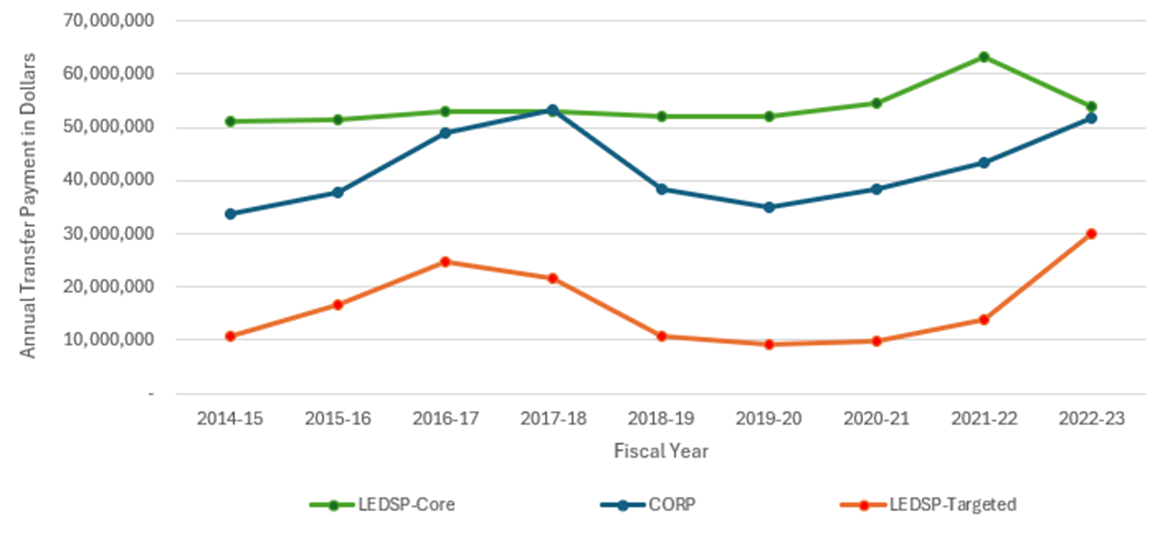
Text alternative for: Figure 1: Annual Transfer Payments by Program Stream and Fiscal Year
| 2014-15 | 2015-16 | 2016-17 | 2017-18 | 2018-19 | 2019-20 | 2020-21 | 2021-22 | 2022-23 | |
|---|---|---|---|---|---|---|---|---|---|
| LEDSP-Core | 51,135,045.00 | 51,453,128.00 | 52,838,290.50 | 53,053,809.73 | 51,907,150.00 | 52,194,781.00 | 54,539,356.00 | 63,170,477.14 | 53,963,756.14 |
| LEDSP-Targeted | 10,741,794.38 | 16,770,515.59 | 24,648,283.14 | 21,753,753.45 | 10,861,438.50 | 9,307,942.72 | 9,937,055.23 | 13,999,942.44 | 29,992,906.19 |
| CORP | 33,825,292.00 | 37,873,181.14 | 48,924,662.20 | 53,323,262.26 | 38,464,255.11 | 34,944,060.35 | 38,283,193.39 | 43,490,822.35 | 51,759,814.66 |
Source: Program Documentation - LEDSP Expenditures 2014-2022 and CORP Expenditures 2014-2022.
Across fiscal years, expenditures across the three program streams spanned various funding approaches, as can be seen in Figures 2 to 4. Over the years assessed, an uptake in fixed and flex agreements illustrates a greater shift towards more flexible agreements, as compared to set funding agreements. Additionally, the proportion of LEDSP-Core funding allocated through the New Fiscal Relationship (NFR) GrantFootnote 8 grew steadily between its inception in 2019 and the end of the evaluated period in 2022-23.

Text alternative for: Figure 2: LEDSP-Core: Annual Allocations by Agreement Type
| Fiscal Year | Block | Fixed | Flex | NFR Grant | Set | Grand Total |
|---|---|---|---|---|---|---|
| 2014-2015 | $20,897,299 | $28,290,754 | $1,671,650 | $275,342 | $51,135,045 | |
| 2015-2016 | $20,746,515 | $30,429,390 | $277,223 | $51,453,128 | ||
| 2016-2017 | $21,065,002 | $31,046,753 | $726,536 | $52,838,291 | ||
| 2017-2018 | $21,466,313 | $31,205,491 | $382,006 | $53,053,810 | ||
| 2018-2019 | $21,884,137 | $30,023,013 | $51,907,150 | |||
| 2019-2020 | $17,868,055 | $26,486,525 | $7,840,201 | $52,194,781 | ||
| 2020-2021 | $17,767,590 | $27,101,037 | $9,670,729 | $54,539,356 | ||
| 2021-2022 | $17,880,129 | $33,070,008 | $1,800,000 | $10,420,340 | $63,170,477 | |
| 2022-2023 | $17,862,372 | $24,372,815 | $147,000 | $11,581,569 | $53,963,756 | |
| Grand Total | $177,437,411 | $262,025,786 | $3,618,650 | $39,512,839 | $1,661,107 | $484,255,794 |
Source: Program Documentation - LEDSP Expenditures 2014-2022
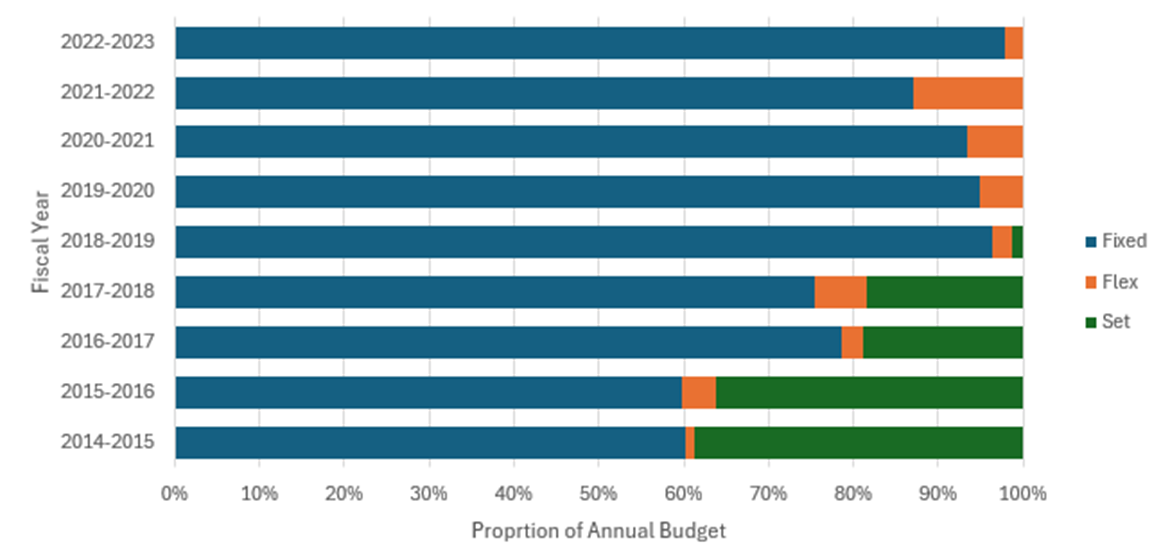
Text alternative for: Figure 3: LEDSP-Targeted: Annual Allocations by Agreement Type
| fiscal year | Fixed | Flex | Set | Grand Total |
|---|---|---|---|---|
| 2014-2015 | $6,469,193 | $116,890 | $4,155,711 | $10,741,794 |
| 2015-2016 | $10,032,849 | $656,481 | $6,081,186 | $16,770,516 |
| 2016-2017 | $19,360,813 | $643,040 | $4,644,430 | $24,648,283 |
| 2017-2018 | $16,394,982 | $1,359,479 | $3,999,292 | $21,753,753 |
| 2018-2019 | $10,463,689 | $250,000 | $147,750 | $10,861,439 |
| 2019-2020 | $8,831,667 | $476,276 | $9,307,943 | |
| 2020-2021 | $9,272,838 | $664,217 | $9,937,055 | |
| 2021-2022 | $12,202,278 | $1,797,664 | $13,999,942 | |
| 2022-2023 | $29,371,468 | $621,438 | $29,992,906 | |
| Grand Total | $122,399,777 | $6,585,485 | $19,028,369 | $148,013,632 |
Source: Program Documentation – LEDSP Expenditures 2014-2022

Text alternative for: Figure 4: CORP: Annual Allocations by Agreement Type
| Funding Approach | 2014-15 | 2015-16 | 2016-17 | 2017-18 | 2018-19 | 2019-20 | 2020-21 | 2021-22 | 2022-23 | Total |
|---|---|---|---|---|---|---|---|---|---|---|
| Fixed | $14,247,097 | $18,225,199 | $33,594,289 | $35,053,881 | $31,382,391 | $26,969,529 | $31,814,701 | $40,020,760 | $42,804,966 | $274,112,814 |
| Flex | $11,542,047 | $1,861,613 | $2,867,434 | $15,350,174 | $7,081,864 | $7,974,531 | $6,468,492 | $3,470,062 | $8,954,849 | $65,571,066 |
| Set | $8,036,148 | $17,786,370 | $12,462,939 | $2,919,207 | $41,204,664 | |||||
| Grand Total | $33,825,292 | $37,873,181 | $48,924,662 | $53,323,262 | $38,464,255 | $34,944,060 | $38,283,193 | $43,490,822 | $51,759,815 | $380,888,543 |
Source: Program Documentation – CORP Expenditures 2014-2022
3. Evaluation Scope and Methodology
3.1 Evaluation Scope
This evaluation covered the period from 2014-15 to 2022-23. As per the Policy on Results (TBS 2016), the evaluation was designed to assess the relevance, effectiveness, and efficiency of EDCR. In alignment with ISC’s Five-Year Departmental Evaluation Plan (ISC 2024a), the evaluation questions were also designed to consider a number of cross-cutting themes where appropriate, including: service transferFootnote 9; Gender-Based Analysis Plus (GBA Plus); Indigenous children and families; impacts of the COVID-19 pandemic and climate change. The full list of evaluation question can be found in Annex B. Given the separation of lands and environment from economic development programming in the 2018-19 Departmental Result Framework, this evaluation focused primarily on budget allocations related to economic development.
This is the first evaluation of the EDCR in its current form; however, details on previous evaluations related to EDCR program streams can be found in Annex C.
3.2 Evaluation Context
In alignment with ISC Evaluation’s focus on co-development and co-creation with Indigenous partners (ISC 2024a), this evaluation piloted a hybrid evaluation approach, which focused on Indigenous priorities, but still fulfilled the Policy on Results (TBS 2016) requirement to examine relevance, effectiveness, and efficiency. This approach was built on the work of the Indigenomics Institute as part of a partnership with ISC entitled "Centering Indigenous Worldviews Within Evaluation Frameworks"Footnote 10. The work resulting from this partnership project is described in section 3.3.
3.3 Evaluation Framework
3.3.1 Evaluation Planning and Opening Ceremony
The EDCR evaluation framework was developed through three phases of collaborative work:
- Phase 1: Literature Review and Background Documentation
- Phase 2: Development of the Theory of Living
- Phase 3: Prototype Development
The development and approval of the evaluation’s Terms of Reference occurred simultaneously with the framework planning phases and included considerable dialogue surrounding the language employed in typical federal evaluations, balancing the requirements of the Policy on Results (TBS 2016) while transforming evaluation practice focused on Indigenous worldviews, and broadening definitions of wealth and wellbeing. To honour the investments of time, effort, and consideration by various parties in developing the evaluation framework, an Opening Ceremony was hosted by ISC Evaluation and led by a First Nations Elder. The Opening Ceremony provided the opportunity to honour and commemorate the individual gifts that each contributor had made to the project development, and the relationships built across teams that enabled this work to take place.
3.3.2 Theory of Living
The Indigenomics Institute’s Theory of Living offered a transformational vision for ISC Evaluation to support Indigenous Peoples’ pursuit of self-determination. Rather than approaching evaluation with a theory of changeFootnote 11 , the Indigenomics Institute proposed that ISC ground its evaluation process in a Theory of Living, or way of life, in order to center Indigenous perspectives within the evaluation’s process and relationships (see Figure 5; Hilton 2023).The Theory of Living did not prescribe a formulaic path forward; instead, it acted as a "compass for wayfinding and sensemaking" (Indigenomics 2021c). The Theory of Living for Indigenous communities’ economic development called for the evaluation process to be collaborative, inclusive, community-defined, and culturally relevant. The Theory of Living’s lens shifted evaluation away from a deficits-based approach to a relational-based approach that fostered holistic and intergenerational well-being, including Indigenous worldviews and community-defined visions of good living and wealth. In this way, development activities were expected to better support Indigenous self-determination.

Text alternative for: Figure 5: Theory of Living Model
Center piece
- Ultimate goal: Good living, community, determined well-being, and wealth
North direction, from the outside inwards:
- Outcome: Accelerating self-determination
- Teaching and values: Basic for evolution
East direction, from the outside inwards:
- Outcome: Incorporation of Indigenous values & teachings in economic dev pursuits
- Assumption: Community values make work more relevant & beneficial
South direction, from the outside inwards:
- Outcome: Sustainability of efforts with a view to support seven generations ahead
- Assumption: Interconnection/ecosystem/living
West direction, from the outside inwards:
- Principles: Guide the process
- Outcome: Improved Nation-to-Nation relationships
3.3.3 Bringing the Theory of Living to Life
The Theory of Living orients evaluation processes towards the goal of Indigenous self-determination, which the Evaluation Team embraced within this evaluation by working with communities to bring the Theory of Living to life within the evaluation process. In response to the Theory of Living, the ISC Evaluation team committed to the actions illustrated in the following panel.
Actions to Bring the Theory of Living to Life
Principle:
Value community partnership
EDCR Evaluation Practices:
- Partnered with economic development officers (EDO)s working in First Nation communities to create a Working Group to ground the evaluation process in community voices and Indigenous values and teachings;
- Honoured relationship-building, trust-building, transparency, clarity and honesty about what the ISC Evaluation team could and could not do in this evaluation, including how the stories shared throughout the data collection process would be recorded, checked for accuracy, and reflected in the evaluation products;
- Sought communities’ ongoing feedback and, where possible, honoured their engagement preferences;
Principle:
Address current and historical structural power imbalances
EDCR Evaluation Practices
- Where appropriate, contextualized findings and recommendations to duly highlight existing inequalities as consequences of colonization;
- Used strengths-based language to reflect what has been learned
Principle:
Incorporate process that centers both community wellbeing and wealth creation
EDCR Evaluation Practices:
- Explored what wellbeing as an outcome of economic development looks like from communities’ perspectives and how communities define & assess economic success; by contrasting these perspectives with the program’s logic, the evaluation intended to lead to program changes that better reflect community wellbeing as central
Principle:
Align evaluation with community’s socio-economic, current, and historical context
EDCR Evaluation Practices:
- Sought to include, via targeted recruitment and stratification approaches, communities and individuals who have been under-represented in the existing programmatic indicators;
- Assessed the equitability of formula-based funding across community-level factors, and variability in the accessibility of proposal-based funding;
- Contextualized evaluation discussions and documents with the interconnected factors that impact economic development and success, beyond what is captured by the siloed model employed by the Government of Canada
Principle:
Create and support ethical research protocols
EDCR Evaluation Practices:
- Practiced evaluation processes according to ethical protocols
Principle:
Design an evaluation that is co-created and mutually beneficial
EDCR Evaluation Practices:
- Respected the autonomy of communities in determining the extent and ways in which they were willing and able to engage with this evaluation process;
- Co-interpreted evaluation findings with the Community-Level Working Group to contextualize the impact on Indigenous communities;
- Committed to broadly disseminate evaluation findings to First Nations and Inuit communities in a variety of formats for transparency and to allow communities to leverage these findings within their contexts
Principle:
Center Indigenous epistemology and ways of knowing, and respect Indigenous knowledge systems
EDCR Evaluation Practices:
- Advanced methods and tools that aligned with EDOs’ preferred strategies as per the Survey of Interest;
- Designed evaluation tools with the Community-Level Working Group to ensure that they were aligned with Indigenous ways of knowing and perspectives.
3.4 Evaluation Governance
The Indigenomics framework recommended that evaluators gather a "team of designated Leadership Champions and network to guide the evaluation experience and contribute that to abundance and wellbeing" (Indigenomics 2023:53). As such, the evaluation included feedback mechanisms with internal and external partners. An Elder from a First Nation community provided guidance and support throughout the evaluation process through shared knowledge, teachings, relations, and encouragement. An independent reviewer with expertise in Indigenous economic development and some background in evaluation provided strategic advice on key evaluation milestones. A Community-Level Working Group consisting of EDOs working in First Nations across Canada was organized to provide foundational guidance to support the utility and appropriateness of evaluation tools, methods, and products. The Working Group were instrumental in guiding evaluation activities, particularly by refining data collection instruments, supporting sensemaking of how central concepts to the program, such as wealth, wellbeing, and holistic impacts, were understood, and contextualizing thematic areas emerging from data analysis. EDCR program staff within headquarters (HQ) and regions supported the evaluators’ scoping and understanding of the program theory and administration and provided ongoing feedback on the evaluation milestones. Lastly, as is required by the Policy on Results (TBS 2016), the Performance Measurement and Evaluation Committee (PMEC) at ISC provided critical oversight and feedback at key milestones of the evaluation process, including the Terms of Reference, Preliminary Findings, and Final Reporting stages. As of the 2024-25 fiscal year, the PMEC includes three external advisors.
3.5 Methodology
The evaluation methodology intended to advance the ultimate goals of self-determination and community-defined good living. A Survey of Interest was distributed to EDOs (or their equivalent) working in First Nations and Inuit communities to gauge willingness to participate in the evaluation process on several levels, including options for a survey, interviews, community tours, sharing circle, storytelling, and arts-based methods. A subset of data collection methods were chosen according to EDO’s preferences. Wherever possible, EDOs subsequently received invitations to engage in the method of their choice, although budget and time considerations did not allow the evaluators to accommodate all of the community tours that were requested.
The evaluation was conducted ultimately using a mixed-methods approach. Sample sizes for each data collection method are provided in Table 1, with additional details below.
| Category | Method | # of Interviews | First Nation Participants | Inuit Participants | Total Participants |
|---|---|---|---|---|---|
| External | Community ToursTable note 1 | 10 | 14 | 12 | 26 |
| Survey (EDOs)Table note 2 | 32 | 1 | 33 | ||
| Interviews (EDOs) | 11 | 18 | |||
| Interviews (Capacity-Building Orgs) | 7 | 9 | |||
| Internal | Interviews (HQ Staff) | 9 | 13 | ||
| Interviews (Regional Staff) | 7 | 21 | |||
| Total | 44 | 46 | 13 | 120 | |
|
|||||
3.5.1 Methods
Survey of EDOs
A virtual survey was administered via email invitation to those EDOs who requested a survey as their preferred method of engagement. Additionally, an invitation to complete the survey was sent via regional offices to ensure that community members who were not originally represented in the Survey of Interest still had the opportunity to share their experience with the program. Survey questions focused on EDOs’ experience with the program, the associated impacts, and alignment with community-defined economic success. The sample size for the evaluation survey was limited; therefore, survey responses are not disaggregated across identity factors to protect confidentiality.
Semi-Structured Interviews with Program Users
Virtual interviews with program users (individual and group, where appropriate) were hosted, which considered community experiences of the program, and the program’s alignment with the community’s economic development goals and perspectives.
Community Tours
Based on budgetary limitations, a stratified sample of First Nation and Inuit communities whose representative indicated a desire to host the evaluators for a community tour were selected for an in-person visit. Stratification efforts considered a variety of factors, including: funding history with CORP and LEDSP; geographical characteristics (region, remoteness); and population. Community tours were originally planned and budgeted to reflect one tour per region; however, one region (Alberta) was not represented in this method as the evaluators were unable to connect with the community representative.
Semi-Structured Interviews with ISC Staff
Virtual interviews (individual and group, where appropriate) were conducted with program staff at HQ and regional offices, with an effort to ensure representation across the country. Key lines of questioning among ISC staff emphasized program administration, including funding process and budgets, the application of GBA Plus, and steps taken to advance service transfer.
Literature, Document, and File Review
The ISC Evaluation team assessed published literature and program documents to better understand themes related to the evaluation questions, such as Indigenous worldviews on economic activity and prosperity, the historical context of EDCR, and the continued relevance of the program. Literature was sought from a variety of sources, including publications from Indigenous, and community-based groups, and academic journals.
Data Review
Data collected and held by ISC, including program performance and financial data, were analyzed to speak to questions of performance and efficiency.
3.6 Evaluation Limitations
The findings of this evaluation reflect the opinions of First Nation and Inuit community and organization representatives within the provinces, as well as ISC staff members who were interested and available to participate. The findings cannot be generalized to all First Nation or Inuit communities. This is particularly true given the evaluation framework prioritized analysis of how EDCR supported goals and definitions of economic success and well-being that were unique to each engaged community, and were therefore grounded in diverse local contexts and experiences.
Engagement with Inuit communities throughout the evaluation process was limited, with few Inuit communities expressing a wish to participate as per the Survey of Interest. Despite targeted efforts by the evaluators to enhance participation, Inuit communities also were not represented on the Community-Level Working Group. During the engagements with Inuit community- and organization-representatives that were possible, the evaluators specifically intended to uncover potential explanations to the under-representation of Inuit communities in the program writ large, including barriers to access. The evaluation team attempted to mitigate the under-representation by seeking literature from Inuit communities and organizations related to the evaluation scope.
Various members of ISC’s Evaluation Branch supported the EDCR evaluation process, and each team member contributed biases and blind spots in addition to experience, skills, knowledge, and perspectives. Cognizant of these positionalities, the evaluation team responsible for this report aimed to create it collaboratively and transparently (see Evaluation Governance section).
4. Key Findings
4.1 Reader’s Guide
Although the evaluation questions were originally developed along the Treasury Board Secretariat’s categories of relevancy, effectiveness, and efficiency, a mapping exercise found that the findings could be presented more cohesively across the following thematic areas: Program Design and Processes, Program Impacts, Equitability of Program Access, Performance Measurement, and Relationships. Annex D for an overlay of findings across themes of relevance, effectiveness, and efficiency.
In alignment with the evaluation framework, finding statements intentionally began by centering the specific priorities expressed by First Nations and Inuit community and organization representatives, followed by a comparison to how these priorities were reflected in the program reality. Additionally, where possible, the evaluation aimed to reflect distinctions-based perspectives. The report sought to refer specifically to First Nations or Inuit, rather than using the broader term "Indigenous," except in cases where distinctions were not possible—such as when referencing organizations or initiatives that served all Indigenous Peoples.
Wherever possible, the findings identify the specific EDCR program stream being referenced. However, in many cases, particularly between the proposal-based streams (LEDSP-Targeted and CORP), it was not possible to differentiate between them, as interviewees did not always indicate which proposal-based stream they were referring to. In such instances, the term "proposal-based" is used to indicate that the findings relate only to program streams that require proposals.
The evidence from semi-structured interviews is described with reference to the scale below and refer to how frequently a subject was raised in an interview (see Table 2).
| Percent of Interviews | Reported as: |
|---|---|
| More than 90% | Almost all |
| 60-90% | Most |
| 40-59% | Around half |
| 30-39% | Several |
| Less than 30% | Some |
| n = a small number of interviews | A few |
4.2 Findings: Program Design and Processes
Finding 1: There was alignment between First Nations and Inuit communities and the Government of Canada in terms of their respective visions for self-determination, economic advancement, and the holistic nature of economic development; but realizing those visions was limited by program restrictions and silos.
Across both literature and interviews, Indigenous Peoples consistently described economic development as holistic, relational, and grounded in self-determination. Rather than being viewed solely through the lens of financial gain or material wealth, Indigenous economic development was seen as deeply interconnected with broader aspects of wellbeing—including physical health, food security, language, ceremony, and cultural identity. Indigenous authors emphasized that this holistic approach is supported by key enablers such as land control, infrastructure, environmental stewardship, and investments in social development (Sxwpielemaát Siyám [Chief Leanne Joe] & Raphael, 2022). For example, a case study on Indigenous economic development in Atlantic Canada found that communities that achieved economic stability had intentionally prioritized social development as a foundational part of their economic planning (Atlantic Aboriginal Economic Development Integrated Research Program 2011). These themes were strongly echoed in interviews conducted for this evaluation. One EDO explained: "CORP won’t fund market residential, and should look at funding this as an eligible expense. We are in a national housing crisis… Nations could be at the forefront. They often have land that is undeveloped because they don’t have access to development funds and could create meaningful employment in construction, property management, project management, etc., and have a really sustainable income."
"Transformation inherently requires a shift in who gets to decide where the money goes. Right now it’s Canada, but it should be the rightsholder…we need to be investing in rightsholder’s decisions."
Alongside this holistic vision, the principle of self-determination emerged as essential to meaningful economic development. Seminal documents developed under Indigenous leadership including the National Indigenous Economic Strategy (2022), the National Inquiry into Missing and Murdered Indigenous Women and Girls (2019) Calls for Justice, and the Truth and Reconciliation Commission’s (2015) Calls to Action, as well as other literature spanning the evaluation period emphasized that full jurisdiction and control over economic activities is critical for maximizing impact, including the ability to ground economic decision-making by community values, vision, and goals (e.g., Group ATN Consulting 2023; First Nations Financial Management Board 2022; National Indigenous Economic Development Board 2013; Nelson 2019). LEDSP and CORP were designed to support First Nation and Inuit communities’ self-determined economic priorities, particularly through LEDSP-Core. One ISC staff member specified that "the Core funding is incredibly important to enable communities to mobilize towards their own identified priorities". Interview participants reinforced this point. One EDO stated: "It should be [the] Nation’s money to make their own decisions and what they need… That is self-determination."
Supporting First Nation and Inuit economic development is core to ISC’s mandate as expressed in its enabling legislation (Government of Canada 2019), and both ISC and the broader Government of Canada have consistently acknowledged the inherent link and mutually reinforcing nature of self-determination and economic development. Examples can be found in the Minister’s 2021 mandate letter (Prime Minister of Canada 2021), the 2023 United Nations Declaration on the Rights of Indigenous Peoples Act Action Plan (Government of Canada 2023d), ISC’s Annual Report to Parliament (2023c), as well as numerous recent Budget announcements, including Budget 2023, which stated: "Indigenous governments must be able to set and implement priorities respecting their communities, lands, and resources. Indigenous Peoples, businesses, and communities must have the opportunity to fully participate in the economy and build opportunities for themselves and future generations in the ways they see fit, consistent with their constitutionally protected rights" (Government of Canada 2023a:125).
Various Government of Canada reports also acknowledged the importance of holistic, community-driven economic development in achieving sustainable impacts. For example, the Indigenous Community Development National Strategy highlighted that efficient and enduring development must be community-driven and nation-based (ISC 2021). Similarly, CIRNAC’s (2019) Audit of Economic Development Programs called for a shift away from a program-centric approach toward one centered on community priorities. Government publications also identified the interconnected nature of economic development with infrastructure, housing, training, and education. For example, the House of Commons (2022) emphasized that infrastructure is a precondition for a well-functioning economy, whereas CIRNAC’s (2019) Audit reported that flexibility across departmental programs could better support integrated, community-driven goals. These acknowledgements reinforced the need for ISC to ensure that programming enables communities to drive their own definitions of economic success, with adequate authority, flexibility, and support to address needs that might fall outside of a narrow conventional definition of "economic development."
The role of OSR in economic development – whether as a support or a result – holds a complex place in this shared drive toward self-determined economic development. On one hand, there is a clear sense that OSR is an important element of Indigenous self-determination. To illustrate, one ISC staff member noted that "in order for communities to be less reliant on government…they have to be able to have their own source of revenue, they have to be able to make decisions outside of the fences that government puts around funding for social programs and education and all of those other things," a sentiment echoed in interviews with some EDOs. On the other hand, a few EDOs, as well as reports (Indigenous and Northern Affairs Canada and Assembly of First Nations 2017; Lees & McCulloch 2017) published during the evaluated period highlighted First NationsFootnote 12 concerns that an overemphasis on OSR by ISC could be used to justify reducing federal transfers, shifting fiscal responsibilities away from the Crown, or creating unintended pressure for communities to pursue revenue generation over other priorities.
The overarching design of the EDCR program aligns, in principle, with the convergent views of the Government of Canada and First Nations and Inuit on economic development, aiming to support them in designing and pursuing opportunities that reflect their needs and priorities while developing partnerships and OSR to strengthen independence from federal support and oversight. Despite this broad alignment, ISC’s siloed program structure restricted communities’ ability to realize their holistic and self-determined economic goals. The lack of streamlining within departmental programs was described during almost half of external interviews to be burdensome to program users, with the onus being on communities to navigate different programs and requirements. One EDO noted that "the siloing of programs and strict regulations on programming means that we are leaving opportunities on the table." Another EDO described the consequence of siloing as a "huge inefficiency...We have to chop the project into five pieces and apply for five funding programs for each piece [of the project]." Yet another EDO shared that "there may not be enough flexibility in the programs to fit the reality of the community. Cookie cutter programs won’t fit ... We need to find the programs where we fit and our needs are met, rather than trying to fit our needs into the program 'designed’ to fit us... it needs to evolve with us." This notion was supported in a report commissioned by ISC in 2020, which found that rather than applying for funding for projects that reflected the communities’ needs, the current application criteria, process, and structure for the proposal-based programs meant that project ideas were being molded to fit the application (Two Worlds Consulting 2020). Conversations with the Community-Level Working Group supported the notion that time and money were wasted when teasing out project components to fit with disparate funding programs, which did not meet community needs nor the principles of self-determination, and ultimately reduced the return on the Government of Canada’s investment.
Priorities of First Nation and Inuit individuals, communities, and organizations were not consistently reflected in eligibility criteria for the proposal-based program streams, which resulted in misalignment between program design and community realities. For example, community infrastructure unrelated to business development or expansion was ineligible under the program; however, the evaluation heard that public spaces, such as community centers, which are eligible for funding from another ISC sector only as non-revenue generating structures, allowed communities to generate revenue in rent that contributed to OSR. Similarly, the operation, repair, and maintenance of existing or municipal infrastructure was ineligible; however, a few EDOs (interviews and survey participants) mentioned that already-existing buildings in the community could be used for economic development purposes if they could be renovated or repaired. When asked how they would design the program to best suit their community’s needs, one EDO shared "if it’s from a blank slate, it should be designed with project eligibility [determined] by First Nations," with communities able to define how to prioritize opportunities, which they suggested would provide communities greater autonomy.
Additionally, proposal assessment criteria was not designed to account for First Nation- and Inuit-defined factors of success, such as the value that many communities and organizations placed on sustainable resource development and management. One ISC staff member noted that the program did not prioritize or show preference for projects that had a positive environmental impact, which was seen to put sustainability-focused projects at a disadvantage. Another ISC staff member similarly shared that because project success was defined in economic terms alone, projects whose value lied in contributions to sustainability or adaptation to climate change were supported less often due to higher costs that minimized the financial return on investment. The prioritization of quantitative economic benefits in the assessment of CORP proposals was raised as problematic in a few interviews, given the lack of qualitative assessment of holistic aspects of success. An ISC staff member gave the example of developing a grocery store, which among other benefits would support food security for the community; however, given that the benefit of food security is not readily quantifiable in economic terms, it would not necessarily be reflected in the proposal score. One EDO shared that "some of these projects don’t have a killer return – if they did, we wouldn’t need subsidies. Most of these communities are small and remote, and it can be tough to have projects that break even in terms of these funding requirements, but these are essential services to the community. Not providing profit doesn’t mean it doesn’t provide a benefit." The focus on quantitative economic benefits when assessing proposals disregarded holistic benefits that could be achieved by various projects beyond financial gain.
It is important to note that other programs within ISC’s inventory address some of the gaps left by EDCR, and that EDCR was not designed with the intention to unilaterally meet the broad range of holistic factors related to economic development; however, without meeting communities’ holistic needs, investments in economic development priorities may not succeed. In fact, around half of ISC staff raised the importance of collaborating across teams within the department to support holistic projects, particularly given the complement between service areas such as economic development, housing, and infrastructure. For example, the recent evaluation of SPI highlighted the Ring of Fire initiative, which was designed to meet economic development priorities, but required adjustments to address health and social needs to ensure community readiness to benefit from mining projects. Models to support Indigenous economic development in a holistic manner already exist within ISC and SPI provides a promising example. As highlighted in its recent evaluation, SPI offers a single-window approach with a single application, reporting process, and designated federal liaison for Indigenous partners (ISC 2025). This model was credited with streamlining access, strengthening relationships, and reducing administrative burden, especially compared to other federal programs. However, it is important to note that the SPI evaluation also highlighted the inherent tension between providing the flexibility needed to address broader community needs and maintaining the program’s intended scope and mandate.
Similarly, given the vast number of programs that may be relevant to advancing an economic project, the National Indigenous Economic Development Board recommended creating Navigator positions to help Indigenous communities and businesses access the full range of federal economic development supports (2022). An Indigenous Business Navigator Service was launched by ISC in 2022 to support Indigenous individuals, businesses, organizations, and communities in their search for economic development supports and services, and future evaluations should address its efficacy. Although this new service was beyond the scope of this evaluation, it represents another mechanism with potential to address the coordination challenges identified by ISC staff and First Nations and Inuit partners.
Finding 2: EDOs identified a need to simplify program administration to more closely reflect their realities and values.
Almost half of the external interviews reflected that the application processes for the proposal-based programs were burdensome, describing difficulties in accessing information on how to complete the application, understanding eligible expenses, and knowing who to contact about the program offerings. Some interviews also highlighted technical challenges with the application forms not being digitally fillable.
"The colonial nature of the application and reporting process—written communications [are] designed in ways that are more in line with settler practices than Indigenous."
A few external interviews indicated a perception that there is an onerous application process for CORP, which deterred communities from applying, especially for smaller projects, which some EDOs described as not providing sufficient return on investment given the level of effort involved An ISC staff member noted that while CORP’s process for soft costs was relatively easier than other funders, its process for capitalization was more challenging. Some EDOs recommended that ISC could support communities that have limited experience with proposal-based programs by encouraging and facilitating collaboration across communities and sharing examples of successful proposals. One EDO shared that "perhaps there is a role for ISC at a regional level to share highlights of how the funding could be used to support communities and share what the projects have been. Seeing project highlights from all the other communities gives a bit of permission for thinking outside the box."
The requirement to include three quotes for services (e.g., professional, consulting) in CORP applications was raised as a barrier in a few interviews. An ISC staff member pointed out that the requirement created challenges and delays for communities to undertake the public tendering process. A lack of cultural relevance in this process was noted in one external interview: "When operating with the value of relationships, which is common in many Nations’ value systems, you may see communities that don’t want to seek out three quotes. When they have a trusted relationship with a service provider and can trust the quality of work, they want to move forward with their selected choice. Some communities have problematic histories or experiences with consultants who have over-charged and under-delivered—and the Nations are tired of this. They want to work with people who they have long running, trusted histories of performance with. When the procurement policy requires going for the lowest-cost bid, sometimes the community is then being forced to work with consultants that they don’t have relationships with, and whose performance may not be at the standard they are looking for." Finally, depending on the geographic location of the community, sourcing three competing bids could be difficult or impossible for various services given the lack of contractors or consultants that serviced the area, particularly for northern and/or remote communities.
"If federal funds don’t get released until July, then the construction season is almost over."
Almost half of the interviews pointed to challenges with timelines in the proposal-based programs. Some EDOs reported delays in funding that caused missed opportunities, especially where the short construction season in remote areas made timing critical. Single-year funding cycles compounded challenges for communities dependent on air or sea transit, resulting in delays transporting materials, inflated budgets, and shortened work seasons, which were intensified by climate change (e.g., fluctuations in the freeze and thaw timeline). It was raised in one external interview that "sometimes you have to scale projects to what is feasible to complete in one season... with deadlines that the government has, there’s no way that a northern community, particularly on the coast, can spend the money on time."
Some interviews also noted a lack of standard turnaround times from application submission to fund approval and release for the proposal-based programs. One EDO said, "Look at what happens to the cost of concrete over three months. It’s difficult to get shovels in the ground because by the time you get the answer from the funder, all the costs have changed …Even though we give…costings with built-in contingencies, these contingencies are not sufficient, particularly after COVID." The lack of transparency on timing was seen to exacerbate such challenges; one representative of a funded organization shared, "I’ll hear back months later that [ISC] wants more information before submitting the application, whereas I thought the application was submitted and we were waiting to hear if it was approved."
The delayed receipt of funding also had reputational consequences. An EDO stated, "Sometimes you get money late in the year, like January, and expected to spend it by March, and then the Nation is blamed for not adequately spending the money." An ISC staff member echoed this concern and suggested that enabling carry-over of funding could mitigate this issue. Fixed and Flex agreements, which do allow carry-over under certain circumstancesFootnote 13, had replaced Set funding by 2018-19 (see Figures 3 and 4), for carry-over, interview findings suggest that these flexibilities may not have been sufficient or were not always being leveraged.
Reporting requirements were also described as arduous, with limited understanding of how reported information was used. One EDO recommended that "reporting needs to be a lot less, making the process more simplified [and] reporting what is necessary for the government". Another noted that while reporting is reasonable in principle, "the reports themselves need to be sensical, efficient, and then used." An ISC staff member argued that "reconciliation, and economic reconciliation in particular, is about reducing administrative burden so that [community] staff are actually building business opportunities and not doing their paperwork." Similarly, a User Experience Study commissioned by ISC found that both ISC staff and representatives of First Nation and Inuit communities and organizations were often unclear about what data was required by ISC’s economic development programs and why, and that communities lacked sufficient human resources to meet reporting demands—especially when juggling multiple funders’ requirements (Two Worlds Consulting 2021). Within the Study, representatives of First Nations and Inuit communities unanimously agreed that there were insufficient human resources for communities to effectively participate in ISC’s reporting processes, which was exacerbated by the need to juggle reporting requirements across funders.
CIRNAC’s (2019) Audit of Economic Development Programs recommended that ISC streamline performance data collection, limiting it to what is required for the program’s Performance Information Profile, to reduce the burden on First Nation and Inuit communities and regional staff. One EDO said that ISC should "look at these [requirements] as someone who maybe does this form once a year, English could be a second language, and they perhaps have no post-secondary" when adjusting the requirements to be more user-friendly.
4.3 Findings: Program Impacts
Finding 3: The program filled unique gaps in supporting communities to advance economic development activities.
Some interviews, including with EDOs, organization representatives, and ISC staff emphasized that, despite the program restrictions highlighted in Finding 1, EDCR was nonetheless supporting a spectrum of capacity-building and preparation activities and therefore meeting unique needs. While some thematic overlap with other programs was mentioned in interviews (e.g., Indigenous Financial Institutions, SPI), key differences were outlined. For example, an ISC staff member highlighted the risk aversion demonstrated by economic development programs offered by other federal departments, which required demonstrated capacity and past performance of the applicant and could therefore exclude many First Nation and Inuit communities who are still building their economies. Another ISC staff member noted that by supporting pre-cursors and soft costs for projects that mitigate risks before entering into an economic opportunity, LEDSP and CORP supported aspects of projects that are not typically eligible to be funded by mainstream funding institutions or programs, and supported First Nation and Inuit communities in building those projects towards capitalization, acquisition, or expansion, which qualify for a greater variety of funds. The ability to fund economic infrastructure costs was described as unique by one ISC staff member, who shared that "the way the other [program] authorities are worded or structured, economic development and [commercial] infrastructure are not eligible."
"On the project development side, these programs are really helpful. We tap into $250,000 to design the project, hire the architects and engineers… there aren’t a lot of [programs] that would fund that."
The support for pre-development costs, such as business plans, feasibility studies, project design, and training as opposed to just major projects was highlighted in interviews as a unique niche that was filled by EDCR. An EDO noted that "[The programs] act as a kickstart to a project before you invest community dollars into it." A few interviews and survey responses specifically described that they would not have been able to advance their economic development goals without the support provided through CORP and LEDSP. One EDO reflected on their experience applying for CORP to support pre-development studies, specifically citing the necessity of the funding to "do the studies that we need prior to undertaking a project... If I didn’t have the ability to get these studies done, I wouldn’t have gotten all these projects done."
The benefit of being able to hire and retain a consistent, skilled EDO with the support of LEDSP-Core was made clear by external interviews for the evaluation. For example, one representative of a funded organization described that "Without core foundational funding, you cannot move things ahead in a real way. If everything is project-based, you cannot secure the right staff, you will have a hard time hiring and retaining staff to do the work". As capacity and skills were built over time, communities were able to learn from and build on their past experiences to better support success within the community. For example, an EDO reflected on the experience they gained in negotiating Impact Benefit Agreements with mining companies, sharing that with the initial Agreements, they observed that community members were being employed, but were primarily stagnant in entry-level positions, as employee progression wasn’t considered in the Agreement. The community negotiated specialized training programs to support community members in developing skills to advance within the company, and when negotiating new Impact Benefit Agreements, the community now considers how they can ensure that the benefits to community members grow as the mine grows. The notion that the success of community economic development hinges on communities’ ability to build, maintain, and retain capacity in terms of financial and human resources, training and skill-development was supported by the literature review (National Indigenous Economic Development Board 2013; Tarbell & Manuel 2008; Williams 2011).
Finding 4: Economic development projects supported holistic well-being within communities.
Although EDCR’s design did not support the full range of holistic precursors needed to advance economic development (as discussed in Finding 1), the evaluation found that funded projects nonetheless generated broad, holistic impacts for individuals, families, and communities across multiple dimensions of wellbeing. EDOs described various economic impacts resulting from development projects, including building financial wealth, creating jobs for community members, and reducing "leakage" from the local economyFootnote 14. Through CORP-PF, ISC supported 118 projects from 2018-19 to 2022-23 (see Figure 6).Footnote 15

Text alternative for: Figure 6: CORP-PF Projects by Type
- Economic Opportunity Projects: 4%
- Equity Gap Projects: 64%
- Infrastructure Projects: 32%
Source: Program Documentation – CORP & LEDSP Dashboard
"Every time a development succeeds, it’s putting equity into the community and money into the pockets of community members, ensuring that there is sustainability, prosperity, and growth."
Estimated community economic benefits from those CORP-PF projects included 2,949 Indigenous jobs created over 8 years, $95.9M in salaries over 8 years, and a community economic benefits-cost ratio of 13.34Footnote 16. When discussing the creation of a commercial building within the community, one EDO explained that "there’s hundreds of people in that building every day, folks that are going to our gas station and our restaurants. Some of these are community members but a lot are not...that enhances the audience that’s coming to the community with the hope that they spend their dollars, time, and energy in the community." The financial gains of such projects directly supported community members in terms of equity, job creation, and the services available to them within the bound of their own community.
In addition to economic achievements resulting from economic development projects, interviews described holistic impacts that were observed within their communities, including a sense of pride, ownership, and motivation; improved quality of life, mental health, and wellbeing; and improved social conditions (e.g., education, housing, and healthcare; and self-sufficiency). A sense of pride and purpose resulting from economic success clearly emerged during interviews with EDOs. One EDO reflected on the impacts of economic success, noting the most significant impact as "Pride! It’s bigger than a Pow Wow, it’s bigger than a wedding… it’s a rebirth of the energy in the community." Another EDO shared, "You’ll hear things like 'we’ve been talking about this for 30 years’ and now it’s finally done, and this feels really good. There’s an uplift in mental health from this sense of pride and it really lasts...it creates momentum and buy-in for the next project." The First Nations Financial Management Board reported similar sentiments, in which Indigenous economic reconciliation not only has significant potential for contributing to the Canadian GDP, but also creates pride in Indigenous ownership, nation-building, and individuals’ self-actualization (2021). One EDO specifically contextualized the importance of this sense of pride and motivation in light of the history of colonial trauma, including the forced relocation of the community. The EDO explained that "there are still people alive in the community who had to leave their homes, who watched their homes get bulldozed, and now they’ve seen this growth... all of the economic development goals are to honor the people of this community."
In the 2024 Indigenous Economic Progress Report, income and wealth were described as contributing positively to feelings of well-being and development amongst individuals for various reasons, including higher standards of living and improved social services (National Indigenous Economic Development Board 2024). When asked about the most important impacts of economic development projects, one EDO reflected that the "biggest impact is the improved quality of life for community members – when you don’t have to drive down to the nearest town to get your car serviced, and can get that done in community instead – it creates a huge impact for community members." Several EDOs described the impact of economic development on social issues within the community, both indirectly and by investing revenue in social services. One survey participant noted that "economic development is the foundation for a healthy community. It provides funding gaps for services, reinvestment into the community and economy, [and] supports local." An EDO observed that by offering employment to 'youth-at-risk' within the community, the proportion of youth aspiring to attend post-secondary education had increased. Similar sentiments were presented in the Step Into the River Framework for Economic Reconciliation, in which the ability to distribute monetary wealth across community members and community development initiatives (e.g., housing, health, cultural preservation) had an important impact on community-defined wealth and wellbeing (Sxwpielemaát Siyám [Chief Leanne Joe] & Raphael, 2022).
In addition to the direct social and economic benefits of development, the evaluation found that these investments in community-defined economic priorities also contributed to advancing wider federal commitments. By supporting First Nation and Inuit participation across diverse economic sectors, the program advanced federal commitments such as the transition to a net-zero electricity sector. The First Nations Major Projects Coalition (2022) emphasized that Indigenous participation is essential to achieving this goal, given the proximity of many projects to Indigenous lands. This proximity creates opportunities to advance economic reconciliation through Indigenous ownership, partnerships, job creation, and engagement on climate priorities. EDCR investments strengthened communities’ capacity to lead in the national net-zero transition. Several EDOs identified sustainable development, eco-tourism, and becoming net-zero communities as priorities—findings reflected in survey results, where 63.6% cited "advancing clean and sustainable resources" and 54.5% cited "protecting lands and waters" as economic priorities. In 2022–23, one LEDSP-Targeted recipient used funding to support 24 sustainable resource management projects. Revenues from these initiatives enabled communities to pursue self-determined priorities such as housing development and food security, aligning with federal policy commitments and the United Nations Declaration on the Rights of Indigenous Peoples Act (Government of Canada 2005).
4.4 Findings: Equitability of Program Access
Finding 5: Outdated funding formulas, unclear allocation approaches for LEDSP-Core, as well as limited funding envelopes across the program, constrained EDCR’s impact.
LEDSP-Core was the only aspect of the EDCR program that provided predictable annual funding to communities, as a core program. Previously published reports from ISC and its predecessors, including the Summative Evaluation of Economic Development Programs (Indian and Northern Affairs Canada 2009) Evaluation of Lands and Economic Development Services (Indigenous and Northern Affairs Canada 2015) and the Audit of Economic Development Programs (CIRNAC 2019) repeatedly found that the formula which governed the delivery of funds caused wide disparities in allocations across communitiesFootnote 17. Small and medium-sized remote communities were reported to be particularly disadvantaged and unable to meet their needs with the allocation (Indigenous and Northern Affairs Canada 2015). Although the 2015 evaluation of LEDSP included a recommendation to review the LEDSP-Core funding formulas, a revised formula was not implemented, and ISC staff members indicated that Core funding amounts have not been adjusted since the 1980s, aside for communities that have transitioned to Block fundingFootnote 18 or the NFR Grant, which both receive an annual escalator. One ISC staff member explained that the "program formulas/amounts are not responsive to inflation, remoteness, raising cost of living, population growth, [or the] proportion of community members living in community VS out of community." This is consistent with the evaluation’s finding that the formula was not consistently re-calculated each year by each Region to account for adjustments in formula factors (i.e., population)Footnote 19.
An analysis of the impacts of inflation on LEDSP-Core funding is illustrativeFootnote 20. Funding at the beginning of the evaluated period (2014) was $ 51,135,045. To retain that value over time, funding would have needed to increase to $62,069,327 in 2022 – more than the $53,963,756 that was nominally allocated in 2022-23.
Although not directly comparable to the role of a community EDO (given the inclusion of numerous titles within the category), the evaluators located comparable national wages in Canada using the National Occupation Classification system (Government of Canada 2025). According to the 2024 database, the national annual average wage for "Business development officers and market researchers and analysts", which incorporates example titles as "economic development officer" and "community economic analyst", ranged from $24.8 per hour to $71.79 per hour, with an average of $45.03 per hour. Based on a standard 37.5-hour work week and 52 weeks per year, the gross annual salary for this position was estimated by the evaluators to range from $48,360 to $139,990.50, with an average gross salary of $87,808.50. Comparatively, annual LEDSP-Core allocations range from $3,000 to over $1 million, with a median allocation of $58,000 (ISC n.d.a). Using the National Occupation Classification System as a comparable benchmark, fewer than half of First Nations and Inuit communities receiving LEDSP-Core received a sufficient allocation to hire an EDO with the annual average salary.
"I’m here because I love my community and want to invest in my community, but I recognize that I’m incredibly underpaid. That’s unfortunate, and a big reason for a high turnover rate with economic development that communities experience."
Several EDOs (interviews and survey participants) noted challenges in employing and retaining an EDO with the current annual funding contributions, highlighting how this can limit a community’s foundational economic capacity. While LEDSP-Core funding can support multiple aspects of capacity, such as governance, foundational planning, and human resources, it was emphasized that having an EDO in place is an essential step to enable progress in these areas. One EDO suggested that "there should be funding for staffing at a professional rate – this investment in a staff person rather than having someone work on [economic development] at the side of their desk under a poor salary would make a huge difference." Similar sentiments were expressed by ISC staff members. One ISC staff member explained that "a community will get funded for 0.15 or 0.2 of an economic development officer position, so the capacity will never be built with that." Another stated that "communities can’t offer competitive rates to EDOs, and it can also be challenging to invest in the capacity of an employee who you anticipate is going to leave."
Concerns were raised in some interviews that funds under the proposal-based programs were being used to hire an external consultant to administer projects, rather than staffing positions in the community. As was described by one ISC staff member, the limited budget for long-term funding under LEDSP-Core "means CORP dollars are being spent on consultants to do the jobs that [the program] is refusing to fund in the community, even though it would build capacity – whereas the funding of consultants doesn’t build any capacity [within the community] but is eligible." While CORP funding can be used to support community-based positions, some interviews highlighted when communities lack the foundational resources to fund an EDO or put in place other long-term economic capacity, this leads to reliance on consultants for proposal-based projects. For example, one ISC staff member emphasized that this "inadvertent dependency on the consultants means that the return on investment will be repeatedly lesser", due to the lack of knowledge transfer and the proportion of funding flowing to the consultant rather than to communities. This pattern in which the use of consultants can fill urgent gaps but minimize opportunities to build lasting expertise within communities, has been reported in various other ISC evaluations (e.g., ISC 2024; ISC 2021; ISC 2024; ISC 2023), suggesting a systemic challenge that limits the long-term effectiveness of program investments.
"These could be useful programs, but the envelope is so small... If you want to be serious about it, you need to provide funding. [The programs are] too small to make a significant impact across the board."
Although the analysis above focused on LEDSP-Core funding, the evaluation found that concerns over funding limitations extended to the program as a whole. The over-subscription of the funding envelope across all three program streams of EDCR was raised as a concern in most interviews. The size of the funding envelope was described as particularly concerning given the vast interconnections between economic development and other factors of community wellbeing, such as infrastructure, health, and housing (as described in Finding 1). One ISC staff member shared that they were "concerned about the relative lack of scale of the program compared to other programs." While they described that the government’s investment in areas such as drinking water and housing are "fundamental", they also pointed out that by investing in economic development, communities are supported to build revenue streams to invest in these areas on their own.
In the 2023-24 fiscal year, spending on Community Economic Development, which encompassed six of ISC’s service areas including EDCR, made up only 0.73% of ISC’s total funding ($337.6M of $46.5B; Government of Canada 2023c). A 2023 study described the federal funding model for community economic development as "'chronically underfunded’ and 'inadequate,’" particularly citing the reliance on per capita assessments of need as the basis for funding calculations as problematic (Group ATN Consulting 2023). Participants in the study described "chronic underfunding for economic development and lack of resources to manage emergencies as they arise" as the most prominent challenges in enacting greater autonomy over economic development (Group ATN Consulting 2023:33-34).
Drastic cost changes since the onset of the COVID-19 pandemic exacerbated budget limitations, as one ISC staff member described: "COVID forced the department to look at cost increases – costs increased on construction projects really quickly, and communities were raising how $250,000 no longer goes as far as it used to. Now prices haven’t come down, they keep going up – it puts pressure on the government and on communities to stretch that dollar further." Similarly, the high costs of living, labour, and materials in remote areas exacerbated challenges, as was noted in one external interview: "It costs more to live, to bring potential employees, services, products, etc., when you are remote, and that’s not reflected in the distribution of funds." A 2022 House of Commons report recommended that federal programs account for remoteness and isolation in both funding mechanisms and amounts; however, evaluation evidence did not suggest that remoteness of communities was considered in the assessment of LEDSP-Targeted or CORP proposals.
Finding 6: A pattern was identified in which the same communities repeatedly succeeded in proposal-based programs.
The equitable distribution of proposal-based funding was raised as a concern throughout the evaluation. CIRNAC’s 2019 Audit of Economic Development Programs reported that the proposal-based programs relied on communities to have sufficient "skills and experience to identify desired economic development projects, develop proposals, and implement the projects." However, many communities lacked such foundational resources, particularly given the varied levels of funding allotted to communities through LEDSP-Core and the reduction in LEDSP-Targeted funding from 2018-19 to 2020-21.
Almost half of ISC staff interviews described a pattern in which communities with stronger past performance repeatedly succeeded in the proposal-based programs. One ISC staff member contextualized this pattern as being a result of gained experience over time: "Typically, if you’ve been successful with economic development projects, you have built capacity over time. What ends up happening is the more successful you’ve been in these, the more successful you’ll be in the future." This sentiment was echoed by a few EDOs, one of whom shared that "some of the most underprivileged who would benefit the most have a hard time accessing the programs, and I think a lot of that is because they don’t have the professionals who can help them surpass that first step of putting together the applications."
This challenge was exacerbated by the program’s risk-assessment process. The Project Assessment and Summary Report for LEDSP and CORP-Targeted proposals included an assessment of risk, including factors such as project management capacity, applicant’s contribution amount, and the likelihood of results to be achieved. This risk score impacted the overall proposal score for CORP-PF projects, with recipients able to receive up to 5 additional points on their proposal if it was deemed as low-risk; proposals deemed as high-risk received 1 point. An ISC staff member indicated that the Government of Canada’s General Assessment score further disadvantaged communities with less experience. The staff member noted that "Every community that has less experience and less capacity, of course is riskier based on the way the [General Assessment] is set up. [The Government] has created this [risk assessment] that automatically will disadvantage the communities that show those characteristics..." Although the results of the General Assessment Score itself did not impact a proposal’s likelihood of approval, it did determine the type of funding arrangement that can be used, with "riskier" recipients eligible for less flexible agreement types.
This dynamic, where capacity and past success fed into future success, was not only identified by evaluation participants but also observed in other program reviews. For example, CIRNAC’s 2019 audit of economic development programs found that most of ISC’s proposal-based economic development funding was provided to communities with low-risk General Assessment scores, who had experience successfully meeting the requirements of past funding agreements with the Government. The audit suggested that potential funding recipients with less experience or resources to manage funding agreements received less funding and recommended that targeted support be provided to communities with less economic development activity (CIRNAC 2019).
The 2019 Management Control Framework for CORP introduced changes to the project assessment scoresheet, in which communities with less experience received extra points. Proposals, which were scored out of 100, could receive 1 to 7.5 points based on the amount of funding the recipient had received from CORP-PF in the past 5 years. The evaluation team attempted to use program data to assess whether this new approach was having the intended equalizing effect. Based on the 68 project score sheets assessed, 56% of CORP-PF recipients received the maximum number of additional points, meaning they had received less than $250,000 from CORP-PF in the past 5 years. In contrast, only six recipients received the minimum number of experience points. However, given that unsuccessful proposals were not tracked, the evaluation could not compare approval rates for communities with more versus less experience; without knowing how many total proposals in each category were submitted, it is not possible to determine whether the additional points actually improved the likelihood of approval for less-experienced communities.
While ongoing monitoring of unsuccessful proposals would be useful for statistical purposes as discussed above, it could also support knowledge sharing to communities. For example, one EDO indicated that "we need to know what mistakes the communities have made so we can learn from them. The inspiration and motivation from success stories is great, but we need to learn how these communities achieved success so we can also advance." Interviews suggested that, in addition to knowledge sharing, such networking had the potential to lead to working partnerships to collectively advance CORP projects and build on the strengths of each community. For example, an EDO of a First Nation that had previously succeeded in CORP shared that they have since supported the capacity of other First Nations by applying to CORP in partnership. The EDO explained that these kinds of partnerships enabled the community to support other First Nations where it was needed, whether by investing capital, providing in-house expertise that supports the application (e.g., architects, engineers), or by taking lead on the CORP application itself, while advancing a mutually beneficial economic project. Another EDO shared that "where one First Nation is focusing on different sectors of industry, it can create opportunities for other communities. Communities can work together to support different goals, to learn from one another."
Based on an analysis of funding recipients, Inuit communities and organizations rarely accessed either of the proposal-based programs. According to the 2021 Census, the total population of First Nations peoples and Inuit was 1,118,950, of which Inuit comprised 6.3% (Statistics Canada 2022). It therefore could be expected that Inuit would receive approximately 6% of proposal-based funding if access across First Nations and Inuit communities and organizations was proportionalFootnote 21. However, Inuit organizations and communities received 0.32% of all proposal-based funding during the fiscal years covered by this evaluationFootnote 22. The disproportionately limited funding allocated to Inuit communities and organizations was also described in a research report commissioned by ISC (Two Worlds Consulting 2019), which reported that recipients in Nunatsiavut and Nunavik received substantially less funding through the proposal-based programs than those within any other eligible region.
Although Inuit were under-represented in this evaluation, conversations with representatives of Inuit communities and organizations suggested that Inuit communities faced challenges to accessing these programs similar to small, remote First Nations, in terms of capacity and staffing limitations, and geographical limitations. Interviews indicated that in many remote Inuit communities, development was hindered by factors such as shortened construction seasons, transportation schedules amongst fly-in and/or water-access communities, lack of infrastructure, and inflated costs of living and doing business, such as shipping costs. As noted above, funding for foundational economic development within Nunatsiavut and Nunavik was allocated to Inuit Treaty Organizations as determined in Land Claims Agreements, rather than at the community-level. This lack of stable, multi-year core funding at a community level was described in interviews, and in a report commissioned by ISC (Two Worlds Consulting 2019), as a barrier to Inuit communities in advancing economic development activities, as it meant that many communities did not have EDOs, or that these positions were seasonal or temporary while funding was available. Internal capacity of communities was identified as an area of need, which was exacerbated by both physical and digital infrastructure, as well as social issues faced by communities (Two Worlds Consulting 2019). For example, retaining staff and building capacity was further challenged by limited housing availability (Two Worlds Consulting 2019).
4.5 Findings: Performance Measurement
Finding 7: Significant data limitations impeded the ability to assess whether EDCR was meeting performance targets as determined by the logic model.
Performance metrics that were in place during the evaluation timeframe can be found in Annex E. Of these indicators, four were actively tracked by the program. The three indicators with established targets were generally meeting them:
- CORP’s leverage ratio target (whereby every $1 invested by ISC should be accompanied by $3.00 invested by sources outside the department) was largely met, fluctuating between $3.24:1 in 2018-19 and $3.04:1 in 2022-23.
- The program’s target of 68% of First Nation communities having non-government revenue representing 25% or more of total revenue was likewise largely met, fluctuating between 67.4% in 2018-19 and 71.8% in 2022-23.
- Finally, the target of 30 investments in capacity development initiatives and institutions under LEDSP-Targeted was consistently exceeded, averaging 112 per year.
However, some indicators did not have associated targets, and targets did not consistently include a rationale. For example, the target of 30 investments in capacity development was surpassed even when the LEDSP-Targeted funding was reduced in 2018-19 to 2021-22. It was unclear to evaluators what was the rationale for the target of 30, which seemed very low compared to the program’s actual apparent operating capacity.
Data related to the two additional indicatorsFootnote 23, while technically collected, were nonetheless unavailable owing to issues with the reporting process. Specifically, the program did not typically extract the data into an analysable format; and the evaluation team was only able to extract values from recipients who used the "fillable PDF" version of the program’s data collection instrument. The team was not able to extract values for recipients who completed the form manually and submitted scans. These technical barriers align with the 2019 Audit of Economic Development Programs (CIRNAC) and a User Experience Survey commissioned by ISC (Two Worlds Consulting 2021), which similarly reported that information on communities’ economic development goals was not being collected consistently or being regularly leveraged from LEDSP-Core reports, and therefore, reports to senior management and decision-making were not being informed by the data.
Additionally, several ISC staff members spoke of challenges in collecting data related to GBA Plus, primarily due to the program’s focus at the community-level as opposed to the individual-level. One ISC staff member shared that the program could disaggregate data based on distinction group; however, other intersectional factors such as employment created for Indigenous women were not tracked within the application or reporting requirements of the program.
Finding 8: Indigenous definitions of economic success represented multi-faceted aspects of community wellbeing that were not fully reflected in the program’s logic model and performance indicators.
As discussed in Finding 5, the direct impacts of economic development in First Nations and Inuit communities extended beyond monetary value, encompassing holistic quality of life for community members. This notion of the holistic nature of economic development extended to the associated metrics of success for economic development projects. The 2014 Audit of Economic Development Programs reported that performance metrics focused on the number of projects approved and value of funding provided did not adequately demonstrate the impact of the programs on communities (Aboriginal Affairs and Northern Development Canada 2014). Previous reports with Indigenous entrepreneurs have highlighted the importance of community, cultural alignment, and personal fulfillment in both defining and measuring economic success. For example, Pauktuutit Inuit Women of Canada (2021) found that Inuit women business owners valued success metrics linked to community, culture, or personal fulfillment, over metrics related to profits and growth. Similarly, ISC’s (2023b) evaluation of the Indigenous Entrepreneurship and Business Development Program reported that Indigenous entrepreneurs experienced benefits beyond personal wealth, including improved wellbeing for themselves and their families, opportunities to serve as role models, and enhanced community economic and social outcomes. The literature and document review illustrated that many communities maintain similar views regarding the holistic role of economic development. For example, Miawpukek First Nation’s emphasis on social development was described as both the main community priority, and the primary measure of community economic development (The Atlantic Aboriginal Economic Development Integrated Research Program, 2011). Tsawwassen First Nation linked economic growth to cultural, educational, and community values (Dishart 2018). Likewise, in the Indigenous Community Development National Strategy, ISC (2019) noted that the best metrics of community development were real-world, socio-economic indicators selected by Indigenous communities that were relevant to local priorities. The strategy described the need for adjustments to program reporting requirements to increase local relevancy, and ensure that funding is effectively achieving community’s goals (ISC 2019).
EDOs who chose to complete the evaluation survey were asked to rate how well the EDCR program’s indicators reflected success in their community (does not meaningfully reflect success; somewhat reflects success; fully reflects success; see Figure 7). For example, 90% of participating survey respondents rated the 'percentage of First Nation communities where non-government revenues represent 25% or more total revenue’ as somewhat or fully reflecting success. In qualitative responses to the survey, as well as interviews with EDOs, it was reported that rather than economic wealth itself qualifying success, economic wealth is a priority because it enables the community to achieve economic and social prosperity on their own terms. One organization representative specified that the independence that comes from OSR is important to capture as a metric of success, as this independence is crucial to sovereignty.

Text alternative for: Figure 7: Relevance of Program Indicators to Survey Participants
| Does not meaningfully reflect success | Somewhat reflects success | Fully reflects success | |
|---|---|---|---|
| Value of investments from sources outside of the Government of Canada. | 1 | 14 | 7 |
| # communities that have implemented strategic economic development plans. | 2 | 6 | 10 |
| Income per capita as compared to neighbouring non-Indigenous communities. | 0 | 11 | 8 |
| % First Nation communities where non-government revenues represent 25% or more total revenue. | 2 | 8 | 11 |
| % First Nation and Inuit communities providing economic development public services to their members. | 1 | 9 | 11 |
Source: Evaluation Survey
EDOs were asked to describe alternative aspects of success that were meaningful to their community; responses reflected the holistic breadth of impact created by economic development. For example, while sustainable, long-term employment, business growth, and skill-building opportunities were listed as metrics of success, so was increased quality of life. EDOs shared the importance of building confidence, self-esteem, self-efficacy, pride, and a sense of purpose in community members, particularly, youth, as aspects of success. The ability to reduce economic leakage by providing services and income to community members, by community members, and within the community was an important aspect of success.
Beyond the need for holistic metrics of success, some interviews expressed concern regarding the short-term nature of performance assessment. Similarly, an ISC staff member shared that the program’s outcomes were difficult to measure based on the reporting collected. The data required to determine whether a LEDSP or CORP investment led to the expected quantifiable impacts was not collected over the long-term, and therefore could not illustrate the extent to which community membership benefitted from the investments. An ISC staff member explained: "we can’t illustrate whether membership actually benefitted from the investments, particularly over time – we don’t look at outcomes over a number of years following project completion. [We]used to in Aboriginal Business Canada daysFootnote 25, but it was incredibly onerous for communities to submit." The 2015 evaluations of CORP and LEDSP reported that a new performance measurement strategy launched in 2014, which, amongst other things, sought to improve results-based reporting by measuring longer-term results (Aboriginal Affairs and Northern Development Canada 2015; Indigenous and Northern Affairs Canada 2015). The 2015 evaluation of LEDSP found that the revised data collection instruments that resulted from this new strategy continued to be ineffective and time consuming and recommended that ISC refine the Data Collection Instruments (Indigenous and Northern Affairs Canada 2015). Despite work undertaken to revise the performance measurement strategy, the lack of long-term measurement of benefits and outcomes from these programs was reported to be an ongoing challenge in the User Experience study commissioned by ISC (Two Worlds Consulting 2021).
4.6 Findings: Relationships
Finding 9: Strong relationships between ISC regional staff and communities were identified as critical to success in proposal-based programs, but a lack of reciprocal accountability on ISC’s part was a noted barrier.
Almost half of all interviews emphasized that a positive relationship between communities and the ISC regional office was critical to success in the proposal-based program streams. One EDO shared that having the "human element and agent on their side, if they are good, qualified and helpful, makes a world of difference," and that the benefits of this support then followed into the next proposal. Similarly, another EDO explained that "relationships can get you down the road when it comes to funding applications. If you don’t have a relationship with the funding program manager, you will not understand exactly what you need to put into a proposal." An ISC staff member specified that "our first priority is the relationship and getting to know the community and building the trust first, because we really feel like in order to utilize our program to best support the communities we need to understand all the things they're thinking and how they intertwine." The strength of the relationship between ISC staff and communities was also identified as a main factor of success in the 2015 evaluation of CORP activities (Aboriginal Affairs and Northen Development Canada 2015), as well as an ISC-commissioned report with Inuit community representatives (Two Worlds Consulting 2020).
CIRNAC’s 2019 Audit of Economic Development Programs found that the department’s regional officers were in a unique position to offer applicants insight on factors of success from previous projects, and this knowledge sharing was seen to benefit communities looking to pursue new opportunities. An ISC staff member shared their perspective that the "strength of applications and projects depended on the strength of the region – if you have someone who is dynamic in the [ISC] regional office, you can get a lot of great projects in the application process with higher value. If you have a weaker regional office, there are less applications, and the applications are less descriptive. If there is an area to improve, it is to ensure that regions have good staff – the staff who could put together the most competitive packages." However, interviews conducted for this evaluation suggested that regional staff had limited time to build and nurture strong relationships due to the significant administrative workload associated with managing proposal-based programs like CORP and LEDSP-Targeted.
"I know who to call in CORP and LEDSP. We’ve been working together since I started and [the ISC regional officer] is awesome. [They have] helped me do applications, explaining how they work and how I can use them to advance our community, program, and projects."
Most EDOs who spoke about their current relationship with the regional office described it positively. However, those who raised challenges with the relationship identified ISC staff turnover and a lack of transition services for the new regional officer as a point of frustration. One EDO shared that their community "went through a slew of regional officers, and that was difficult because as soon as someone understands what you are doing, they’re gone…Trying to get the new person up to speed is part of our role, so that they understand the community and the Chief’s background. EDOs want to help make those transitions and relationships healthier." Similarly, another EDO explained that "in the last few years, there has been extremely high turnover, and we had a new person every 6 months. By the time we trained them, they were goneFootnote 26."
"Communities are upholding their end of the bargain on deadlines, and this is not matched [by ISC]. Opportunities are missed. Either you don’t get funding on time, or it comes end of fiscal year and you can’t get anything done that quickly."
Aspects of the relationship between communities and ISC were mentioned as an area for improvement, particularly in a perceived imbalance of trust and accountability across parties. The extent of information required to be submitted by communities to ISC was not reciprocated. For example, the requirement of First Nations to report a change in Chief and Counsellors was raised as imbalanced, given that ISC does not have a similar requirement to share a change in regional office staff. Similarly, an ISC staff member shared that within the program proposal processes, ISC is "asking information on those [Data Collection Instruments] that is inappropriate...we are asking for education of the economic development officers in communities, but they don’t get to ask our educational backgrounds in return. So why are we asking them?" Conversations with the Community-Level Working Group corroborated the notion that accountability within the relationship is unbalanced, including in upholding timelines, determining what data is collected, how it is used, who has access to it, and the lack of a feedback loop for communities to share what is and isn’t working in the relationship. Building a mutually accountable Nation-to-Nation relationship was described as crucial to advancing self-determination and autonomy within these programs.
5. Conclusions
The evaluation determined that although the EDCR program’s objectives aligned with the holistic and self-determined visions of First Nations and Inuit communities, program restrictions, siloed structures, and administrative burdens had constrained the extent to which these priorities could be achieved. Communities were frequently required to adapt their needs to fit federal program structures, resulting in reduced flexibility and efficiency. While EDCR addressed a unique niche by supporting capacity building, pre-development activities, and economic infrastructure not typically funded through other programs, its processes did not consistently reflect Indigenous definitions of success or community-specific realities.
EDCR investments produced measurable results, including job creation, increased own-source revenue, and reduced economic leakage, as well as holistic benefits such as enhanced community pride, improved wellbeing, and strengthened social services. In certain instances, the program facilitated participation in emerging sectors, including sustainable resource management and the net-zero transition. However, persistent challenges arising from outdated LEDSP-Core funding formulas, and limited funding envelopes constrained the program’s overall impact, particularly for smaller, remote, and Inuit communities. Proposal-based funding frequently favoured communities with greater existing capacity, thereby reinforcing disparities.
Performance measurement practices did not fully capture long-term or holistic outcomes that reflect community-defined indicators of success. Furthermore, key performance data were often unavailable or inaccessible due to reporting limitations, inconsistent data collection methods, and technical barriers, which hindered the ability to assess whether the program had met its intended outcomes. Finally, strong relationships between ISC regional staff and communities were identified as critical to success; however, high turnover of ISC staff, inconsistent communication, and a lack of reciprocal accountability weakened these relationships.
6. Recommendations
Based on the findings of this evaluation, it is recommended that ISC:
1. Take concrete actions to update the program’s funding approaches (including the allocation LESDP-Core funding formula, overall funding envelopes, and agreement time frames) to reflect contemporary community realities.
The evaluation found that the current LEDSP-Core funding formula was outdated, without considering factors such as inflation, rising costs of living, or geographic remoteness, and thus was not designed to reflect the actual costs of economic development (Finding 5). Many communities, especially those which are small or remote, could not afford to hire, retain, or train EDOs with their annual allocation, undermining the program’s goal of building local capacity (Finding 5). The evaluation also found that the overall funding envelope across the three program streams was too small to support long-term, strategic development (Finding 5). Additionally, rigid fiscal timelines and funding disbursement schedules disrupted project planning and implementation, particularly in communities with short construction seasons (Finding 2). Maximizing the use of multi-year funding and leveraging carry-over options in funding agreements would mitigate issues with timing and better align agreements with community planning cycles.
2. Develop options for a single-window model, or other appropriate collaborative strategy across ISC sectors, to support a holistic approach to proposal-based economic development funding.
The evaluation found that First Nation and Inuit communities viewed economic development as part of a broader ecosystem of wellbeing, which is inherently connected to aspects such as housing, infrastructure, health, education, and governance (Finding 1). However, ISC’s departmental structure remained fragmented, with programs operating in silos and requiring communities to navigate multiple, uncoordinated proposal processes (Finding 1). This approach created inefficiencies, delays, and unnecessary administrative burden for communities advancing multi-faceted projects (Findings 1 and 2). By developing a coordinated, cross-sector strategy for proposal-based funding, ISC could better support comprehensive, community-led development. The evaluation pointed to SPI as a promising example, and called for scaling lessons learned from SPI to enable more timely, flexible, and effective support for Indigenous-defined priorities (Finding 1), thereby advancing holistic community wellbeing and generating broad economic and social benefits (Finding 4).
3. Prioritize capacity within ISC regional offices to ensure consistent, transparent, equitable, and targeted support for communities, particularly those with less experience with proposal-based programs.
The evaluation found that ISC regional staff played a pivotal role in determining how communities experienced and accessed EDCR’s proposal-based funding streams (Finding 9). However, the evaluation found inconsistencies across regions in how guidance and support were provided, particularly amongst periods of staff turnover, which contributed to inequitable access (Finding 9). The findings emphasized that less-experienced communities would benefit from support in proposal development, as well as in navigating eligibility, timelines, and reporting expectations (Finding 6). Strengthening internal capacity within ISC regional offices would help ensure more consistent, targeted, and equitable support to meet each community’s unique needs, grounded in strong relationships. In addition, developing service standards for engagement with communities regarding these programs, such as standardizing response times, and developing protocols to support service continuity during staff turnover, would support mutual accountability and transparency within the relationship.
4. In collaboration with the Head of Performance Measurement, Chief Data Officer, and Chief Information Officer, co-design a new program logic model and performance indicators with First Nations and Inuit partners that incorporates broader, culturally-relevant definitions of economic success; as well as an accompanying data strategy to maximize the availability and quality of relevant data while minimizing unnecessary respondent burden.
The evaluation found a disconnect between the holistic view of economic development and prosperity held by many Indigenous communities, and the Government of Canada’s siloed program structure (Finding 1). Additionally, the current performance measurement for EDCR was found to be limited in both scope and relevance (Finding 7 and 8). The indicators within the program logic model primarily reflected quantitative, economic impacts, which did not fully reflect the broader, community-defined outcomes that resonated with First Nations peoples and Inuit, such as cultural revitalization, pride, sustainability and social wellbeing (Finding 8). The utility of data currently collected was questioned in the evaluation, given that consistent data across indicators and fiscal years was not always available (Finding 7). Additionally, the evaluation suggested that tracking both successful and unsuccessful proposals would enhance the program’s ability to consistently monitor and identify patterns of unmet need (Finding 6). Tracking unsuccessful proposals would also enable regions to provide stronger, targeted support to communities by identifying common areas of weakness or reasons for proposal decline, thus helping improve future applications and program accessibility. The recommended co-designed performance measurement strategy is expected to enhance shared accountability between ISC and the First Nation and Inuit communities who access these programs, improve the quality and utility of performance data, and reduce administrative burden for communities.
Annex A: 2018 Logic Model

Text alternative for: Annex A: 2018 Logic Model
Activities
- Building relationships with partners
- Building Indigenous readiness
- Building Indigenous capacity
Outputs
- Participation in targeted economic development opportunities
- Development of partnerships, intergovernmental agreements and regulations
- Planning and economic development services
- Capacity building supports
Immediate Outcomes
- Leveraged investments advance Indigenous economic development
- Regulatory certainty
- Increased capacity and resources support Indigenous economic development
Intermediate Outcomes
- Indigenous people and communities benefit from participation in economic development
Ultimate Outcome
- Indigenous communities advance their business development and economic growth
Annex B: Past Evaluations
The program has not been evaluated in its current form, but several previous evaluations cover activities now included under EDCR. Only details related to CORP and LEDSP from the previous evaluations are described below.
Evaluation of the Investment in Economic Opportunities Program, 2015
The evaluation found that CORP is aligned with federal priorities as articulated in the Federal Framework for Aboriginal Economic Development. program addresses wide gaps faced by First Nations and Inuit communities when pursuing economic development, including gaps for large capital investment for First Nations on-reserve. As a result, communities are more equipped to pursue large-scale projects that could lead to significant economic benefits. The amalgamation of programs to create CORP in [year] was found to allow for a more focused approach to project-based funding for a range of activities to support communities’ pursuit of economic opportunities, and resolved many issues related to the approval process and overlap and duplication across program streamsFootnote 27. The relevant recommendations and corresponding action items related to CORP can be found in table 3.
| Recommendation | Action Taken |
|---|---|
| As part of the Performance Measurement Strategy, design and implement performance measures and indicators which provide metrics to objectively evaluate and demonstrate both the short-term and longer-term impact of Investment in Economic Opportunities. |
|
| Ensure that CORP continues to work as part of a continuum of economic development programs within ISC to support economic opportunities for First Nation and Inuit communities. |
|
Evaluation of the Lands and Economic Development Services Program, 2015
The evaluation found LEDSP to be a key element of a shared vision between First Nations and the federal government, with direct alignment to the Federal Framework for Aboriginal Economic Development. The LEDSP – Core Economic Development component was found to support First Nations and Inuit communities to hire or contract individuals that contribute to economic development activities to the benefit of the community. Base funding was found to be critical to exploring, developing, and management opportunities, which supported positive economic outcomes and social benefits for the community; however, LEDSP-core allocations were found to vary significantly across communities. Limited quantitative information was available on the results and outcomes of the investment through the LEDSP’s economic development core allocations. Additionally, capacity development and support of EDOs continued to be an issue affecting performance, particularly given the numerous roles required of EDOs. For example, particularly in small and remote communities, EDOs often serve roles in lands, environment, housing, and training. LEDSP-Targeted funding continued to support key initiatives in capacity development, environmental management, and regional priorities. The relevant recommendations and corresponding action items related to CORP can be found in the following panel.
Recommendations and Action Items from the Evaluation of Lands and Economic Development Services
Recommendation:
Review Land and Economic Development Services Core funding formulas.
Action Taken
- Funding formulas for Core-Economic Development, First Nations Land Management and Reserve Land and Environment Management Program were set to be reviewed. While work was completed to review and update the Core-Economic Development formula to consider additional factors, a revised approach has yet to be implemented. The action item was closed in Dec 2015.
Recommendation
Continue to ensure regional offices are able to utilize targeted funding in a flexible manner that meets strategic community needs while maintaining an emphasis on the environmental stream.
Action Taken
- Lands and Economic Development developed interpretation bulletins to clarify the objectives of the targeted funding and the process for priority setting. They continue to work with regions annually on work plans.
- Recommendation stated as complete as March 2016.
Recommendation
Develop a strategy for continued capacity development of communities to maximize access to the continuum of Lands and Economic Development programs and facilitating aspirational communities’ transition to sectoral self-government.
Action Taken
- A study was commissioned by Lands and Economic Development to assess the impact of Council for the Advancement of Native Development Officers training on Economic Development Officers in Nov 2015. A second phase of the study, released in 2016, looked at the impact of Economic Development Officers on the economic success of First Nation communities and the businesses they work with.
- Recommendation closed in June 2016.
Recommendation
Review data collection instruments and performance measurement strategy to ensure they adequately inform departmental decision making around community development, with a focus on economic development and land management.
Action Taken
- Lands and Economic Development reviewed the Performance Measurement Strategy for both LESDP-Core-Economic Development and CORP and refined the Data Collection Instruments to make them clearer for recipients.
- Recommendation closed March 2016.
Annex C: Evaluation Questions
- How does the Economic Development Capacity and Readiness suite of programs address the strengths and priorities of Indigenous communities, including First Nation, Métis, Inuit, Indigenous women and youth?
- How well is the program supporting the economic development goals put forward by the communities involved in the program?
- In what ways are the programs consistent with federal priorities and mandate?
- How has the program worked towards ensuring the eventual transfer of departmental responsibilities to First Nations and Inuit, as mandated by the Department? In what ways does the program advance Indigenous peoples’ right to self-determination, including the right to freely pursue their economic, political, social, and cultural development?
- What could the advancement of service transfer look like within the EDCR program, and how does this respect self-determination?
- What barriers must be addressed before service transfer can occur? (e.g. legislative, regulatory, rigidity of Terms and Conditions, skills and resource development, service funding)?
- What are the opportunities for service transfer?
- How ready is the program for this eventual transfer of services?
Effectiveness
- To what extent have the programs contributed to the intended outcomes:
- Leveraged investments advancing economic development;
- Increased capacity and resources to support Indigenous economic development;
- Indigenous people and communities benefiting from participation in economic development; and
- Indigenous communities advancing their business development and economic growth.
- Do these outcomes represent community-defined measures of success? Why or why not? How have communities achieved economic development by their own measures of success? What do reimagined, Indigenous-Centred measures of economic success look like in this program?
- What efforts are taken during program administration to provide equitable access across all regions and community factors (e.g., remoteness, population, existing capacity)? What barriers exist for communities that traditionally have not accessed the program, and how could these be addressed?
Efficiency
- Is the current funding model the most efficient way to achieve program outcomes?
- Is funding flowing in a predictable and timely manner?
- How do funding recipients experience the reporting cycle?
- What are the main challenges in delivering the program efficiently? Are there practices or innovations that could make program delivery more efficient?
- How does the existing program architecture allow for the illustration of Indigenous economic success?
Early Impacts of COVID-19
- How has the COVID-19 pandemic affected the program (i.e. effects on planned activities)?
- How have communities been impacted by COVID-19? How have they demonstrated resilience amidst the COVID-19 pandemic?
Annex D: Matrix Connecting Evaluation Findings, Questions, and TBS Categories of Relevance, Effectiveness, and Efficiency
Finding 1:
There was alignment between First Nations and Inuit communities and the Government of Canada in terms of their respective visions for self-determination, economic advancement, and the holistic nature of economic development; but realizing those visions was limited by program restrictions and silos.
Relevant Evaluation Questions and Relevant TBS Category:
- EQ1 (Relevance)
- EQ2 (Relevance)
- EQ5 (Effectiveness)
- EQ7 (Effectiveness)
Finding 2:
EDOs identified a need to simplify program administration to more closely reflect their realities and values.
Relevant Evaluation Questions and Relevant TBS Category:
- EQ7 (Efficiency)
- EQ8 (Efficiency)
Finding 3:
The program filled unique gaps in supporting communities to advance economic development activities.
Relevant Evaluation Questions and Relevant TBS Category:
- EQ1 (Relevance)
- EQ5 (Effectiveness)
Finding 4:
Economic development projects supported holistic well-being within communities.
Relevant Evaluation Questions and Relevant TBS Category:
- EQ1 (Relevance)
- EQ4 (Effectiveness)
- EQ5 (Effectiveness)
Finding 5:
Outdated funding formulas, unclear allocation approaches for LEDSP-Core, as well as limited funding envelopes across the program, constrained EDCR’s impact.
Relevant Evaluation Questions and Relevant TBS Category:
- EQ1 (Relevance)
- EQ4 (Effectiveness)
- EQ6 (Effectiveness)
- EQ7 (Efficiency)
Finding 6:
A pattern was identified in which the same communities repeatedly succeeded in proposal-based programs.
Relevant Evaluation Questions and Relevant TBS Category:
- EQ6 (Effectiveness)
- EQ8 (Efficiency)
Finding 7:
Significant data limitations impeded the ability to assess whether EDCR was meeting performance targets as determined by the logic model.
Relevant Evaluation Questions and Relevant TBS Category:
- EQ4 (Effectiveness)
Finding 8:
Indigenous definitions of economic success represented multi-faceted aspects of community wellbeing that were not fully reflected in the program’s logic model and performance indicators.
Relevant Evaluation Questions and Relevant TBS Category:
- EQ5 (Effectiveness)
- EQ9 (Efficiency)
Finding 9:
Strong relationships between ISC regional staff and communities were identified as critical to success in proposal-based programs, but a lack of reciprocal accountability on ISC’s part was a noted barrier.
Relevant Evaluation Questions and Relevant TBS Category:
- EQ3 (Relevance)
- EQ8 (Efficiency)
Annex E: Program Indicators, Targets, and Data, by Fiscal Year (2014-15 to 2022-23)
| Performance Indicator | Target | 2014-15 | 2015-16 | 2016-17 | 2017-18 | 2018-19 | 2019-20 | 2020-21 | 2021-22 | 2022-23 |
|---|---|---|---|---|---|---|---|---|---|---|
| Leverage Ratio: For every dollar invested by ISC, X dollars were invested by sources outside the department (CORP)Table note a | 3:1 | 3.24:1 | 3.11:1 | 2.27:1 | 5.3:1 | 3.04:1 | ||||
| Number and value of contribution agreements (CORP-PF)Table note b | N/A | 27 $23,947,042 |
24 $21,612,443 |
21 $23,663,418 |
32 $31,314,475 |
30 $37,922,240 |
||||
| % First Nation communities where non-government revenue represents 25% or more of total revenueTable note c | 68% | 67.4% | 69.7% | 68.2% | 71.8% | |||||
| Number and value of investments in capacity development initiatives and institutions (LEDSP-Targeted)Table note d | 30 N/A |
109 $10,696,527 |
162 $16,809,792 |
182 $24,694,567 |
161 $21,796,545 |
52 $10,713,689 |
49 $9,010,943 |
59 $9,790,055 |
63 $13,852,942 |
170 $30,088,156 |
| % First Nation and Inuit communities providing economic development public services to their members | ||||||||||
| Number of communities that have implemented strategic economic development plans | ||||||||||
| Total income per capita is comparable to neighbouring non-Indigenous communities | ||||||||||
Source:
|
||||||||||
References
- Aboriginal Affairs and Northern Development Canada. 2014. Audit of Economic Development Programs.
- Aboriginal Affairs and Northern Development Canada. 2015. Evaluation of the Investment in Economic Opportunities.
- Atlantic Aboriginal Economic Development Integrated Research Program. 2011. Social Impacts of Aboriginal Economic Development: Three Case Studies from Atlantic Canada.
- ATN Consulting. 2023. Final Report: Innovative Governance Structures to Support Indigenous Economic Growth.
- Crown–Indigenous Relations and Northern Affairs Canada. 2018. "Departmental Results Framework 2018 to 2019."
- Crown–Indigenous Relations and Northern Affairs Canada. 2019. "Audit of Economic Development Programs."
- First Nations Financial Management Board. 2021. Advancing Economic Reconciliation. West Vancouver, BC: First Nations Financial Management Board.
- First Nations Financial Management Board. 2022. Unlocking First Nations Economies.
- First Nations Financial Management Board. 2021. Advancing Economic Reconciliation.
- First Nations Major Projects Coalition. 2022. The Only Road to Net-Zero Runs Through Indigenous Lands: Indigenous Equity Ownership of Major Projects. Vancouver, BC: First Nations Major Projects Coalition.
- Government of Canada. 1989. "Canadian Aboriginal Economic Development Strategy."
- Government of Canada. 2005. United Nations Declaration on the Rights of Indigenous Peoples Act.
- Government of Canada. 2009. "Federal Framework for Aboriginal Economic Development."
- Government of Canada. 2019. Department of Indigenous Services Act. Ottawa: Government of Canada.
- Government of Canada. 2023a. "Budget 2023: A Made-in-Canada Plan."
- Government of Canada. 2023b. "Contributions to Support Land Management and Economic Development: Terms and Conditions."
- Government of Canada. 2023c. "GC Infobase: Program Spending 2023–24."
- Government of Canada. 2023d. "The United Nations Declaration on the Rights of Indigenous Peoples Act Action Plan."
- Government of Canada. 2025. "Open Data: Employee Wages by Occupation, Annual."
- Group ATN Consulting Inc. 2023. Final Report: Innovative Governance Structures to Support Indigenous Economic Growth. Ottawa: Group ATN Consulting Inc.
- Hilton, Carol Anne. 2023. Centering an Indigenous Worldview in Evaluation Project Presentation. Presentation to the Treasury Board Secretariat of Canada.
- House of Commons. 2022. "Barriers to Economic Development in Indigenous Communities: Report on the Standing Committee on Indigenous and Northern Affairs."
- Indian and Northern Affairs Canada. 2009. "Summative Evaluation of INAC’s Economic Development Programs."
- Indigenomics Institute. 2021a. Integrating an Indigenous Framework into a Value for Money Paradigm: Theory of Change Narrative.
- Indigenomics Institute. 2021b. Centering Indigenous Worldviews into Program Evaluation: A Review of Literature.
- Indigenomics Institute. 2021c. Theory of Living.
- Indigenomics Institute. 2023. Wayfinding Final Report.
- Indigenous and Northern Affairs Canada. 2015. "Evaluation of Lands and Economic Development Services."
- Indigenous and Northern Affairs Canada and Assembly of First Nations. 2017. Engagement Session on a New Fiscal Relationship between First Nations and the Crown: Summary Report (PDF). Ottawa: Assembly of First Nations.
- Indigenous Services Canada. 2019. "Indigenous Community Development National Strategy."
- Indigenous Services Canada. 2020. Inuit Economic Sufficiency Research: Final Report. Two Worlds Consulting.
- Indigenous Services Canada. 2023a. "Departmental Results Framework 2023 to 2025."
- Indigenous Services Canada. 2023b. "Evaluation of the Indigenous Entrepreneurship and Business Development Program."
- Indigenous Services Canada. 2023c. "Annual Report to Parliament 2023."
- Indigenous Services Canada. 2024. "Five-Year Departmental Evaluation Plan 2024-2025 to 2028-2029."
- Indigenous Services Canada. 2025. "Evaluation of the Strategic Partnerships Initiative."
- Indigenous Services Canada. n.d.a. Internal Documentation – LED-EBOB-EPMD-Eval-Economic Capacity and Readiness 101 Slidedeck. Ottawa: Indigenous Services Canada.
- Indigenous Services Canada. n.d.b. Internal Documentation – CORP & LEDSP Map – Power BI Dashboard. Ottawa: Indigenous Services Canada.
- Kirbyson, Geoff. 2022. Stem the Flow: Reversing Economic Leakage from Indigenous Communities. Manitoba Inc. Magazine.
- Lees, John, and Caitlin McCulloch. 2017. Enhancing Trust and Federal Horizontality in Crown–First Nations Fiscal Relationships (PDF). Ottawa: Assembly of First Nations.
- National Aboriginal Economic Development Board. 2013. "Addressing the Barriers to Economic Development on Reserve."
- National Indigenous Economic Development Board. 2024. Indigenous Economic Progress Report 2024.
- National Indigenous Economic Development Board. 2022. 2019 Indigenous Report Recommendations Revisited.
- National Inquiry into Missing and Murdered Indigenous Women and Girls. 2019. "Reclaiming Power and Place."
- Nelson, R. 2019. "Beyond Dependency: Economic Development, Capacity Building, and Generational Sustainability for Indigenous People in Canada." Journal of Environment & Development.
- Niestrategy.ca. 2022. "National Indigenous Economic Strategy."
- Pauktuutit Inuit Women of Canada. 2021. Gender-Based Analysis of Inuit Women-Owned Businesses.
- Prime Minister of Canada. 2021. "Minister of Indigenous Services and Minister Responsible for the Federal Economic Development Agency for Northern Ontario Mandate Letter."
- Siyám, S., and Lily Raphael. 2022. "Step into the River: A Framework for Economic Reconciliation for Municipalities, Institutions, and Industry Partners."
- Statistics Canada. 2022. "Indigenous Population Continues to Grow and Is Much Younger than the Non-Indigenous Population, Although the Pace of Growth Has Slowed."
- Tarbell, H., and Collette Manuel. 2008. The Anishinabek Nation Economy: Our Economic Blueprint. North Bay, ON: Union of Ontario Indians (PDF).
- Treasury Board Secretariat of Canada. 2016. "Policy on Results."
- Truth and Reconciliation Commission of Canada. 2015. "Calls to Action."
- Two Worlds Consulting. 2020. "Inuit Economic Sufficiency Research Final Report."
- Two Worlds Consulting. 2021. "ISC User Experience Survey Final Report: Examining the User Experience in Order to Enhance Reporting Outcomes for ISC’s Economic Development Programs."
- Williams, T. 2011. "Journey to Economic Independence: BC First Nations’ Perspectives." Pp. 49–56 in Understanding Indigenous Economic Development in Northern, Rural and Remote Settings: Frameworks for Change, edited by C. Southcott. Thunder Bay, ON: Lakehead University Centre for Northern Studies.