Placemat - Economic Development and Capacity Readiness Evaluation
Economic Development Capacity and Readiness (EDCR) Evaluation
Scope and Method
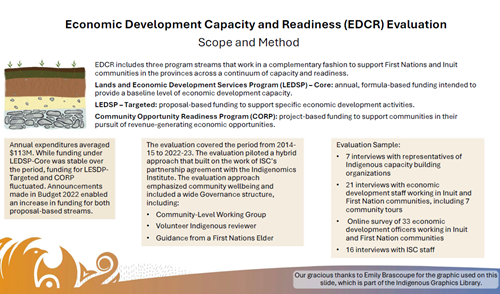
EDCR includes three program streams that work in a complementary fashion to support First Nations and Inuit communities in the provinces across a continuum of capacity and readiness.
Lands and Economic Development Services Program (LEDSP) – Core: annual, formula-based funding intended to provide a baseline level of economic development capacity.
LEDSP – Targeted: proposal-based funding to support specific economic development activities.
Community Opportunity Readiness Program (CORP): project-based funding to support communities in their pursuit of revenue-generating economic opportunities.
Annual expenditures averaged $113M. While funding under LEDSP-Core was stable over the period, funding for LESDP-Targeted and CORP fluctuated. Announcements made in Budget 2022 enabled an increase in funding for both proposal-based streams.
The evaluation covered the period from 2014-15 to 2022-23. The evaluation piloted a hybrid approach that built on the work of ISC’s partnership agreement with the Indigenomics Institute. The evaluation approach emphasized community wellbeing and included a wide Governance structure, including:
- Community-Level Working Group
- Volunteer Indigenous reviewer
- Guidance from a First Nations Elder
Evaluation Sample:
- 7 interviews with representatives of Indigenous capacity building organizations
- 21 interviews with economic development staff working in Inuit and First Nation communities, including 7 community tours
- Online survey of 33 economic development officers working in Inuit and First Nation communities
- 16 interviews with ISC staff
EDCR Evaluation: Key Findings
Program Design and Processes
- There was alignment between First Nations and Inuit communities and the Government of Canada in terms of their respective visions for self-determination, economic advancement, and the holistic nature of economic development; but realizing those visions was limited by program restrictions and silos.
- EDOs identified a need to simplify program administration to more closely reflect their realities and values.
Program Impacts
- The program filled unique gaps in supporting communities to advance economic development activities.
- Economic development projects supported holistic well-being within communities.
Equitability of Program Access
- Outdated funding formulas, unclear allocation approaches for LEDSP-Core, as well as limited funding envelopes across the program, constrained EDCR’s impact.
- A pattern was identified in which the same communities repeatedly succeeded in proposal-based programs.
Performance Measurement
- Significant data limitations impeded the ability to assess whether EDCR was meeting performance targets as determined by the logic model.
- Indigenous definitions of economic success represented multi-faceted aspects of community wellbeing that were not fully reflected in the program’s logic model and performance indicators.
Relationships
- Strong relationships between ISC regional staff and communities were identified as critical to success in proposal-based programs, but a lack of reciprocal accountability on ISC’s part was a noted barrier.
EDCR Evaluation: Recommendations, Management Response and Action Plan Footnote *
Recommendation 1
Take concrete actions to update the program’s funding approaches (including the allocation LESDP-Core funding formula, overall funding envelopes, and agreement time frames) to reflect contemporary community realities.
Action 1.1: Collaborate with Regions to review and revise the LEDSP-Core allocation formula to better reflect current economic realities, including inflation, remoteness, cost of living, and population shifts. This work will be informed by regional data and community feedback to ensure allocations support meaningful capacity development.
Action 1.2: Establish and implement a national/regional monitoring and review protocol and sample current agreements to ensure program officials are maximizing the use of multi-year agreements and flexible carry-forward provisions for proposal-based funding streams (CORP and LEDSP-Targeted).
Action 1.3: Conduct a funding envelope analysis across all EDCR streams to identify opportunities for strategic investment or reallocation, with the goal of enhancing long-term impact and equity of access. This analysis will inform future budget planning and potential Treasury Board submissions.
Recommendation 2
Develop options for a single-window model, or other appropriate collaborative strategy across ISC sectors, to support a holistic approach to proposal-based economic development funding.
Action 2.1: Establish Branch level working group within ISC to explore integrated funding models and develop options to work across sectoral silos to provide more holistic support for community economic development , drawing on lessons from SPI and other streamlined approaches. The group will draw on lessons from SPI and other streamlined approaches and include representation from all sectors of ISC.
Action 2.2: Seek feedback from First Nations and Inuit partners to co-design the integrated model, ensuring it reflects Indigenous priorities, values, and definitions of success. Engagement will include workshops, bilateral meetings, and feedback loops throughout the design process.
Recommendation 3
Prioritize capacity within ISC regional offices to ensure consistent, transparent, equitable, and targeted support for communities, particularly those with less experience with proposal-based programs.
Action 3.1: Work with regional offices to identify and address gaps in orientation, capacity, and professional development.
- Build on existing training on proposal development and assessment offered to Regions at annual proposal screening meetings, including by leveraging web-based training tools for regional staff.
- Collaborate on orientation tools and share professional development resources.
Action 3.2: Perform workload analyses and redistribute staff as needed; having staff in different regions provide surge support.
Action 3.3: ISC will assess the outcomes of the five-year funding provided to support the capacity of Indigenous regional economic development organizations through Budget 2022. This assessment will determine the effectiveness of these investments to inform future investments, ensuring that communities - especially those with limited internal capacity - have access to sustained support.
Recommendation 4
In collaboration with the Head of Performance Measurement, Chief Data Officer, and Chief Information Officer, co-design a new performance measurement strategy with First Nations and Inuit partners that incorporates broader, culturally-relevant definitions of economic success; as well as an accompanying data strategy to maximize the availability and quality of relevant data while minimizing unnecessary respondent burden.
Action 4.1: Meet with the Departmental leads to Initiate a collaboration to scope a renewed logic model and performance framework for EDCR, grounded in Indigenous definitions of success that reflect holistic economic development, including social, GBA+, environmental, and cultural dimensions.
Action 4.2: Seek advice on how to engage First Nations and Inuit partners to co-develop culturally relevant indicators and outcomes.
Action 4.3: Develop a program data strategy to improve the availability, consistency, and usability of data, while minimizing reporting burden on communities. This strategy will include mechanisms to track both successful and unsuccessful proposals to better identify gaps and inform targeted support to maximize the analytical utility of data collected.